

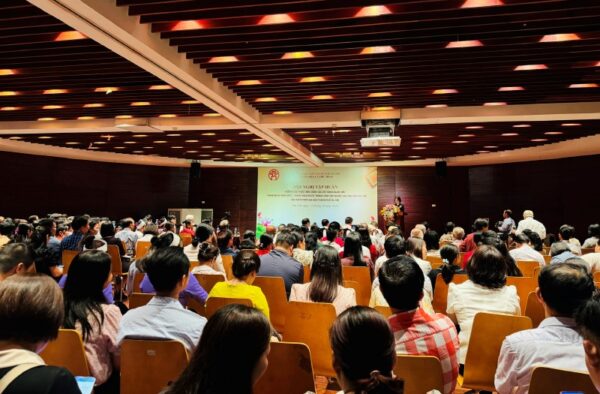
The conference was attended by nearly 300 delegates.
Decree No. 93/2023/ND-CP issued by the Government, which regulates the nomination of “People’s Artisan” and “Outstanding Artisan” titles in the field of intangible cultural heritage, took effect on February 15, 2024, introducing some new contents compared to Decree No. 62/2014/ND-CP. In addition to 6 previously identified categories of intangible cultural heritage, namely spoken and written language, folk literature, folk performing arts, social customs and beliefs, traditional festivals, and folk knowledge, Decree No. 93 requires that traditional handicrafts be nominated also.
On June 24, 2024, the Ministry of Culture, Sports, and Tourism made Decision No. 1690/QD-BVHTTDL, outlining the plan for the 4th round of nominations for “People’s Artisan” and “Outstanding Artisan” titles in the field of intangible cultural heritage. Subsequently, on July 04, 2024, the Ministry issued Circular No. 2806/BVHTTDL-TCCB, providing guidance for the 4th round of nominations for “People’s Artisan” and “Outstanding Artisan” titles in the field of Intangible Cultural Heritage.
Pursuant to the aforementioned regulations and guidelines, on September 09, 2024, Hanoi People’s Committee made Decision No. 4726/QĐ-UBND, outlining the Plan for the 4th round of nominations for “People’s Artisan” and “Outstanding Artisan” titles in the field of Intangible Cultural Heritage in Hanoi city. On September 19, 2024, Hanoi Department of Culture and Sports issued Implementation Plan and Guidance No. 681/KH-SVHTT in this regard.
These Decrees, Decisions, and Plans have been disseminated by Hanoi Department of Culture and Sports to local districts, towns, and municipalities in order to raise awareness and provide guidance to individuals and artisans who are practicing, teaching, preserving, and promoting the values of intangible cultural heritage in the city.
At the Conference on Training and Guidance for the 4th round of nominations for “People’s Artisan” and “Outstanding Artisan” titles in the field of intangible cultural heritage, Hanoi Department of Culture and Sports invited Dr. Nguyen Thị Thu Trang, the Head of Intangible Cultural Heritage Management Division – Cultural Heritage Department – Ministry of Culture, Sports and Tourism, to answer some questions given by artisans regarding the procedures for making application for these titles. Regarding the newly included category of traditional handicrafts, Dr. Nguyen Thu Trang explained that “Traditional handicrafts encompass cultural expressions that are manifested through the practices and creativity of individuals or communities. These crafts are created by hand, using techniques, forms, decorations, artistic styles, and materials that have been deeply rooted in local traditions and passed down from one generation to the next, so as to make unique and one-of-a-kind products that carry the distinctive identity and cultural heritage of the community.”
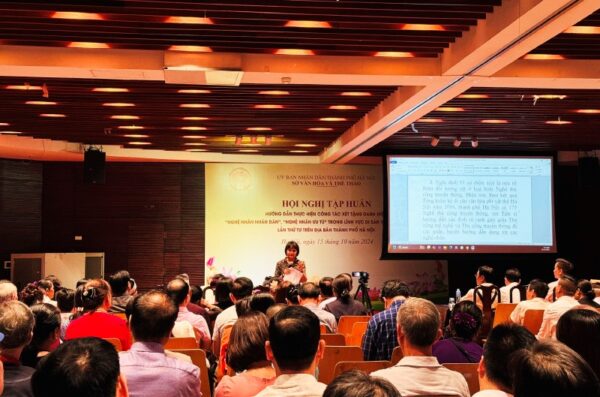
Dr. Nguyen Thi Thu Trang, the Head of Intangible Cultural Heritage Management Division – Cultural Heritage Department – Ministry of Culture, Sports and Tourism addressed some questions and provided guidance on how to prepare the application.
Nguyen Thi Tuyen, an artisan from Hau Ai village (Van Canh commune, Hoai Duc district, Hanoi), shared that she has spent many years making traditional star lanterns, preserving the spirit of folk culture through Mid-Autumn Festival toys. Other artisans, such as those making Vietnamese pickled fruits in Hoan Kiem, growing pomelos in Bac Tu Liem, healing broken bones in Ha Dong, making tofu, banh gai (cake from gai leave), banh day (sticky rice cake), soy sauce, che lam (Vietnamese chewy rice cake with ginger), and che kho (Vietnamese mung bean paste dessert), or raising silkworms, and so on, also wondered about the type of intangible cultural heritage they are preserving. Dr. Nguyen Thi Thu Trang also explained that it’s important to correctly identify the specific category of cultural heritage when preparing application. For example, pomelo and ornamental plant cultivation fall under the category of traditional farming knowledge, while making tofu, banh gai, banh day, soy sauce, che lam, and che kho are categorized as traditional culinary knowledge.
Apart from that, there were some following questions: “For traditional crafts that have almost disappeared, with very few practitioners remaining and the transmission of knowledge being extremely difficult, such as La Khe silk weaving craft in Ha Dong District, whether or not the artisans can be considered for recognition as “People’s Artisan” or “Outstanding Artisan”?” or “For some heritages that have not yet been formally cataloged or identified, whether or not the artisans can be considered for recognition as “People’s Artisan” or “Outstanding Artisan”?”
In response to the artisans’ questions, Dr. Nguyen Thị Thu Trang explained: In addition to criteria such as loyalty to the homeland, adherence to the Party’s guidelines and the state’s laws and policies, and strong moral character, an artisan nominated for recognition must possess outstanding talent or skills in their job, representing the intangible cultural heritage in question. They should also have made significant contributions to the preservation and promotion of the cultural heritage hold by them, demonstrating through their knowledge, expertise, secrets, and practical skills related to that particular form of intangible cultural heritage.
“The recognition of artisan titles is not about whether the craft is in decline or whether it is difficult to pass down. What matters is that whether the artisan is still actively practicing and passing down the craft, demonstrating the continuation and sustainability of the heritage. Artisans should feel confident in submitting their applications. In fact, the more a craft is fading, the more we need exceptional and distinguished artisans. The purpose of this recognition is to encourage individuals, promote the continuity of the craft, and inspire more people to learn and maintain these traditional skills,” – said Dr. Nguyen Thị Thu Trang.

Artisans at the Conference
In addition to the topics mentioned above, at the training session, experts also recommended that local authorities at the district and commune levels intensify their efforts to review and actively support artisans in preparing and completing their applications for “People’s Artisan” and “Outstanding Artisan” titles ensuring that the legal requirements are properly, thoroughly, and effectively implemented.
Reporter