
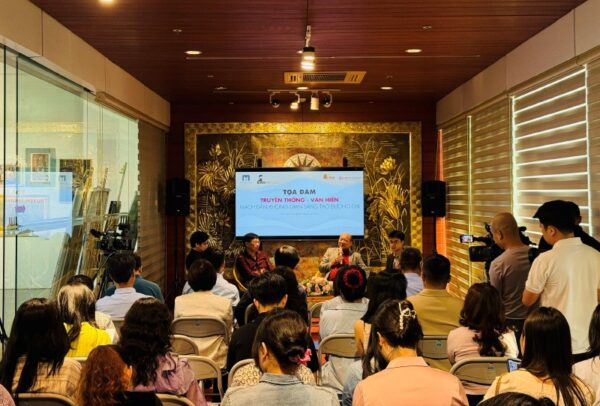
Overview of the panel discussion
On September 12, 2024, the Hanoi People’s Committee issued Plan No. 266/KH-UBND regarding Hanoi’s participation in UNESCO’s Creative Cities Network for 2024-2025. Implementing this plan, on October 15, 2024, the Hanoi Department of Culture and Sports issued Document No. 734/KH-SVHTT concerning the establishment of a creative spaces network and the implementation of a coordination center for creative activities. These positive developments demonstrate the city’s transformation in building and developing cultural spaces to preserve and promote the capital’s cultural values.
Speaking at the panel discussion, Mr. Nguyen Tien Da – Director of the Hanoi Museum emphasized: “In October 2019, Hanoi was honored to become a member of UNESCO’s Creative Cities Network (in the field of Design), participating in the process of promoting international cooperation between network cities with the goal of using cultural resources and cultural creativity as the foundation for sustainable urban development. This is a favorable step for Hanoi to establish cultural development goals, inspire creativity, and position a new brand for Hanoi internationally; it is advantageous progress for Hanoi to leverage collective strength and resources for cultural industry development. For cultural resources to develop strongly and effectively while still conveying messages from each artwork and architectural structure about our ancestors’ civilized traditions, our generation needs to take responsibility for action. The Hanoi Museum is a cultural institution, a cultural space that includes creative spaces. The museum has recently been assigned by Hanoi city to become the coordination center for Hanoi’s creative spaces. This place will become a connection point for creative spaces, working with experts to provide direction and support from young people, helping the Museum develop new perspectives on culture based on traditional foundations.”
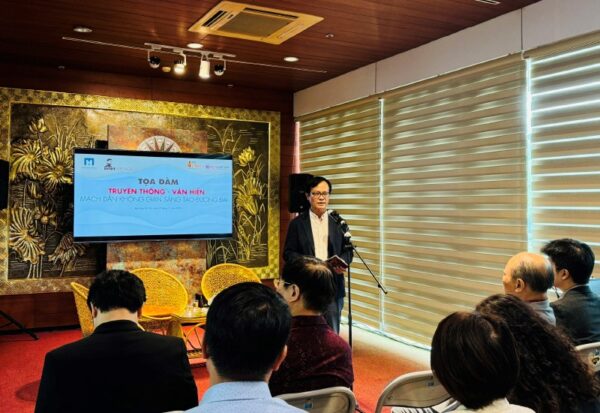
Mr. Nguyen Tien Da – Director of Hanoi Museum speaking at the panel discussion
The panel discussion featured experts from various fields. Dr. Nguyen Quang, an architect with over 30 years of experience in urban planning and management, observed: “Hanoi aims to build a cultured, civilized, and modern city, that aligns with international trends. Hanoi has joined UNESCO’s Creative Cities Network focusing on Design. In 2018, the creative industry contributed approximately 1.4 billion USD to Hanoi’s economy. This demonstrates that the creative industry generates tangible economic value and employment opportunities, proving that culture can bring material benefits. Hanoi possesses vast resources and assets to exploit these cultural values, as it is a city rich in historical layers and values.”
Professor Ngo Xuan Binh expressed joy in noting that Hanoi has been implementing various activities to support artists, painters, and creators. He particularly mentioned that the Hanoi Museum has been nurturing and facilitating creative expressions for many years.
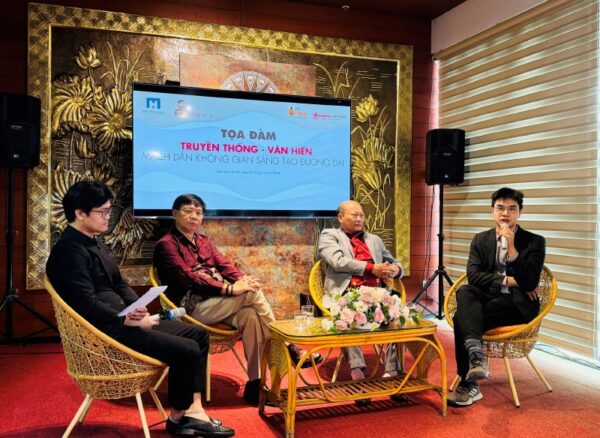
Experts and managers contributing opinions at the panel discussion
The experts’ and managers’ opinions at the panel discussion highlighted the unique cultural values of Hanoi through the creative spaces network being implemented. This helped better understand these values and the scale of the capital’s creative spaces network, working toward UNESCO’s Creative Cities Network 2024-2025. They also discussed the transformation of Hanoi’s cultural flow and the major factors affecting this shift. Speakers analyzed and evaluated fundamental changes in the capital’s cultural orientation, discussing traditional elements in creative spaces and young people’s perceptions. They explored how combining traditional and modern elements in creative activities at the Hanoi Museum contributes to Hanoi’s sustainable cultural development, enabling younger generations to connect with the capital’s traditional culture. They also provided suggestions for activities in the Hanoi Museum’s creative space to promote the capital’s cultural values both domestically and internationally.
The speakers emphasized that the creative space at the Hanoi Museum plays a crucial role in maintaining and promoting the capital’s cultural identity. They also addressed challenges facing the Hanoi Museum in enhancing the appeal of creative activities and attracting visitors, especially youth. As Hanoi’s cultural heritage continues to evolve, the Hanoi Museum needs clear direction in updating and refreshing creative spaces to meet future public demands.
As part of the Hanoi Department of Culture and Sports’ plan to establish a creative spaces network and implement a creative activities coordination center, on November 10, 2024, the Hanoi Museum’s garden creative space will host the “Divine Presence” ceramic art exhibition by Professor Ngo Xuan Binh. This is one of the most notable events in the series of activities at the Hanoi Museum’s creative space during this period.
Thuy Nga