
In the morning of November 14, at Nam Quat village, Nam Trieu commune, Phu Xuyen district, the Management Board of Hoa Lo Prison Relic coordinated with the Museum of Revolutionary Soldiers Captured and Imprisoned by the Enemy to inaugurate the thematic exhibition “The Moment of Revival.” This exhibition is one of the meaningful activities leading up to the 80th anniversary of the establishment of the Vietnam People’s Army (December 22, 1944 – December 22, 2024).
The event was attended by representatives of the National Liaison Committee of Revolutionary Soldiers Captured and Imprisoned by the Enemy, the Liaison Committee of Revolutionary Soldiers Captured and Imprisoned in Hanoi, and similar committees from several northern provinces and cities, as well as former political prisoners and POWs who were released in Thach Han and Loc Ninh in 1973-1974
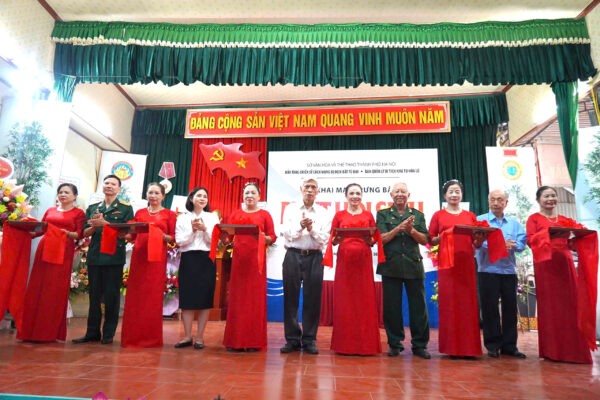
Delegates cutting the ribbon to open the Exhibition.
The exhibition evokes the historic moments of the triumphant return, helping the younger generations understand and appreciate the contributions and heroic sacrifices of the revolutionary soldiers captured and imprisoned by the enemy for the cause of national liberation and reunification, fostering a greater appreciation for peace, independence, and freedom.
The exhibition is presented through three sections: “Breaking the Prison Gates,” “The Triumphant Return,” and “Continuing the Epic.”.
The “Breaking the Prison Gates” section includes documents and images from after 1954, depicting the prison system established by the U.S. and the Republic of Vietnam across southern Vietnam. Six prisons, infamous as “hell on earth,” included Con Dao, Phu Quoc, Chi Hoa, Phu Loi, Tan Hiep, and Thu Duc. These places were notorious for their brutal tactics, both physical and mental, against prisoners. Revolutionary soldiers bravely resisted the harsh imprisonment conditions, with many sacrificing their lives.
Con Dao Prison (1955-1975) witnessed the most sinister and brutal tactics. Prisoners were tortured day and night, wasting away in tiger cages and cells. On May 25, 1970, a part of the truth about the tiger cages was exposed to the international community by students returning from Con Dao Prison.
Phu Quoc POW Camp (1967-1973), the largest of its kind run by the U.S. and the Republic of Vietnam, detained nearly 40,000 POWs, with around 4,000 killed.
Before being sent to Con Dao, many prisoners were temporarily held and tortured at Chi Hoa Prison, known as the “maze of death” in Saigon. Nguyen Van Troi was executed here on October 15, 1964.
In late November 1958, the enemy poisoned prisoners at Phu Loi Prison. The prisoners, weakened, were denied medical care or antidotes, sparking a nationwide movement to “Turn Hatred into Action.
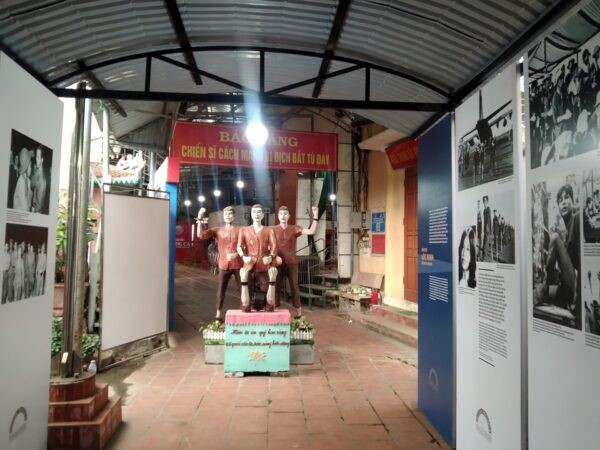
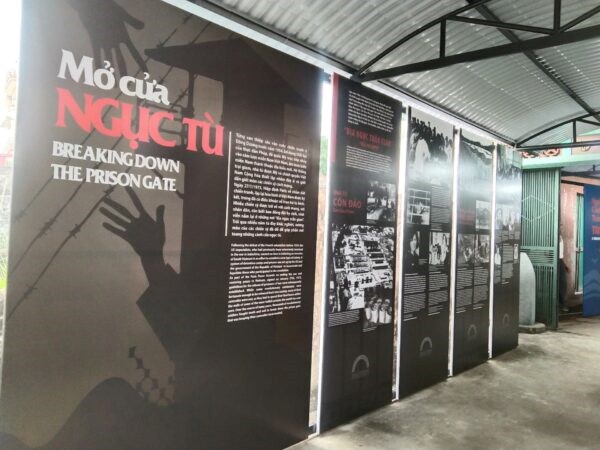
Some documents and images in the Exhibition
From 1957-1975, thousands of prisoners were detained at Tan Hiep Prison and Can Tho Central Prison, mostly cadres and patriotic citizens from the southern provinces. At Thu Duc Prison and Phu Tai Women POW Camp, women were brutally beaten and sent to Con Dao if they disobeyed regulations.
Following repeated battlefield defeats, especially the 12-day aerial bombardment in the North (December 1972), the U.S. was forced to sign the Paris Agreement on ending the war and restoring peace in Vietnam (January 27, 1973). This historic milestone paved the way for the return of captured revolutionary soldiers.
“The Triumphant Return” section details the implementation of the Paris Agreement, with prisoner exchanges between both sides starting in February 1973. Major exchanges occurred at Thach Han River (Quang Tri province) and Loc Ninh Airport (now in Loc Ninh district, Binh Phuoc province).
At Thach Han River, under the supervision of the Four-Party Joint Military Commission and international monitors, thousands of soldiers were returned to the Provisional Revolutionary Government of South Vietnam. As they approached the northern bank of Thach Han River, the sight of the liberation flag stirred emotions, with many prisoners jumping into the river to reunite with their comrades.
At Loc Ninh Airport, POWs from Can Tho’s second solitary camp faced delays and harsh treatment, waiting over a year for their release.
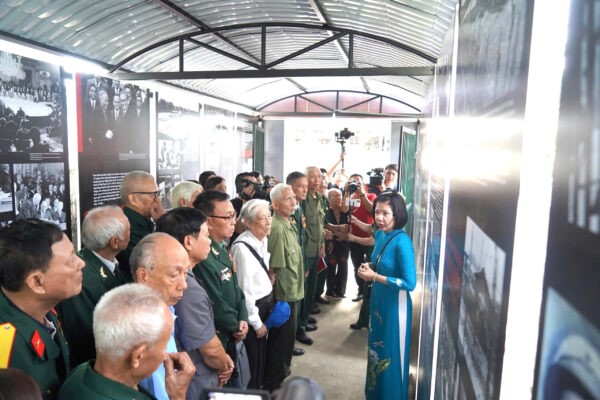
The exhibition draws public interest.
“Continuing the Epic” highlights the former POWs and political prisoners who, despite physical and emotional scars, overcame adversity to succeed in their studies and careers. Remembering their fallen comrades, these veterans worked with local armed forces to locate and repatriate the remains of martyrs. In 2008, over 1,300 remains of Phu Quoc POW martyrs were interred at the Phu Quoc Martyrs’ Cemetery.
Annually, the Party, State, and Hanoi city hold meetings to honor former political prisoners and POWs. On significant anniversaries, former POWs revisit the “hell on earth” of Phu Quoc, reminiscing about their heroic struggles.
The exhibition aims to inspire national pride, foster the spirit of patriotism, and educate the younger generations on the nation’s history of struggle, encouraging gratitude and remembrance.
“The Moment of Revival” exhibition runs from November 14, 2024, to March 31, 2025./.
Ngoc Tram