
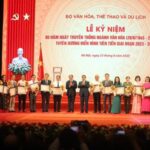
Attending the Anniversary Ceremony were Comrade Pham Minh Chinh, Member of the Politburo and Prime Minister; Comrade Nguyen Trong Nghia, Member of the Politburo, Secretary of the Party Central Committee, Head of the Central Commission for Propaganda and Education and the Central Commission for Mass Mobilization; Comrade Phan Van Giang, Member of the Politburo, Deputy Secretary of the Central Military Commission, Minister of National Defense, General; Comrade Le Hoai Trung, Secretary of the Party Central Committee, Chief of the Party Central Office; Comrade Mai Van Chinh, Member of the Party Central Committee, Deputy Prime Minister, along with leaders of central agencies, ministries, sectors, mass organizations, and Hanoi City; ambassadors and representatives of several countries.
Also in attendance were former leaders of the Party and State; leaders of the Ministry of Culture, Sports and Tourism through different periods; directors and former directors of provincial and municipal Departments of Culture, Sports and Tourism, Departments of Culture and Sports, and Departments of Tourism; 80 exemplary individuals in the fields of culture, information, sports, and tourism; artists, scientists, intellectuals, and outstanding athletes…
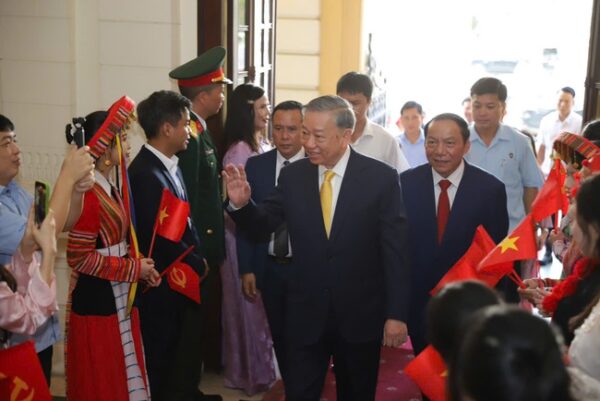
General Secretary To Lam attends the ceremony marking the 80th anniversary of the traditional day of the Culture Sector.
The ceremony marking the 80th anniversary of the traditional day of the Culture Sector was an opportunity for the entire sector to look back on its achievements and milestones throughout its journey, thereby reaffirming the special role and position of culture in the cause of national construction and defense, as well as in the aspiration for a prosperous and happy Vietnam in the new era.
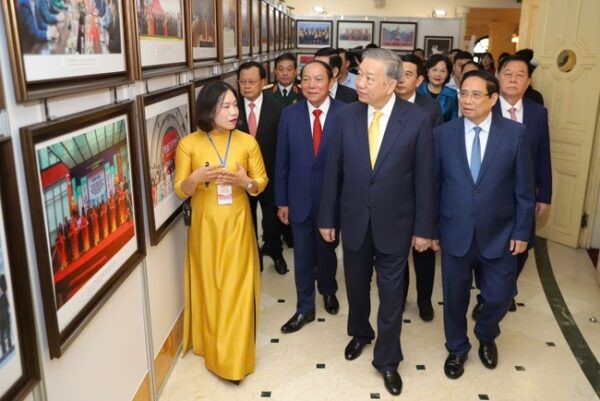
General Secretary To Lam, Prime Minister Pham Minh Chinh, and other leaders visit the exhibition space prior to the ceremony.
Delivering his remarks at the ceremony, General Secretary To Lam emphasized: From the early days of the Party’s establishment, amidst the flames of revolution and a vision for the country’s future, our Party and President Ho Chi Minh already defined the special position of culture. The Outline of Vietnamese Culture of 1943 outlined a far-sighted vision and established three major principles – national, scientific, and popular – affirming that culture lights the way for the nation, that culture is a front, and that cultural workers are soldiers. From the earliest days of the people’s government, even during the resistance wars against the French and Americans, the Party and Uncle Ho sent hundreds of young people abroad to study culture, arts, and sports.
Since then, throughout Party Congresses, Resolutions, Conclusions, and Directives of the Central Committee, the Politburo, and the Secretariat have consistently emphasized that culture is the spiritual foundation of society – both the goal and the driving force of development; that culture is soft power, the boundless “original energy” of the Vietnamese nation.
Today, we are building an advanced Vietnamese culture imbued with national identity; promoting the role of people as the center, the subject, the goal, and the driving force of development; advancing cultural industries and a healthy cultural market; building a cultural environment and cultural lifestyle; promoting national, family, and human value systems; and preventing moral degradation, “self-evolution” and “self-transformation” in the ideological and cultural spheres. At the same time, we focus on building “culture within the Party” and within the political system; fostering an exemplary, upright, and dedicated style of governance; and promoting the culture of rule of law, public service, enterprises, and business.
This is the foundation to spread throughout society, strengthen trust, create consensus, and ignite the aspiration for a prosperous and happy nation. Culture must always be intertwined with political, economic, and social life; it must permeate every policy decision, every project, every road, bridge, field, industrial park, city, and village; be reflected in the thoughts, behavior, and qualities of the Vietnamese people. Culture shapes the nation’s identity, defines the national value system, and nurtures the family and human value systems of the new era – patriotism, compassion, solidarity, honesty, responsibility, creativity, discipline, and aspiration.
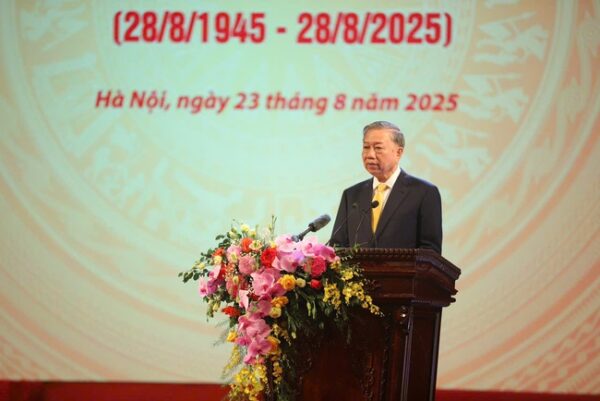
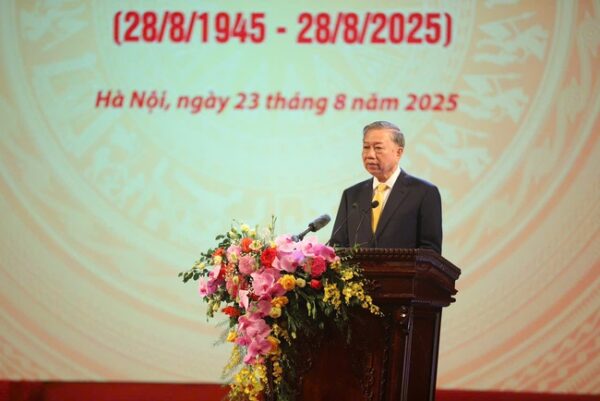
General Secretary To Lam delivers a speech at the ceremony.
General Secretary To Lam emphasized that Vietnam is entering a new stage of development with the goal of becoming a developed, high-income country following the socialist orientation. The global context is rapidly changing and complex; the Fourth Industrial Revolution, digital economy, green economy, circular economy, and smart cities are setting new standards; strategic competition, information explosion, and “struggles in cyberspace” are intensifying; and the infiltration of diverse, multidirectional foreign cultural products is growing. In this context, culture must take the lead, illuminating the path, guiding development, strengthening national identity, and fostering resilience and confidence.
On that spirit, General Secretary To Lam called on the entire cultural sector to focus on effectively implementing the following key tasks and solutions:
First, continue to deeply grasp and comprehensively implement the Party’s guidelines and viewpoints on culture; place culture on par with the economy, politics, and society; concretize them through focused and strategic plans, programs, and projects; ensure commensurate resources, breakthrough mechanisms, clear decentralization and delegation; and strengthen supervision, evaluation, and inspection.
Second, build a healthy cultural environment beginning from families, schools, and society; emphasize exemplary roles of officials and Party members; promote moral, lifestyle, and digital skills education, as well as cultural conduct; prevent domestic and school violence; develop a civilized and safe digital culture; and build vibrant, distinctive, green, clean, and beautiful grassroots cultural communities.
Third, nurture, value, and honor intellectuals, artists, coaches, athletes, tourism entrepreneurs, and cultural workers at all levels, especially at the grassroots. Establish mechanisms for commissioning, awarding, supporting creativity, and protecting copyright and related rights; improve the material and spiritual lives of cultural workers; encourage young talent; and discover and foster creative seeds in schools, clubs, and grassroots cultural institutions.
Fourth, develop cultural industries and the creative economy as new pillars of growth; improve the institutional framework for the cultural market, financial mechanisms, tax, credit, land, investment, and data policies; encourage cultural enterprises and creative startups; develop digital infrastructure for the production, distribution, and consumption of cultural products; and establish creative industrial clusters and “cultural valleys” linked with major cities and tourism centers.
Fifth, preserve, restore, and promote heritage in connection with community livelihoods and sustainable development. Strongly apply digital technology and artificial intelligence to heritage digitization, exhibitions, performances, and education; build “digital culture” institutions, “open museums,” “mobile theaters,” and “digital libraries” accessible to all ages; promote responsible heritage tourism; and cherish “living cultural assets” – traditional artisans and folk artists.
Sixth, make breakthroughs in both mass sports and elite sports. Focus on physical education in schools; develop clubs and public sports spaces; enhance sports science and medicine; select and train young athletes to modern standards; expand international cooperation; and pursue goals that are ambitious, sustainable, and humane.
Seventh, restructure and enhance the quality and competitiveness of Vietnamese tourism. Develop culturally distinctive, experiential products; promote smart, green, and low-emission tourism; strengthen interregional and cross-sectoral linkages; improve human resource quality; tighten discipline and standardize services; and build a destination brand “Vietnam – Timeless Charm, Culture Radiates.”
Eighth, enhance cultural diplomacy and promote the national image; actively participate in international creative networks; organize regional and global-scale events, festivals, and cultural weeks; bring Vietnamese cultural essence to the world and welcome the world’s cultural quintessence to Vietnam in the spirit of peace, friendship, mutual respect, learning, integration without assimilation.
Ninth, accelerate comprehensive digital transformation across the sector. Build big data systems on heritage, arts, sports, and tourism; complete open standards and digital cultural maps; develop digital content distribution platforms and copyright protection tools; apply data analytics and extended reality technologies in museums, performances, and education; strengthen cybersecurity and information safety; and combat harmful, distorted content.
Tenth, continue to firmly counter “peaceful evolution” plots in the ideological and cultural fields; resolutely defend the Party’s ideological foundation; build a “soft shield” of values, faith, and social norms; strengthen policy communication capacity; and proactively spread positive inspiration and replicate examples of good people and good deeds.
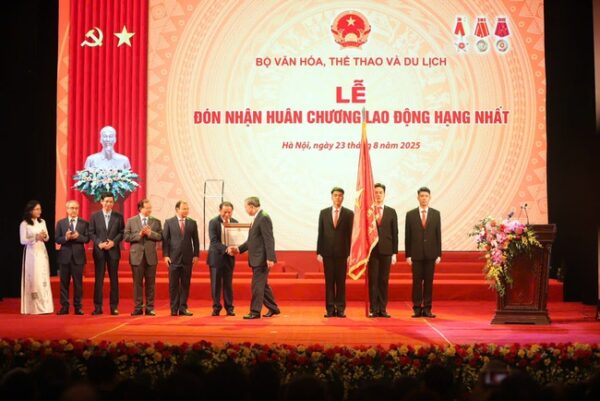
General Secretary To Lam, on behalf of the Party and State leadership, awards the First-Class Labor Order to the Ministry of Culture, Sports and Tourism.
The General Secretary called on all levels of Party Committees, authorities, the Vietnam Fatherland Front, and socio-political organizations to continue their leadership and direction, create favorable conditions, and mobilize social resources for cultural development; integrate culture into urban and rural planning; build comprehensive and effective grassroots cultural institutions; and encourage business and community participation. Culture cannot stand apart from development policies – it must permeate all plans, proposals, and projects with long-term vision and high standards.
He expressed his hope that intellectuals, artists – the “engineers of the soul” of the people – will continue to be persistent, courageous, and passionate in creation; draw inspiration from real life, rely on the people, and use truth, beauty, and righteousness as their compass; resolutely reject vulgar commercialization, falseness, imitation, and extremism; open new creative paths; and absorb the world’s cultural quintessence to enrich Vietnam’s cultural heritage.
The sports sector should continue to cultivate discipline, willpower, and the aspiration to win; uphold ethics as the foundation, science and technology as strength; respect fair play; and nurture talent from schools, families, and communities.
The tourism sector should persist in the direction of identity, quality, sustainability, intelligence, creativity, innovation, and integration; place visitor experience and community benefits at the center; consider culture and nature as “invaluable assets,” and the Vietnamese smile and spirit as the meeting place of hearts.
Grassroots officials – the “cultural seed sowers” – should remain devoted, innovate their methods, and strengthen community bonds, so that every cultural house, library, playground, and public space truly becomes vibrant and meaningful, cultivating good values from the smallest acts.
The General Secretary expressed confidence that, under the leadership of the Party, the management of the State, the participation of the entire political system, and the unity and support of the people – with the dedication, talent, and passion of those working in culture, information, sports, and tourism – we will elevate Vietnamese culture to its rightful stature, for a strong and prosperous nation, for an enduring people, and for every Vietnamese to live happily, confidently, and shine on the global stage.
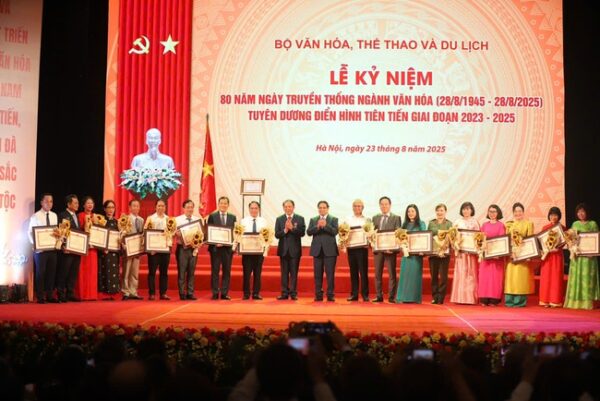
Prime Minister Pham Minh Chinh and Minister of Culture, Sports and Tourism Nguyen Van Hung honor exemplary individuals in the fields of Culture, Information, Sports, and Tourism for the 2023–2025 period
Delivering the commemorative speech for the 80th anniversary of the traditional day of the Culture Sector, Comrade Nguyen Van Hung, Member of the Party Central Committee, Secretary of the Party Committee, and Minister of Culture, Sports and Tourism, emphasized: Since the Party came to leadership, culture has been identified as a key front. The Outline of Vietnamese Culture of 1943 – the Party’s first declaration on culture – established three fundamental principles: “National – Scientific – Popular” in building and developing culture. Subsequent Party Congress Resolutions and specialized Resolutions of the Central Committee and Politburo have affirmed that culture is the soul of the nation, the driving force of development, and the “soft power” of the country. Thanks to this correct and creative direction, over the past 80 years, the Culture Sector has created a long epic with many emotional tones: culture has nourished the soul and identity of the nation – from the heroic melodies of wartime culture to the confident rhythms of sports integration, the tourism journeys that bring Vietnam to the world, and journalism that serves as a channel connecting knowledge and trust between the Party and the People.
With the action declaration: “Culture is the foundation – Information is the conduit – Sports are the strength – Tourism is the bridge of connection,” the entire Sector is determined to successfully fulfill the tasks entrusted by the Party, State, and People, bringing the cultural development cause into a new era with new achievements and new hallmarks, contributing to the building of a prosperous, democratic, equitable, civilized, and happy Vietnam.
Minister Nguyen Van Hung, on behalf of the leadership of the Ministry of Culture, Sports and Tourism, expressed deep gratitude and pledged to thoroughly implement the important instructions of General Secretary To Lam, concretizing them into plans and action programs in the time ahead.
He stated: “We pledge to maintain the highest determination and make even greater efforts to overcome ourselves and reach out to the vast ocean, to overcome ourselves through renewal and creativity, to reach out to the world so that the stature and depth of Vietnamese culture may spread internationally, as the General Secretary has often directed, to absorb the world’s cultural quintessence, enriching and further diversifying Vietnam’s cultural identity.”
On this occasion, the Ministry of Culture, Sports and Tourism honored 80 exemplary individuals in the sector; alongside this was an art program recreating the 80-year journey of construction and development, reaffirming the role and position of culture, information, sports, and tourism in the cause of national construction and defense./.
e-Portal