
From old memories to new hopes
Many residents of Hanoi, especially those who once lived in the Kim Lien, Trung Tu, Thanh Cong, or Giang Vo apartment complexes, surely remember the image of small courtyards bustling with children’s laughter, where the elderly practiced calisthenics, and young people played badminton or volleyball every afternoon.
Ms. Dinh Thi Lan, a resident of the Trung Tu apartment complex, recalled: “Back then, there were no phones or the Internet. Children would rush to the playground after school to jump rope, play football, or ride bikes. In the afternoon, adults would come out to enjoy the breeze and chat. The courtyard was truly the heart of the community.”
However, over time, playgrounds gradually shrank. Population growth, demand for parking, encroaching shops, and new construction reduced playgrounds to memories. Community spaces slowly faded, and many worried that playgrounds would permanently disappear amidst the modern city.
In recent years, thanks to the involvement of local authorities and social organizations, community playgrounds have been gradually “reviving” in many apartment complexes. Not only have the grounds been restored, but playgrounds have also been equipped with sports facilities, lighting systems, and safety fences, creating healthy, civilized activity spaces in the urban heart.
Ms. Anh Thu (Alley 6/75 Dang Van Ngu, Phuong Lien – Trung Tu) shared: “Since the playground was renovated, my children are very excited to play there every evening. I also feel more at ease because the playground has fences, lights, and there’s no worry about traffic or strangers. In a crowded city, such playgrounds are truly valuable for children’s physical activity and development.”
Small space, great value
According to education experts, outdoor activities help children develop communication and cooperation skills, physical fitness, and conflict resolution abilities. In a context where children increasingly depend on electronic devices, small playgrounds help foster social interaction and reduce passivity.
Not only for children, playgrounds are also places that connect the elderly community. Mr. Tran Van Tuan (resident of Giang Vo apartment complex, Ba Dinh) said: “Every morning, I go to the courtyard to exercise, meet neighbors, and feel completely refreshed. Elderly people with exercise space feel happier, healthier, and less lonely.”
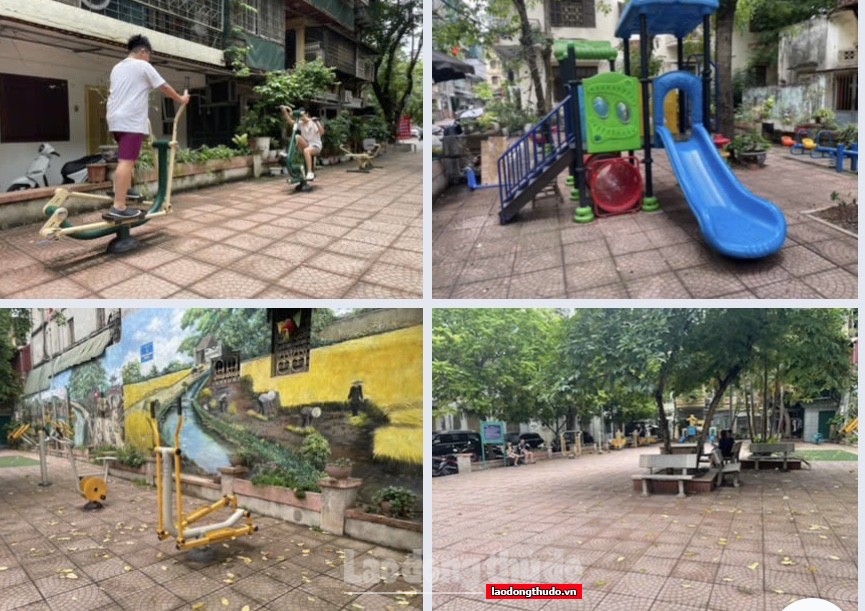 |
Community playgrounds are gradually “reviving.”
One noticeable effect is that frequently used playgrounds help reduce social vices. Ms. Thuc Doan, Head of Neighborhood 22 (Phuong Lien – Trung Tu), affirmed: “Previously, when playgrounds were empty, youths would gather and disturb the order. Now, with lights, people exercising, clean space, replanted greenery, and no more illegal trash dumps, the environment is much improved.”
The success of playgrounds cannot be separated from the role of local authorities. Mr. Pham Minh Chinh, Vice Chairman of the People’s Committee of Phuong Lien – Trung Tu Ward, said: “The ward regularly disseminates information, handles encroachments, and assigns playground management to neighborhood groups with clear regulations. When violations are detected, the 197 Steering Committee intervenes immediately.”
However, Mr. Chinh also frankly admitted that the maintenance of playgrounds faces difficulties due to lack of funding. Therefore, the ward calls for residents’ participation. “Elderly people remind children, women’s associations help with cleaning and protecting equipment. Thanks to that, playgrounds remain orderly and safe,” he said.
Nonetheless, many residents still hope for longer-term policies. Ms. Nguyen Thi Phuong (Kim Lien apartment complex, Dong Da) shared: “Playgrounds are very necessary, but in many places, tiles are broken, swings are damaged, and no one repairs them. If there were a regular maintenance plan with clearly assigned responsibilities, it would be much better.”
In addition to physical activity, many residents propose expanding playground functions into community activity centers. Integrating small libraries, life skills classes, art, and music spaces for children would turn playgrounds into places that nurture the spirit and culture of the community, not just simple play areas.
In 2025, Hanoi aims to increase the average public space per capita to nearly 10m². In the context of increasingly limited land, developing playgrounds in residential areas is a feasible, effective, and low-cost solution that brings significant social benefits.
Urban planning experts emphasize that playgrounds need to be included in permanent planning to avoid being re-encroached upon soon after renovation. The challenge lies not in funding but in the cooperation of three parties: authorities, residents, and social organizations. Only then can playgrounds truly thrive and remain sustainable.
| A residential area with a beautiful playground and vibrant community activities will create a spillover effect of civilized behavior. Residents actively take care of and preserve their living space. This is a healthy social ecosystem, contributing to the goal of sustainable urban development that Hanoi is striving for. |
H.Duy