
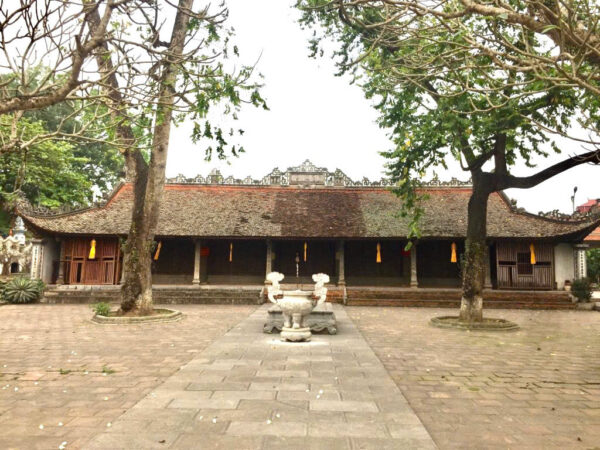
The ancient Boi Khe Pagoda. Photo: Mai Chi
During the resistance war against French colonialism, Boi Khe Pagoda served as a revolutionary base. It preserves many heroic feats of the soldiers and people of Tam Hung Commune. Notably, the model tunnel system was initiated after President Ho Chi Minh issued the “Call for national resistance” on December 19, 1946. Initially, the tunnels were used to hide cadres and store provisions, but they later became a “fortress” that thwarted enemy raids. The tunnel system stretches up to 3 km, featuring 3 branches that originate from a local residence, connect to the Buddha Hall, pass by the Nguyen Truc Top Scholar Church (near Boi Khe Pagoda), and loop around the village, creating a continuous underground defensive network. The system qualifies as an underground fortress due to its scale and its strategic defensive advantages during combat.
At the tunnel entrance near the Nguyen Truc Top Scholar Church, our guerrilla forces fought and eliminated many French soldiers. This tunnel served not only for underground troop movements but also as a secure defensive position during retreats. The Boi Khe tunnel system played a crucial role in repelling three French raids, resulting in the defeat of 372 enemy troops.
Inspired by the resistance efforts and the effective combat role of the Boi Khe tunnel system, surrounding communes enthusiastically began digging tunnels to resist the French colonists.
The Boi Khe tunnels are also associated with moving and inspiring stories, reflecting the resilience and determination of our soldiers and people against French aggression. A notable example is female guerrilla Pham Thi De, who fought for seven days and nights inside the tunnels without food or water, surviving miraculously thanks to her indomitable spirit and the support of the local people.
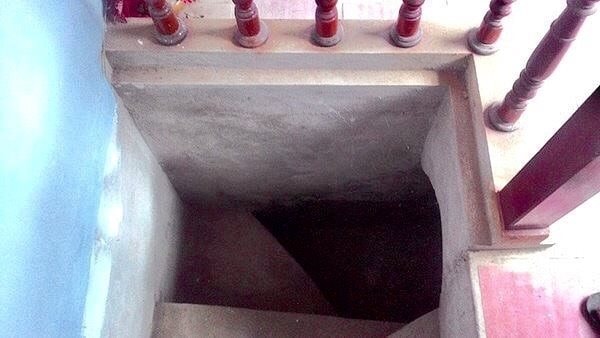
The resistance tunnels at Boi Khe Pagoda have been restored and preserved. Photo: Minh Do
The people of Tam Hung Commune, and Thanh Oai District in general, have always taken pride in this historical legacy. From the model tunnel at Boi Khe Pagoda, in 1949, the Thanh Oai District Party Committee passed a resolution to designate Boi Khe as a model resistance village. In December 1949, the Ha Dong Provincial Party Committee issued a resolution calling for the construction of model resistance villages throughout the province, following the example of Boi Khe.
Today, most of the resistance tunnels in Tam Hung and neighboring communes have gradually been covered or obscured over time. Only the tunnel at Boi Khe Pagoda still preserves one entrance and an underground passage approximately 7 meters long. Thanh Oai District has undertaken efforts to restore and preserve this tunnel.
In the capital’s tourism development strategy, Boi Khe Pagoda stands out as a highlight along the “Nam Thang Long – Hanoi Heritage Route,” connecting historical and cultural relics with traditional craft villages in the southern part of the city.
Boi Khe Pagoda, where spirituality, history, and culture converge, is truly a must-visit destination for both domestic and international tourists coming to Hanoi.
Thao Nhi