


Representatives of the Party and local authorities of Tram Troi Town, along with the abbot of Bao Thap Pagoda, received the city-level historical and cultural site classification certificate. Photo: Hoai Duc Online Information Portal
Located in Giang Xa Hamlet, Tram Troi Town, Hoai Duc District, Hanoi, Bao Thap Pagoda -also known as Bao Thap Tu or Hong Pagoda has a long-standing history. Based on the stele at the pagoda, dated to the 23rd year of the Tu Duc era (1870), the system of Buddha statues, and the recollections of local elders regarding the worship of the Three Teachings (Buddhism, Confucianism, and Taoism), it can be affirmed that Bao Thap Pagoda was originally established approximately 300 years ago.
According to local elders, Bao Thap Pagoda was originally built in a “Dinh”-shaped architectural layout, comprising a front hall and the upper sanctuary. Over the course of history, especially during wartime and due to natural changes, the pagoda fell into serious disrepair, and many of its statues and ritual artifacts were lost. In 1992, the local community came together to restore the pagoda, carving and adding new statues. In 1998, three additional guest rooms were constructed.
Today, Bao Thap Pagoda still preserves two steles listing the names of successful scholars from the former Giang Xa Village. In front of and behind the pagoda, traces of wartime cannon bases can still be seen.
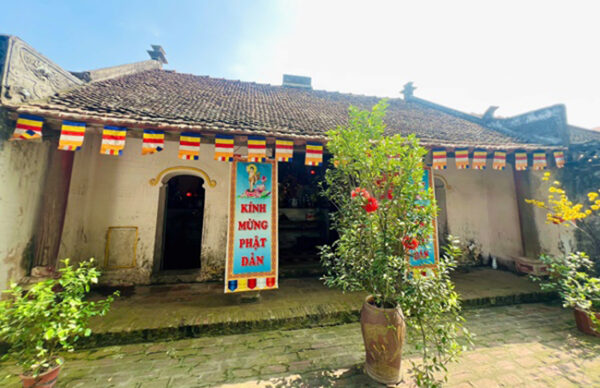
Overview of Bao Thap Pagoda’s Architecture. Photo: Hoai Duc Online Information Portal
It can be said that throughout its history, Bao Thap Pagoda has served not only as a center for spiritual and cultural activities, guiding people toward the values of Truth, Goodness, and Beauty, but also as a contributor to the nation’s construction and defense, clearly reflecting the Buddhist spirit accompanying the Vietnamese people – integrating faith with daily life. Today, the pagoda still preserves unique architectural and artistic features, vividly reflecting the spiritual life and cultural heritage of both the local and surrounding communities.
With these outstanding values, Bao Thap Pagoda in Tram Troi town was officially recognized as a city-level historical and cultural site under Decision No. 1168/QD-UBND issued by the Hanoi People’s Committee on February 28, 2025. This recognition not only affirms the pagoda’s historical and cultural significance but also helps enhance the responsibility of local authorities and the community in the preservation, protection, and promotion of the site’s values.
In her remarks at the certificate handover ceremony, Ms. Bui Thu Huong, Head of the Hoai Duc District Department of Culture, Science, and Information, emphasized that protecting and promoting the values of historical sites is both a responsibility and a source of pride for the entire community. She stressed that the authorities and residents of Tram Troi town in general, and Giang Xa hamlet in particular, should continue to strengthen outreach and education for the younger generation on the historical and cultural significance of the site; foster civilized practices in cultural, religious, and spiritual activities; and develop plans to preserve, restore, and sustainably utilize the site’s values, linking these efforts with the promotion of cultural and spiritual tourism in the future.
Nguyen Phuong