
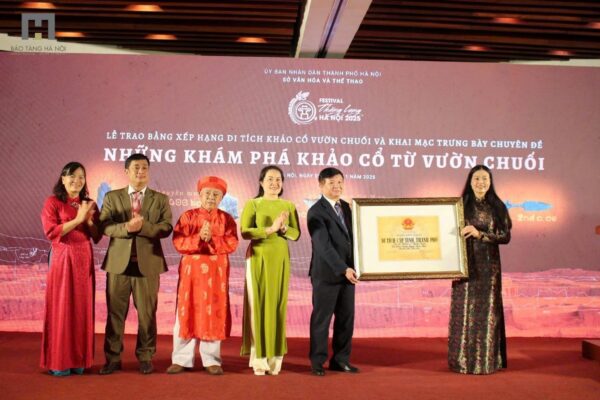
On November 9, 2025, at the Hanoi Museum, the Hanoi Department of Culture and Sports opened the special exhibition “Archaeological Discoveries from Vuon Chuoi” and announced the 2025 scientific research results on the Vuon Chuoi archaeological site.
The Vuon Chuoi site (Hoai Duc Commune, Hanoi) is one of the most representative archaeological locations of the Metal Age in northern Vietnam, reflecting nearly 4,000 years of continuous development of an ancient village through the Phung Nguyen, Dong Dau, Go Mun, Dong Son, and Post-Dong Son cultural phases.
Since its discovery in 1969, the site has undergone 11 excavations with a total explored area of 7,555 m2. Notably, the most recent excavation in the western sector (from March 2024 to March 2025), covering 6,000 m2, revealed a clear layout of the settlement, important traces related to residential areas, daily activities, workshops for stone and wood production, burial grounds, and many characteristic artifacts from the Proto-Dong Son and Dong Son periods.
Systematic processing and analysis of the newly excavated materials, conducted by the Hanoi Museum in collaboration with the Institute of Archaeology and the University of Social Sciences and Humanities, Vietnam National University, Hanoi, have yielded significant new findings:
Regarding settlement remains, research indicates the continuous development of an early Vietnamese village over various cultural phases. From its initial formation on elevated mounds encircled by natural watercourses and defensive trenches, the settlement gradually expanded into lower surrounding areas, where stilt houses and longhouses appear. Studies of human remains show that the practice of removing upper incisors was common around 3,500 years ago during the late Phung Nguyen period but later disappeared. Craft industries such as jade carving, pottery, woodworking, and bronze casting reached a high level of specialization, with the jade-working area showing well-organized spatial planning and possible evidence of an adjacent ritual zone.
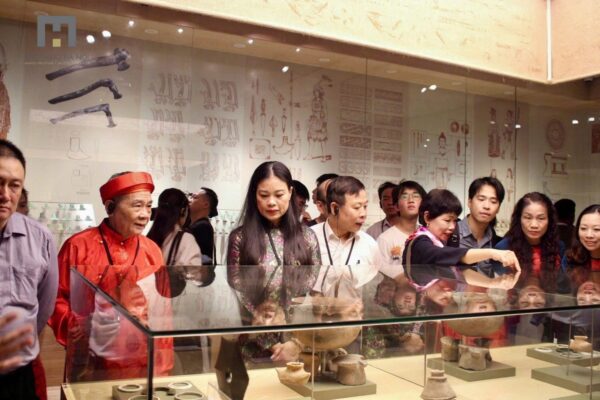
Regarding artifacts, the 2025 processing phase handled more than 15,000 ceramic sherds, nearly 5 tons of soil samples containing botanical remains, and approximately 15,000 objects made of stone, bronze, pottery, wood, bone, iron, and other materials. Although the cataloging is still ongoing, initial assessments have identified numerous rare items appearing for the first time in research on the Metal Age in northern Vietnam and Hanoi, such as jade adzes and axes, a phoenix-head pendant, and a collection of jade objects symbolizing the authority of early community leaders.
These materials further affirm the exceptional historical and cultural value of the Vuon Chuoi site. Vuon Chuoi is simultaneously a settlement, burial ground, and craft-production zone that developed continuously through the Phung Nguyen, Dong Dau, Go Mun, Dong Son, and Post-Dong Son cultural phases. It stands as a representative example of an early wet-rice agricultural village, established by communities who explored, settled, and mastered the Red River Delta nearly 4,000 years ago, laying the foundation for the formation of an early Vietnamese state.
In recognition of its outstanding significance, the Vuon Chuoi archaeological site was designated a Municipal-Level Relic by the Hanoi People’s Committee under Decision No. 3134/QD-UBND dated June 23, 2025.
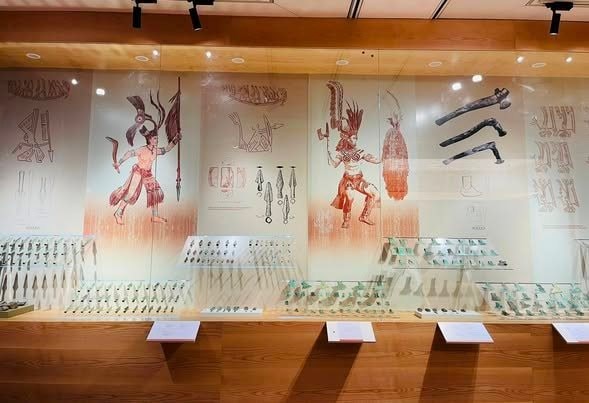
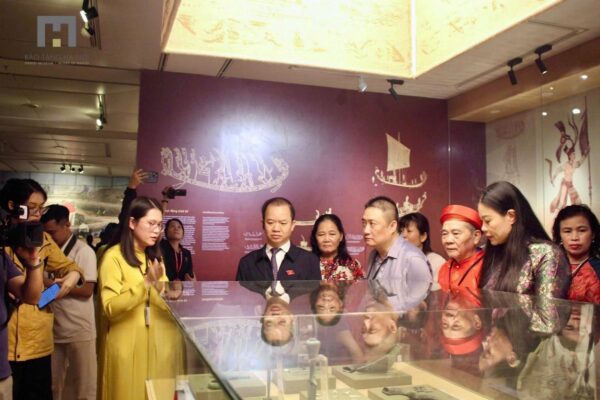
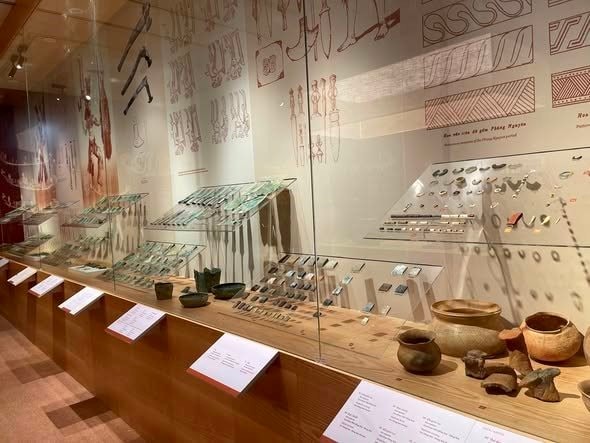
The special exhibition “Archaeological Discoveries from Vuon Chuoi” features five sections: The Journey of Discovery – Convergence and Crystallization of Cultural Phases – Protecting and Promoting Heritage Values – Scholars Associated with Vuon Chuoi – Archaeologist Experience Corner. The exhibition presents nearly 1,000 documents, artifacts, images, and digital reconstructions illustrating various artifact types and the daily life of the ancient Vuon Chuoi community, collected and excavated over many years. The display incorporates 3D projection, 3D mapping, and short films depicting the lifestyles of Proto-Dong Son and Dong Son inhabitants.
On this occasion, the Hanoi Museum also introduced the publication “Exploring Vuon Chuoi (Hanoi) through the 2024-2025 Excavation Season,” which highlights the discovery process, new findings and interpretations from the latest research, Vuon Chuoi’s role as a center of early Vietnamese cultural development, and the enduring vitality of its archaeological heritage in contemporary life.
Uyen Phuong