
Hanoi’s high-performance sports sector closed 2025 with strong highlights, reflected in its significant contributions to Vietnam’s national sports delegation at SEA Games 33.
However, building on this foundation to target gold medals at ASIAD 2026 or secure qualification for the 2028 Olympic Games remains a demanding journey, requiring stronger, more systematic, and sustained investment.
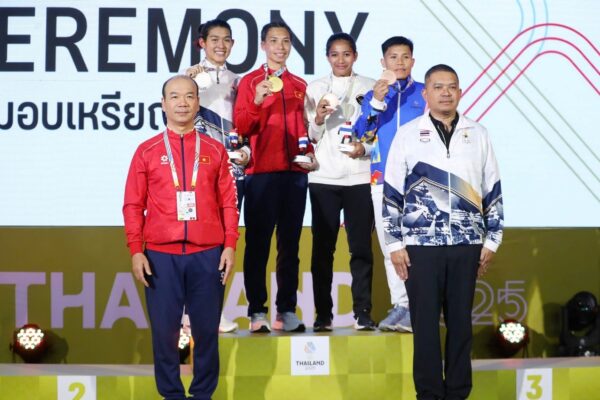
Hanoi athlete Ha Thi Linh (boxing, red uniform) contributed one gold medal to Vietnam’s sports delegation at SEA Games 33. Photo: Bui Luong
Results Beyond Expectations
At SEA Games 33, Vietnam’s national delegation recorded a total of 87 gold medals, 81 silver medals, and 110 bronze medals on the official medal table. Hanoi athletes played a substantial role in that achievement, contributing 29 gold medals, 23 silver medals, and 27 bronze medals.
A closer look at Hanoi’s gold medal tally shows that most of these achievements came from sports included in the Olympic and ASIAD programs. Notable athletes such as Dinh Phuong Thanh (artistic gymnastics), Ha Thi Linh (boxing), Nguyen Xuan Thanh (taekwondo), Hoang Thi Minh Hanh and Nguyen Thi Hang (athletics), Phung Viet Dung (shooting), Can Tat Du and Nguyen Huu Dinh (wrestling), Dinh Thi Hao (rowing), Nguyen Thi Phuong and Dinh Thi Huong (karate), among others, continued to affirm their status as key pillars, delivering gold medals of high technical value.
In team sports, including the women’s futsal team, the men’s four-player sepak takraw team, and the women’s handball team, the core lineups were largely composed of athletes developed through Hanoi’s high-performance sports system.
Commenting on this issue, Hoang Quoc Vinh, Deputy Head of the Vietnam Sports Delegation and Head of the High-Performance Sports Department (Vietnam Sports Administration), noted that Hanoi possesses considerable depth in athlete quality thanks to methodical and professional investment in technical and tactical training. As a result, Hanoi athletes have maintained stable performance over long periods, making meaningful contributions to Vietnam’s overall sporting achievements.
Awaiting a Breakthrough at ASIAD and the Olympics
As with Vietnamese sports as a whole, after each SEA Games cycle, the challenge of conquering medals at ASIAD or earning Olympic qualification inevitably comes to the forefront. The joy of exceeding gold medal targets gradually gives way to new concerns, as Hanoi’s coaches and athletes face the question of how to win medals at ASIAD 2026 or compete for Olympic spots in 2028. Looking at the list of Hanoi athletes who won individual or team gold medals at SEA Games 33, it is difficult to identify candidates capable of replicating individual ASIAD gold medal feats such as Duong Thuy Vi (wushu) at ASIAD 2014 or Bui Thi Thu Thao (women’s long jump) at ASIAD 2018. While these athletes may still create “golden moments” at the SEA Games level, ASIAD presents an entirely different challenge.
At present, in terms of medal prospects, particularly gold medals, at ASIAD 2026 (scheduled for September – October 2026 in Japan), Hanoi sports can only place limited expectations on athletes in certain team events, such as karate kata and men’s and women’s four-player sepak takraw, which contributed two gold medals to Vietnam’s delegation at ASIAD 2023.
To produce individual gold medalists at ASIAD 2026, and further ahead at ASIAD 2030, or to compete for Olympic qualification in 2028, Hanoi sports clearly require a different investment approach, one that is stronger, longer-term, and more decisive than at present. This calls for substantial, well-structured, and in-depth investment, similar to the model Hanoi implemented more than two decades ago, associated with the leadership legacy of figures such as Hoang Vinh Giang and later Nguyen Dinh Lan.
During that period, Hanoi athletes were sent abroad for long-term training and competed regularly at international events, resulting in generations of talented athletes with extended competitive longevity. Even at SEA Games 33, the impact of that investment model was evident in the case of Dinh Phuong Thanh (artistic gymnastics), who trained long-term in China from an early age and impressively won gold in the parallel bars event at the age of 30. Similarly, in table tennis, Nguyen Anh Tu, though not winning gold at SEA Games 33, remains regarded as one of the most consistent and leading players on the national team, an expertise built on years of continuous training in China facilitated by Hanoi.
Unfortunately, this advantage, once a defining characteristic of Hanoi sports, has gradually faded, leading to fewer athletes capable of competing for individual ASIAD gold medals or qualifying directly for the Olympics. Given its leading position nationwide, Hanoi sports cannot afford to overlook this issue, especially as it continues to aspire to produce its first Olympic medalist.
Therefore, surpassing gold medal targets at SEA Games 33 is a commendable achievement, but it would be far more meaningful if, from now on, Hanoi sports continues to play a central role in a long-term investment strategy: sending athletes for overseas training, increasing regular international competition exposure, and fostering joint support from businesses and athletes’ families. Naturally, this is only one aspect of a broader investment equation, alongside other indispensable factors such as medical care, nutrition, and sports science.
In reality, the reward and incentive policies for Hanoi athletes winning international medals are already strong compared to many other localities. However, the more pressing concern today is building the foundation that enables athletes to achieve such results and truly benefit from those policies.
Source: https://hanoimoi.vn/tu-niem-vui-sea-games-33-den-bai-toan-asiad-olympic-728350.html