
Under Resolution No. 25/2025/NQ-HDND, the City permits the controlled pilot implementation of new ideas, products, services, business models, technologies, or creative cultural activities within trade and cultural development zones.
Allowing controlled pilot implementation of new creative cultural activities
Pursuant to Clause 8, Article 21 of the Capital Law, the People’s Council of Hanoi has promulgated Resolution No. 25/2025/NQ-HDND on trade and cultural development zones in Hanoi, setting out specific and detailed provisions that create a legal framework for the establishment and development of such zones.
A trade and cultural development zone is a functional space established in existing neighborhoods, streets, craft villages, or rural residential areas to mobilize social resources for investment in the development of commercial, cultural, and tourism activities; to preserve and promote cultural heritage values; and to create momentum for forming a creative ecosystem.
According to the Resolution, trade and cultural development zones may be established in neighborhoods, streets, craft villages, and existing rural residential areas that have advantages in commercial location and cultural space. Priority is given to establishing such zones in TOD areas as stipulated by the Capital Law.
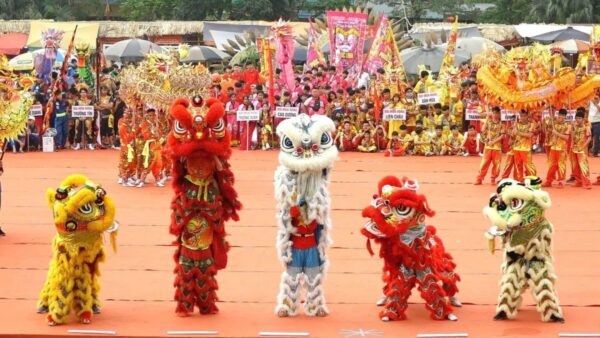
Distinctive cultural festivals attract residents and visitors.
Trade and cultural development zones are subject to business culture standards and requirements on security and order, food safety and hygiene, and environmental protection that are higher than general regulations, in order to develop cultural and creative activities associated with sustainable economic development, preservation and promotion of cultural values and traditional crafts, and to attract and develop tourism.
Also under Resolution No. 25/2025/NQ-HDND, the City allows the controlled pilot implementation of new ideas, products, services, business models, technologies, or creative cultural activities within trade and cultural development zones, within clearly defined limits regarding space, time, participants, and responsibilities.
Associate Professor, Dr. Bui Hoai Son, a full-time National Assembly deputy of the Committee on Culture and Society, commented that Hanoi is demonstrating a proactive, open-minded, and highly serious approach in implementing cultural policies stipulated in the 2024 Capital Law. The City has rapidly concretized the Law’s provisions through various schemes and action programs, including content reflecting a very new mindset toward culture, not only preservation, but also development, creativity, and dissemination.
According to Dr. Son, trade and cultural development zones will be spaces where cultural values can “live,” be “consumed,” and be “exchanged” within the flow of the market, while still retaining the essence and spirit of Thang Long – Hanoi.
Deputy Duong Minh Anh, a part-time National Assembly deputy of the Committee on Culture and Society, shared that through voter engagement, she has observed that voters highly appreciate Hanoi’s positive steps in institutionalizing the contents of the Capital Law, particularly in the cultural sector, considered a key pillar in building the Capital’s identity and competitiveness in a period of deep international integration.
The Hanoi People’s Council’s recent adoption of a series of important resolutions related to cultural development, including the resolution on trade and cultural development zones, reflects a new approach, shifting from an administrative management mindset toward viewing culture as a creative economic sector that directly contributes to sustainable growth and improves the spiritual life of the people.
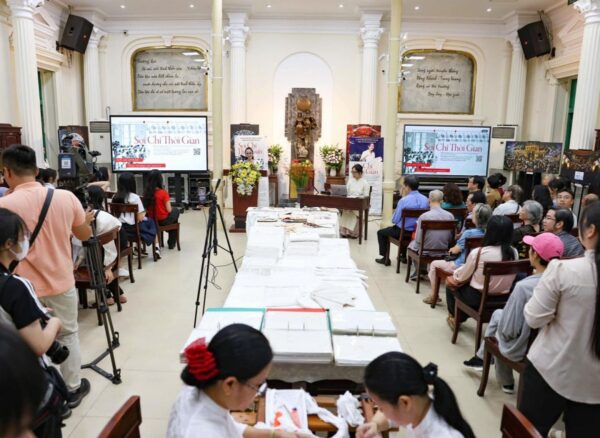
The event “So Chi Thoi Gian” within the framework of the exhibition “Cua Nam Giao Hoa” attracted many young people. Photo: P.CN.
Attracting and developing tourism; preserving and promoting cultural values
Policies on trade and cultural development zones are being actively implemented by localities across the City, notably Cua Nam Ward, which has been selected as a pilot area for the development of the Capital’s cultural industries.
With a total of 23 relics, including 10 historical, cultural, architectural, and artistic relics (communal houses, temples, pagodas) and 13 revolutionary and resistance relics (5 ranked and 8 marked), Cua Nam Ward is considered one of the areas with the richest concentration of cultural, historical, and revolutionary values in Hanoi.
Cua Nam Ward also has the largest number of villas in the City, with 423 villas in total, including 76 Group-1 villas, 143 Group-2 villas, and 204 Group-3 villas. The ward is also home to the headquarters of eight ministries and ministerial-level agencies and other important central bodies.
According to Trinh Ngoc Tram, Vice Chairwoman of the People’s Committee of Cua Nam Ward, the ward has all necessary conditions to be ready to implement the resolutions of the City People’s Council and the directives of the City People’s Committee on developing cultural industries in the area.
Trade and cultural development zones will be established to mobilize social resources for investment in commercial, cultural, and tourism activities in areas with advantages in commercial location and cultural space, in order to attract and develop tourism, preserve and promote cultural values, stimulate commercial activities, and advance innovation, digital transformation, and green transition.
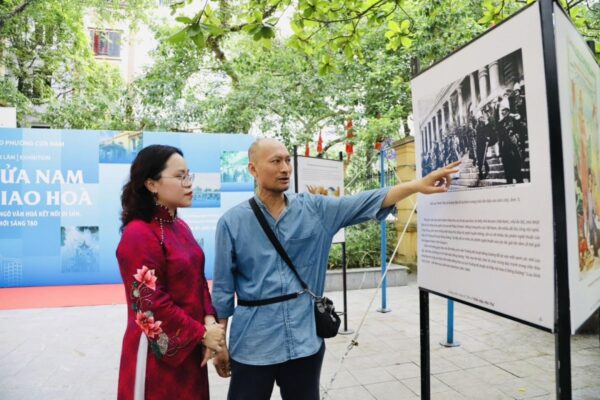
The exhibition “Cua Nam Giao Hoa” attracted many residents and visitors. Photo: P.CN.
At the same time, these zones will create distinctive highlights for night-time economy development in Cua Nam Ward, contributing to improved urban aesthetics, creating and increasing stable revenue sources, and enhancing residents’ quality of life, while efficiently utilizing land functions outside administrative hours.
In addition, the zones will harmoniously combine urban heritage conservation with contemporary cultural elements, creating a unique identity for Cua Nam tourism; ensuring security, environmental sanitation, and good infrastructure to enhance living quality for residents and visitor experiences; and diversifying experiential activities (cuisine, festivals, workshops, shopping, etc.) to extend tourists’ length of stay and spending.
To develop trade and cultural development zones into attractive creative cultural destinations, the ward People’s Committee has proposed a comprehensive set of solutions focusing on public art, spatial design, cultural activities, and tourism experiences.
These solutions are tailored to each specific space, ensuring both the promotion of distinct identities and the creation of fresh appeal for visitors. Specifically, they include: developing street art and creative spaces; improving landscape design and public spaces; organizing cultural events, festivals, and community activities; developing distinctive tourism products and supporting services; and brand positioning and communications.
It can be seen that the promulgation of the Capital Law and Resolution No. 25/2025/NQ-HDND has created a clear legal framework and operating mechanisms that promote creativity and innovation in the cultural sector, thereby contributing to economic development based on cultural values – a key strength of the Capital.
Phuong Thao
According to LDTD