
Implemented since 2017, the two Codes of Conduct, namely the Code of Conduct for cadres, civil servants, public employees, and workers in agencies of Hanoi, and the Code of Conduct in public places across the city, have to date been widely and effectively rolled out. Their implementation has been closely linked to the movement “All People Unite to Build a Cultural Life” in residential areas, attracting active participation and strong support from agencies, units, and all segments of the population.
To further promote the effectiveness of these Codes of Conduct, the People’s Committee of Dai Thanh Commune recently organized a communication conference on “Implementing the Code of Conduct in Public Places in association with the movement ‘All People Unite to Build a Cultural Life,’ and building elegant and civilized Hanoians,” as well as “Implementing the Code of Conduct for cadres, civil servants, public employees, and workers in commune-level agencies, and the Code of Conduct in public places for school managers, teachers, and staff.”
The conference attracted more than 150 participants, including cadres, civil servants, public employees, and workers from commune-level agencies such as the Party Committee, People’s Council, People’s Committee, and the Viet Nam Fatherland Front Committee; leaders of local villages; representatives of residents; and heads of the Women’s Union, Farmers’ Association, Veterans’ Association, and Youth Union.
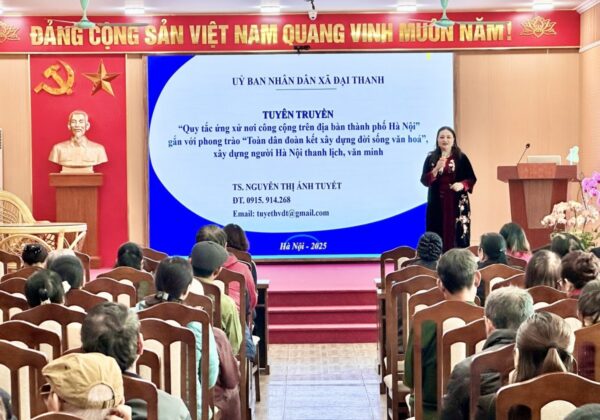
The conference attracted more than 150 delegates in attendance.
In previous years, the movement “All People Unite to Build a Cultural Life” was implemented with key focuses such as guidance on organizing and managing festivals and applying criteria for a cultural environment in traditional festivals; issues requiring attention in heritage site management; and guidance on procedures and processes for awarding titles such as “Cultural Family,” “Cultural Village/Residential Group,” and “Exemplary Commune/Ward/Town,” linked with the criteria of elegant and civilized Hanoians.
Through this movement, appropriate cultural models and values have been developed and replicated, closely connected to people’s daily lives. The movement has made an important contribution to improving spiritual life, building a healthy cultural environment, fostering national solidarity, and inspiring patriotism, national pride, trust, and aspirations for the development of the Capital and the country in a new era.
In 2025, the commune recorded 25,176 out of 26,219 households meeting the standards of “Cultural Family,” accounting for 96%; all 21 villages proposed to achieve the title of “Cultural Village” (currently under public review). The movement to build a cultural life and promote civilized practices in weddings, funerals, and festivals has received strong public participation, particularly in the effective implementation of civilized funerals, with 120 out of 132 cases opting for cremation, reaching a rate of 90.9%.
Through this communication activity, residents have gained a clearer and more thorough understanding of the provisions of the Codes of Conduct, helping the movement to be implemented in a more practical and substantive manner, become routine, and remain closely connected to everyday life. The role-model responsibility of cadres, Party members, and heads of agencies and units continues to be strongly promoted.
Bao Thoa