
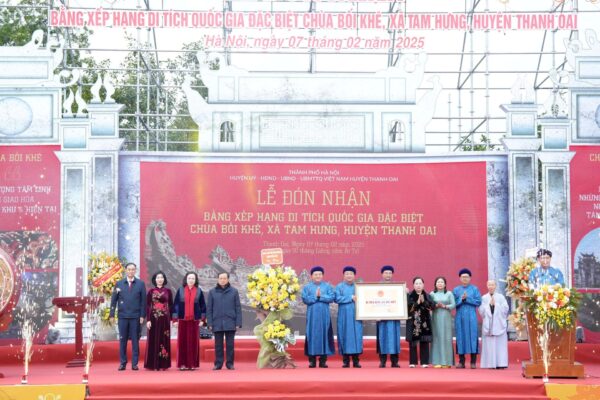
Thanh Oai District receives the Certificate of Special National Heritage Site designation for Boi Khe Pagoda. Photo: Minh Phu
Boi Khe Pagoda is situated on a spacious site of approximately 5,000 square meters. Having undergone multiple restorations, the pagoda embodies architectural and artistic features typical of several dynasties, from the Tran to the Nguyen. The pagoda is designed with a “front Buddha, rear Saint” layout and a “courtyard inside, hall outside” arrangement, oriented westward. It includes the following structures: Duc Ong Temple, pagoda garden, five-gate passage, brick bridge, triple gate, stele house – ritual preparation house, Buddha Pagoda (front hall, incense burning hall, upper sanctuary, left-right corridors), Saint Hall (main worship hall, Muong Hall, rear sanctuary), Ancestor-Mother Hall, and guest house.
The pagoda preserves a lotus-shaped stone pedestal from the Tran Dynasty, wooden Garuda carvings on the ridge of the upper sanctuary, stone lamp pedestals, statues and tiles from the Mac Dynasty, and statues from the Le Dynasty, all of high artistic value. Notably, the Saint Hall features a two-tiered stacked roof with eight curved eaves supported by a system of brackets, representing a masterpiece of sculptural art.
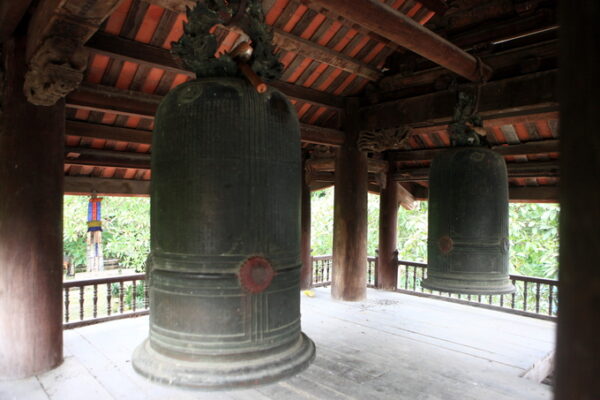
Two bronze bells are cast at the triple gate of Boi Khe Pagoda. Photo: Internet
The venerated Saint Boi enshrined at Boi Khe Pagoda was a real historical figure named Nguyen Binh An – a highly accomplished monk who lived during the Tran Dynasty. Born in 1281 in Boi Khe village, he was orphaned early and cultivated a compassionate, Buddhist-oriented heart. He frequently visited Boi Khe Pagoda to attend sermons. At age 15, he was ordained, taking the Dharma name Duc Minh, meaning “Peaceful,” and later practiced at Trang An Pagoda, known today as the Pagoda of a Hundred Halls.
A unique aspect of Boi Khe Pagoda is its historical role during the anti-French resistance, serving as an operational base for the guerrillas of Tam Hung commune. The underground tunnel system, with a secret entrance at the pagoda connecting to villages throughout the commune over several kilometers, contributed to the heroic legacy commemorated by the four golden words: “Tam Hung Anh Dung (Tam Hung Brave)”.
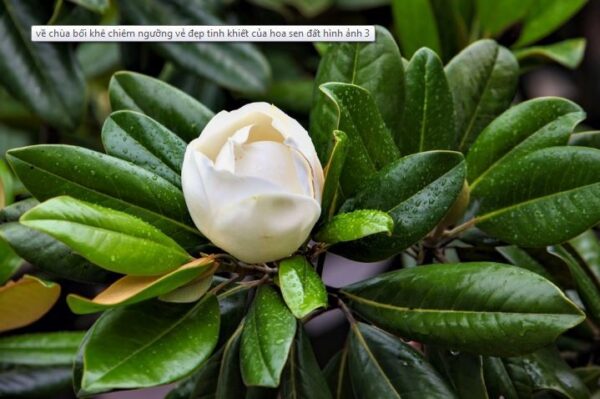
White clay lotus flowers at Boi Khe Pagoda. Photo: Internet
Within the pagoda grounds, three pristine white clay lotus trees bloom, rare in Vietnam. These trees have wooden stems, glossy green leaves on top, and soft light-brown hairs underneath. From bud to full bloom, the clay lotus closely resembles a real lotus. The gentle, pleasant fragrance blends with the sacred, fresh atmosphere of the pagoda, bringing visitors a sense of calm and serenity, as if returning to the land of Buddha.

Boi Khe Pagoda Festival is held annually. Photo: Internet
The annual Boi Khe Pagoda festival takes place from the 10th to the 12th day of the first lunar month. Festivities include the Holy Procession, ritual offerings, and engaging traditional games such as human chess, duck catching, monkey bridge and pot smashing, and cockfighting. Additionally, the festival preserves ancient agricultural rituals, including rain-making ceremonies by rice-farming communities, and the traditional friendship ritual between the two villages of Boi Khe and Tien Lu (Tien Phuong Commune, Chuong My District).
With these unique values, Boi Khe Pagoda has become a highly attractive spiritual destination for both locals and visitors from afar.
Mai Phuong