

A field survey across provinces was jointly organized by Hanoi’s Department of Culture and Sports in collaboration with the Department of Grassroots Culture (Ministry of Culture, Sports and Tourism).
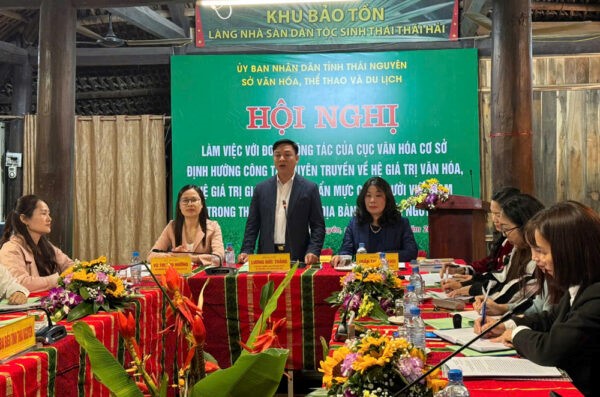
Luong Duc Thang, Deputy Director of the Department of Grassroots Culture, delivered opening remarks during the experience-sharing session with Thai Nguyen Province Department of Culture, Sports and Tourism.
During two experience-sharing sessions between the departments, Deputy Director Luong Duc Thang emphasized: The 13th Party Congress Resolution highlighted and called for clarification of value systems to enrich Vietnamese culture with strong national identity, while developing Vietnamese citizens to meet the country’s sustainable development requirements. Following the 2021 National Cultural Conference, the Ministry of Culture, Sports and Tourism organized a national seminar discussing national values, cultural values, family values, and Vietnamese human standards in the new era. Therefore, surveying and clarifying local implementation and promotion of these value systems holds special significance, contributing to documents preparing for Party congresses at all levels leading up to the 14th National Party Congress, helping build Vietnamese cultural identity in the new era – the era of national revival.
In his connecting role, the Deputy Director also requested parties to focus discussions on: Identifying current value systems, examining implementation advantages and challenges, and proposing recommendations. He emphasized the need to evaluate how values formed through thousands of years of nation-building have evolved, determining which outdated customs should be eliminated and which core national values, aligned with human progress and cultural distinctiveness, should be preserved, promoted, and cultivated.
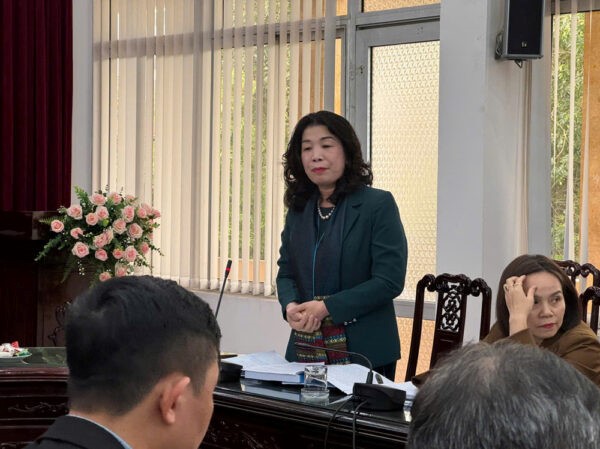
Tran Thi Van Anh, Deputy Director of Hanoi Department of Culture and Sports, sharing experiences with Nam Dinh Province Department of Culture, Sports and Tourism.
Deputy Director Tran Thi Van Anh of Hanoi Department of Culture and Sports stated: Politburo Resolution 15-NQ/TW clearly defined the capital’s development roadmap to 2030: Hanoi will become a “Cultural – Civilized – Modern” city, with a crucial focus on developing elegant and civilized Hanoi citizens embodying qualities of sophistication, elegance, compassion, and civility, exemplifying Vietnamese conscience and dignity. Following the central leadership’s guidance, particularly Hanoi Party Committee and General Secretary Nguyen Phu Trong’s conclusions at the 2021 National Cultural Conference regarding building national, cultural, and family value systems, Hanoi has taken decisive implementation steps.
Hanoi Department of Culture and Sports serves as the standing body for the Hanoi Party Committee’s Program 06-CTr/TU – a program spanning eight terms focused on developing the capital’s culture and building elegant, civilized Hanoi citizens. The Department has advised the city on numerous mechanisms, policies, and specific programs. Currently, the Department is developing criteria for elegant and civilized Hanoi citizens, ensuring they are concise, memorable, and practical. We are eager to exchange experiences with other provinces, especially those within economic regions such as the Capital Region, Red River Delta, and Northern Key Economic Region, which significantly influence the capital’s cultural development.
Experience from Places with “Lit-up Cultural Houses”
Located in the central southern Red River Delta, Nam Dinh province boasts a rich revolutionary cultural tradition. It is a thousand-year-old land of culture with distinctive history and traditions, homeland to many great cultural figures, scholars, revolutionary pioneers, and outstanding Party and State leaders. The province is a convergence point where diverse folk cultural values meet, interact, and spread, preserving many humanitarian ethical and ideological values.
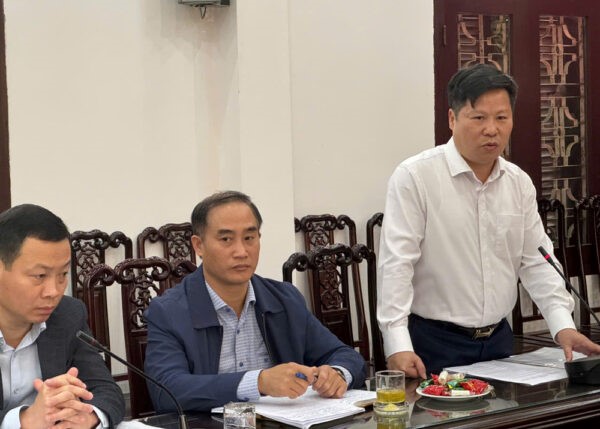
Vu Duc Tho, Director of Nam Dinh Province Department of Culture, Sports and Tourism speaking at the meeting.
Vu Duc Tho, Director of Nam Dinh Province Department of Culture, Sports and Tourism, stated: Following the Party and State’s renovation and development policies, Nam Dinh’s economic sectors have developed steadily, with continued achievements in culture and society. Grassroots cultural life development, particularly the “All People Unite to Build Cultural Life” movement and cultural, artistic, and sports activities, has received focused grassroots-level implementation guidance, enriching people’s spiritual lives and contributing to building a healthy cultural environment. Provincial Party committees and authorities have implemented numerous policies focused on developing well-rounded Nam Dinh citizens in terms of personality, ethics, knowledge, and physical fitness, while promoting family and community cultural values.
Recognizing the role of grassroots cultural and sports institutions in enabling people to create, enjoy, and spread traditional cultural values, the Department has advised the Provincial People’s Committee to direct local authorities in ensuring comprehensive cultural and sports facilities at all levels. These include one provincial museum, one private museum, 48 traditional houses and memorial rooms, one provincial library, 10 district/city libraries, 1,324 grassroots book collections (one commune library, 229 legal bookcases, 198 commune cultural post offices, 914 village/residential group bookcases), and 12,664 classroom bookcases. The province has 10 district-level cultural and sports centers, 175 communes/wards/towns with cultural houses/multi-purpose halls, and 2,160/2,160 villages/hamlets/residential groups with cultural houses/cultural activity venues. These cultural houses remain consistently active, with their operations notably funded by voluntary public contributions.
Nam Dinh currently has 1,361 historical-cultural relics approved and announced by the Provincial People’s Committee, one intangible cultural heritage representative of humanity, and 12 intangible cultural heritages inscribed on the national intangible cultural heritage list. The Department has advised and directed the preservation and promotion of cultural heritage values, particularly traditional cultural identities characteristic of Nam Dinh’s land and people, such as: traditions of patriotism and resilience against foreign invasion; traditions of diligence, intelligence, and creativity; traditions of studiousness, unity, and compassion… along with historical anecdotes about the Tran Dynasty’s emphasis on righteousness, patriotism, compassion, and tolerance that forged the legendary Dong A spirit, awakening unity, fellowship, compassion, and profound humanitarian cultural values.
Strengthening Cultural Connections with the “Capital of Revolutionary Winds”
On the morning of November 28, during a meeting with the Thai Nguyen Province Department of Culture, Sports, and Tourism, Ms. Tran Thi Van Anh expressed her optimism that this field trip and exchange of experiences would mark a significant step forward in the collaboration between Hanoi and Thai Nguyen – known as the “Capital of Revolutionary Winds.” The two localities aim to share and learn from effective models and best practices in cultural development, the establishment of cultural and family value systems, and the shaping of Vietnamese human standards in their respective contexts, thereby contributing to the country’s development goals in this new era.
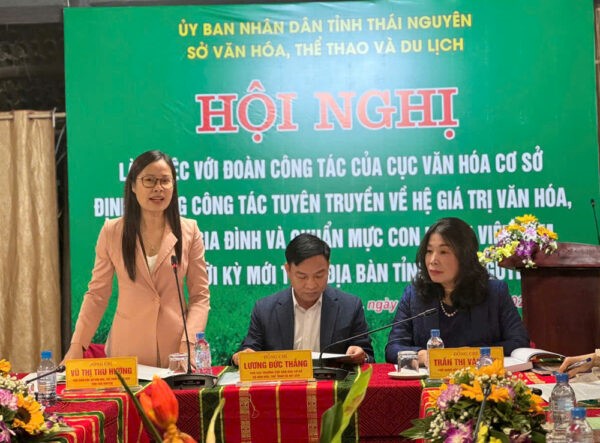
Deputy Director Vu Thi Thu Huong of the Thai Nguyen Province Department of Culture, Sports, and Tourism speaking at the meeting
Deputy Director Vu Thi Thu Huong emphasized that over the years, recognizing the importance of building, preserving, and promoting value systems and the standards of a modern generation, the local Party committees and governments have effectively implemented numerous resolutions, programs, projects, and plans. They have also directed extensive communication efforts on Vietnam’s value systems, integrating these efforts with initiatives for building new rural areas and civilized urban spaces. This has been reflected in cultural activities, literary and artistic creations, heritage preservation, and the promotion of traditional values. These efforts are further integrated into the “All People Unite to Build a Cultural Life” movement, family-related work, and various other activities conducted by local agencies and organizations. Through these comprehensive efforts, the region has deeply internalized and promoted the principles of shaping Vietnamese human standards in the modern era, strengthening family values, and developing cultural systems. This process has also contributed to consolidating national values by preserving and inheriting the cultural heritage of the Vietnamese people while selectively absorbing global cultural excellence. Thai Nguyen has thus positioned itself as a province dedicated to peace, happiness, prosperity, and hospitality, all while aligning its cultural and human development with its aspirations for a better future.
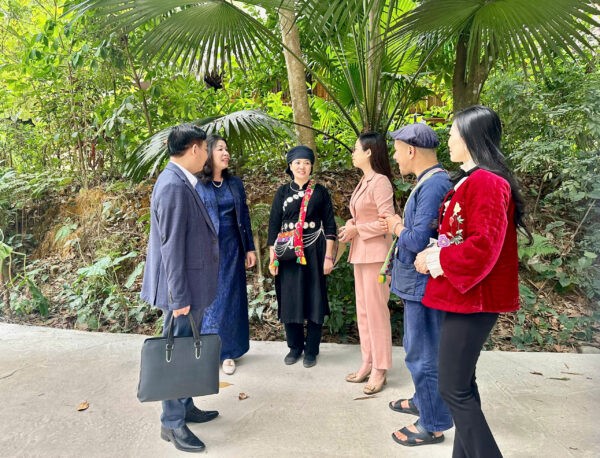
The delegation during a field visit to Thai Hai Stilt House Ecological Village (Thinh Duc Commune, Thai Nguyen City).
Representatives from various divisions and units within the Thai Nguyen Department of Culture, Sports, and Tourism expressed their hopes for enhanced connections between Hanoi and Thai Nguyen. They aspire for opportunities to delve deeper into Hanoi’s strategies for implementing value systems, learning from Hanoi’s model of honoring “Outstanding Capital Citizens,” and exploring ways to promote Thai Nguyen’s tea products in Hanoi, ultimately advancing the tea culture of the region.
As a province rich in history and deeply rooted in cultural traditions, Thai Nguyen is home to a wealth of tangible and intangible cultural heritage reflecting the nation’s identity. Currently, 23 of its cultural practices are recognized as National Intangible Cultural Heritage. Notably, the Then practice of the Tay, Nung, and Thai ethnic groups, which includes Thai Nguyen, has been inscribed by UNESCO as part of the Representative List of the Intangible Cultural Heritage of Humanity. Over 1,000 cultural sites in the province have been preserved, cataloged, and ranked, including the ATK Dinh Hoa Historical Site Complex, which holds Special National Relic status, along with 59 nationally recognized relics and 235 provincially recognized relics. The province also honors 18 artisans in intangible cultural heritage with the titles of “People’s Artisan” and “Excellent Artisan.”
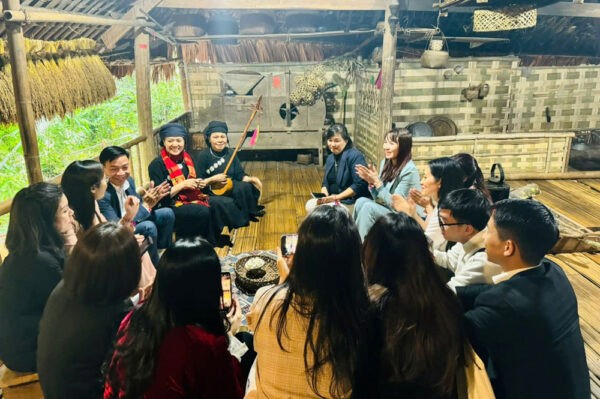
The delegation listens to Then singing in a traditional house in Thai Hai Village.
According to Mr. Luong Duc Thang, Thai Nguyen, with its rich ethnic diversity, should continue leveraging its cultural resources to construct and develop cultural value systems, family values, and Vietnamese human standards. The province should focus on creating community-based tourism products that preserve the cultural identity of ethnic minorities while contributing to the construction of new rural areas. Community-based tourism, which actively involves local residents, allows for the promotion of cultural, historical, and natural values alongside ethnic identities. These models could also serve as valuable references for Hanoi to adapt and implement within the capital.
V.H