
The workshop was attended by: Standing Committee member of the Hanoi Party Committee, Permanent Vice Chairman of the Hanoi People’s Committee Le Hong Son, who chaired the session; leaders of units under the Ministry of Culture, Sports and Tourism; leaders of departments and agencies; representatives from several districts, towns, and communes; as well as scientists, craft village representatives, artisans, artists, and neighborhood groups…
Permanent Vice Chairman of the Hanoi People’s Committee Le Hong Son chaired the workshop. Photo: Ngoc Tu
Awakening the Capital’s Aspiration
In his opening remarks, Permanent Vice Chairman Le Hong Son stated that Hanoi is currently seeking opinions on draft plans for building Cultural Industry (CI) Centers and Trade–Culture Development Zones to implement the Capital Law (2024), aiming to facilitate the city’s development. According to the plan, at the 4th session of the People’s Council, the city will consider issuing these two resolutions, creating momentum for Hanoi’s development based on culture as a driver of socio-economic growth.
Currently, along with the whole country, Hanoi faces the need for development and double-digit growth, and further growth is required in the coming years. To achieve sustainable, green growth, Hanoi must maximize its cultural potential and advantages while preserving its identity and fostering innovation.
Le Hong Son emphasized that the development of the cultural industry is not new; many countries in the region, such as China, South Korea, Japan, Singapore, Thailand… have developed it strongly. However, for Vietnam in general and Hanoi in particular, the development of the cultural industry still faces many issues that need careful study to ensure feasibility and practicality.
“We hope Hanoi will have many CI Centers to attract all social classes, especially young people, to participate in creative activities across multiple fields. We will implement this in a manner that is neither hasty nor overly perfectionist,” Le Hong Son shared.
At the workshop, Director of the Institute for Socio-Economic Development Research Le Ngoc Anh remarked that developing CI (or the creative industry) has become a global trend, an important, comprehensive, and sustainable development strategy, attracting international cooperation, creating competitive advantages, and contributing significantly to GDP.
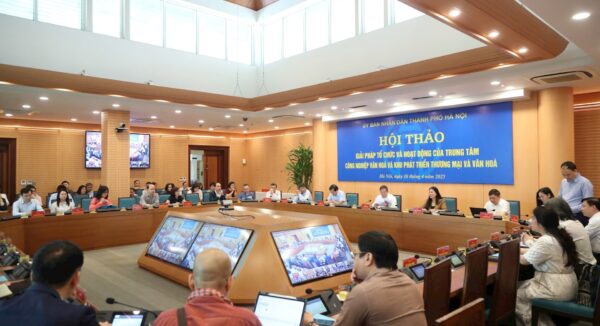
Overview of the Workshop. Photo: Ngoc Tu
The amended Capital Law contains provisions to promote cultural development, awakening the aspiration for “Civilized – Cultured – Modern” Hanoi; effectively leveraging geopolitical, geo-economic advantages, natural conditions, and development resources; and preserving and promoting the tangible and intangible cultural values of Thang Long – Hanoi. The Capital Law also allows Hanoi to develop cultural industry centers on river islands and sandbanks of the Red River; with focus on five types of spaces, including: Cultural–creative spaces (expanding historical sites and creative spaces in line with UNESCO’s creative city orientation); public spaces (especially green spaces, protection of rivers and lakes, and water landscapes).
Le Ngoc Anh proposed that Hanoi improve mechanisms and policies (land incentives, urban planning, taxes…) to create a legal framework for developing creative spaces and strong CI sectors; prioritize and support cultural–creative enterprises; invest in transportation infrastructure serving the centers; diversify public–private organizational models; and update planning consistent with CI orientation.
Lessons from International Models
At the workshop, experts from both domestic and international backgrounds presented various CI development models from other countries, drawing lessons for Hanoi.
Emmanuel Cerise, Head of the Ile-de-France Regional Office in Hanoi, noted that in France, cultural management is linked to economic development. Currently, the CI sector contributes about 110 billion euros to the French economy. Across the EU, CI ranks third after Construction and the Hospitality & Restaurant sector. The CI sector includes arts, advertising, television, journalism, cinema, video games…
Cerise suggested that Hanoi, with its large administrative boundaries and strong cultural attraction in the suburbs, could develop CI Centers effectively. Hanoi should develop centers managed by both the state and private sector. To optimize CI Centers, investment in transportation infrastructure is needed, including bus routes connecting heritage sites and providing materials for passengers.
Drawing from experience organizing cultural events in France, Emmanuel Cerise recommended that Hanoi hold regular events such as Creative Design Festivals and heritage promotion activities at 46 Hang Bai Villa. “We are ready to accompany Hanoi in preserving and promoting heritage and building effective CI Centers,” said Emmanuel Cerise.
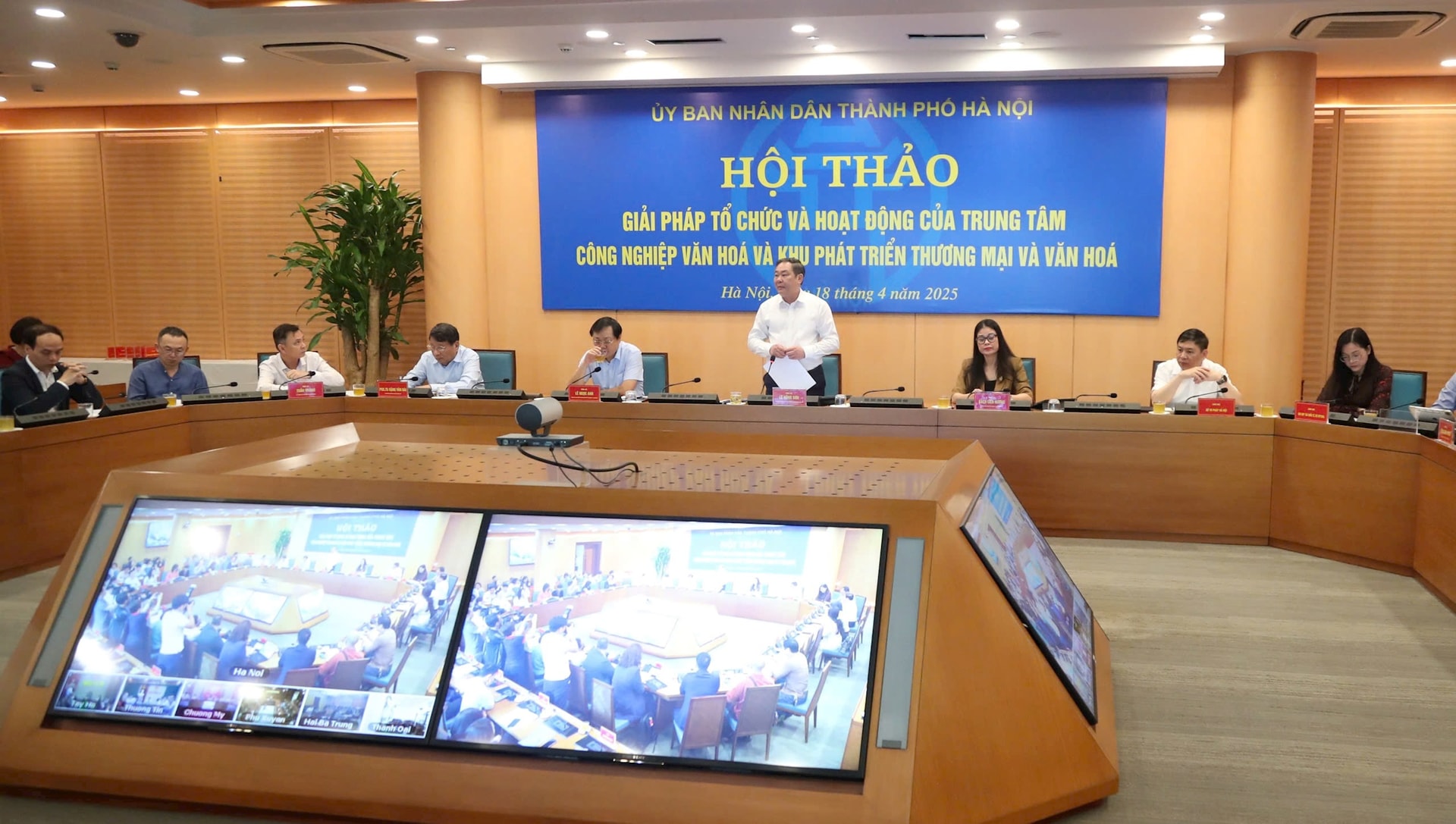
Permanent Vice Chairman Le Hong Son concludes at the workshop. Photo: Ngoc Tu
Meanwhile, Pham Thanh Huong, Head of the Culture Department at the UNESCO Office in Hanoi, said that Hanoi has many old urban heritage sites that have been revitalized through creative festivals such as Bot Hang Dau and Gia Lam Locomotive Factory… This represents great potential for developing CI Centers.
Pham Thanh Huong suggested reusing old industrial zones and abandoned industrial heritage as CI Centers – saving costs while fostering creative inspiration. In addition, multi-sectoral linked centers should be developed, combining culture, creative design, technology, encouraging experimentation, and creating experiential spaces.
Architect Doan Ky Thanh, who has participated in building several CI models in Hanoi, shared criteria for new models alongside reusing old structures. According to him, for effectiveness, a CI Center should cover 1–5 hectares, attract about 60–80 stalls, and provide a friendly common space that connects the community.
Promoting Public–Private Partnerships
At the workshop, delegates provided feedback on the draft resolution, suggesting that the city clarify the resources for developing CI, especially from foreign enterprises; establish more specific mechanisms for leasing public assets; and supplement policies to support creative actors in CI activities based on cultural spaces and heritage, linked to the community.
In his concluding remarks, Permanent Vice Chairman Le Hong Son affirmed that developing CI is one of the city’s important initiatives to turn culture into a driver of socio-economic development. Under current conditions, the city will prioritize reusing old factories, offices, and industrial zones for renovation and repurposing to serve cultural development.
Moreover, the city has issued resolutions on joint ventures, partnerships, and franchising… This provides a basis for units to promote CI development in these forms. “The city will promote Public–Private Partnership models (public investment, private management), leveraging the creativity and innovation of the private sector,” Le Hong Son stated.
Additionally, Le Hong Son emphasized the need to pay attention to specialized planning to avoid overlaps, allowing maximum mobilization of resources for development. With its guiding role, Hanoi will focus on supporting technology, media, international cooperation, and market development. Developing CI Centers should follow a phased approach with appropriate and solid steps.
Hoang Lan