
In 2023, the Hanoi Department of Culture and Sports, in coordination with the Propaganda and Education Commission of the Hanoi Party Committee, organized two scientific symposiums themed “Building the Value System of the Capital’s Family and the Standards of Elegant and Civilized Hanoians: Current Situation and Solutions.” The outcomes of these symposiums served as an important foundation for the Propaganda and Education Commission of the Hanoi Party Committee to advise the Standing Committee of the City Party Committee to issue Directive No. 30 dated February 19, 2024, on strengthening the Party’s leadership in building elegant and civilized Hanoians. The directive emphasizes that developing the image of elegant and civilized Hanoians is a long-term process that requires persistence, endurance, and regular implementation. The criteria for building Hanoians are designed to suit the new context, following a specific, concise, memorable, and practical motto.
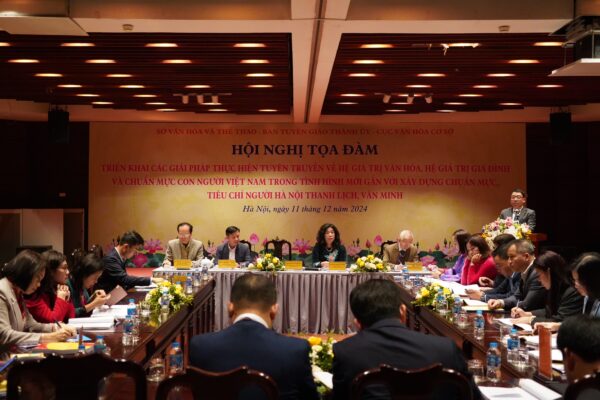
The symposium held on December 11, 2024, at the Hanoi Museum gathered managers and representatives from districts, towns, and cities.
At the symposium titled “Implementing Solutions for Promoting Cultural Value Systems, Family Value Systems, and the Standards of Vietnamese People in the New Era – Building the Criteria for Elegant and Civilized Hanoians,” jointly organized by the Hanoi Department of Culture and Sports, the Propaganda and Education Commission of the Hanoi Party Committee, and the Department of Grassroots Culture under the Ministry of Culture, Sports and Tourism (now the Department of Grassroots Culture, Family, and Library), on December 11 and 13, the Organizing Committee drafted proposed plans and quantified standards for developing the image of Hanoians who are “Graceful, Elegant, Kindhearted, and Civilized” into specific measurable criteria.
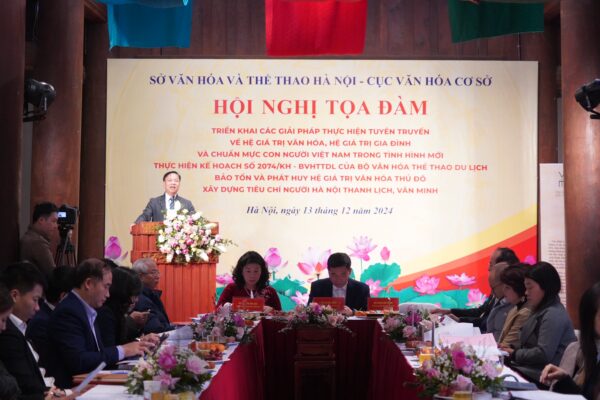
The symposium held on December 13, 2024, at the Van Mieu-Quoc Tu Giam Center for Cultural and Scientific Activities gathered experts, scholars, leaders of cultural management agencies from provinces and cities, and representatives from universities.
The standards for “Graceful, Elegant, Kindhearted, and Civilized Hanoians” – in the era of renovation and international integration should embody the following elements: elegance in demeanor and behavior reflected in communication and neat, appropriate attire; civility in public conduct, such as awareness of legal compliance, maintaining order, protecting environmental hygiene, and respecting shared spaces; creativity in thought and action; modernity in lifestyle, demonstrated by mastering technology and applying it effectively to work and life; international integration in communication and awareness (being proficient in foreign languages and actively engaging with global civilized values); and adherence to tradition in spirit and character.
These criteria help translate abstract standards into measurable indicators, supporting the monitoring, evaluation, and implementation of Hanoi’s cultural values in the new context. At the same time, they affirm the Capital’s special role in both preserving traditions and leading integration and development.
At the symposium, Deputy Head of the Propaganda and Education Commission of the Hanoi Party Committee, Dao Xuan Dung, stated that developing the standards and criteria for Hanoians not only aims to enhance the cultural life of the people but also contributes to strengthening the competitiveness and international integration capacity of the Capital. Moreover, this is an important solution to promote solidarity, social consensus, and sustainable development.
Contributing ideas at the symposium, representatives from districts, towns, and cities shared opinions emphasizing the need for innovation in leadership thinking and methods, and raising awareness among Party committees, state management agencies, and the public about the role and position of culture in socio-economic development.
The presentations also stressed the importance of focusing on building standards and criteria for Hanoians to promote sustainable development; perfecting these criteria to fit current circumstances; developing a value system with clear and appropriate standards for each group; and establishing a human value system suited to the present era, which is now an urgent requirement. In addition, it is necessary to continue preserving and promoting cultural heritage values; improving the system of legal normative documents to enhance the effectiveness of state management in cultural heritage preservation and promotion; strengthening the dissemination of local historical and cultural values to domestic and international visitors; and broadly communicating the standards of Vietnamese people in general so that organizations and individuals can understand, concretize, apply, and implement them appropriately in each place and period.
Furthermore, many opinions suggested that implementing the standards of Vietnamese people today should be linked to the standards of civilized families, cultural lifestyles at the grassroots level, cultural villages, residential groups, agencies, and units that meet cultural standards.
The symposium provided an opportunity for researchers and administrators to discuss, share experiences, and propose practical, specific solutions to establish criteria for the people of the Capital that truly embody the representative characteristics of Hanoi’s identity in the era of renovation and international integration.
Phuong Uyen