
Empowering Self-Governance to Develop the Capital’s Cultural and Commercial Spaces
According to the draft Resolution, commercial and cultural development zones are to be established in locations that possess advantages in terms of trade, cultural space, and tourism areas or sites recognized by the State and international organizations.
The main goal is to attract and develop tourism, promote cultural values, foster commercial activities, preserve traditional crafts, and at the same time improve local residents’ living standards.
A highlight of this model lies in the principles of voluntariness, self-governance, and the consensus of the majority of residents in the area, with standards for business culture, public order, and environmental protection that are higher than current
regulations.Reviving the potential of Bat Trang traditional craft village through commercial and cultural development zones
According to the draft model Regulation, a commercial and cultural development zone is organized into three levels. The first is the Community Assembly – the highest decision-making body, consisting of representatives of production, business, and service establishments, residents, as well as representatives of the local People’s Committee and the local Vietnam Fatherland Front. This assembly is held annually or extraordinarily to decide on important matters of the area.
Next is the Management Council – the executive body, comprising at least nine members with a five-year term. The Management Council represents the commercial and cultural development zone in relations, organizes activities for landscape protection, environmental sanitation, public order, and manages revenues and expenditures. Finally, there is the operating and management unit, which can either be the Management Council itself or a professional entity hired to perform daily management and operational work.
The commercial and cultural development zone carries out a variety of activities, such as organizing cultural events, festivals, and art performances; developing systems of shops, markets, and commercial centers associated with local cultural characteristics; promoting and introducing tourism activities; implementing activities to enhance landscapes, street sanitation, and environmental protection; organizing traffic and maintaining public order.
To fund its operations, the commercial and cultural development zone is allowed to collect revenue from ticket sales for visits and art performances; from vehicle parking and other services; from contributions by residents, organizations, and businesses; from State budget allocations as prescribed; and from other lawful sources. Importantly, these revenues must adhere to the principle of non-profitability, solely ensuring payment for the zone’s activities, while guaranteeing fairness for groups such as policy-beneficiary families, people with meritorious service, persons with disabilities, and small business households.
Multiple perspectives and contributions

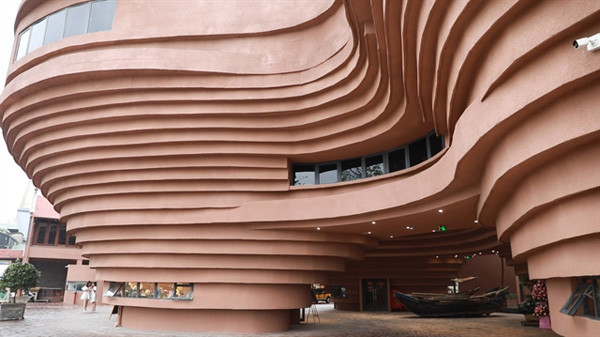
Exhibition “The Essence of Vietnamese Craft Villages through the Lens of Contemporary Interior Design” at the Hanoi Museum
During the consultation process, most residents expressed the view that promulgating the Resolution is appropriate. Many people believe that the establishment of commercial and cultural development zones is expected to generate many positive impacts, such as creating mechanisms to mobilize social resources for the development of commerce, culture, and tourism; improving the landscape and living environment for residents; promoting cultural values and preserving traditional crafts; increasing revenue from tourism and commercial activities; and creating more jobs and income for local people.
Mr. Vu Ha, a Party member from Thịnh Quang Ward, Dong Da District, Hanoi, said: “I agree with the model of commercial and cultural development zones; however, it is necessary to further clarify the contents related to planning, land funds, and distribution across localities, especially in the context that Hanoi is transitioning to a two-tier government model (abolishing the district level). It should be clearly determined whether every locality must have a commercial and cultural development zone, or whether the city should only establish several large-scale zones associated with signature products, such as the Bat Trang ceramics area, Van Phuc silk area, or handicraft zones. This would help concentrate resources and create distinctive highlights for each area instead of being spread out and lacking identity.”
Meanwhile, Ms. Dinh Thi Hong Vui (an official of the Ho Chi Minh National Academy of Politics) stated: “I support the establishment of commercial and cultural development zones, but there should be clearer regulations on the preservation of traditional architectural spaces. Many business households in these areas tend to renovate facades or demolish old houses in a modern style, erasing the distinctive features of ancient streets and traditional craft villages. It is recommended to have specific provisions on maintaining characteristic architecture during repairs or renovations.”
As a young person who loves traditional culture, Ms. Minh Ngoc from Phuc Dien Ward, Bac Tu Liem District, said: “I propose adding specific preferential policies for artisans and traditional craft workers within the commercial and cultural development zones. The preservation and development of traditional crafts should be placed at the center, not just as a supporting activity for tourism and commerce”.
The draft Resolution on commercial and cultural development zones is being published on the City’s electronic portal for public consultation. With a new urban management model, the participation and contributions of residents are extremely important to perfect this mechanism.
Comments can be sent to the Hanoi Department of Culture and Sports or posted directly on the City’s electronic portal. Each contribution holds value in building a suitable and effective mechanism that brings practical benefits to the community and promotes the cultural identity of the Capital.
Phuong Bui