
On December 4, the Hanoi Department of Culture and Sports organized a training conference to provide guidance on the implementation of the Cultural Heritage Law across Hanoi. The event aimed to share experience and knowledge in heritage management and conservation activities, while updating participants on new provisions of the 2024 Cultural Heritage Law.
Attending the conference were Tran Dinh Thanh, Deputy Director General of the Department of Cultural Heritage under the Ministry of Culture, Sports and Tourism; Bach Lien Huong, Member of the Hanoi Party Committee and Director of the Hanoi Department of Culture and Sports; along with numerous scientists, experts, representatives of heritage site management boards, and heritage officers from 126 wards and communes across the city.
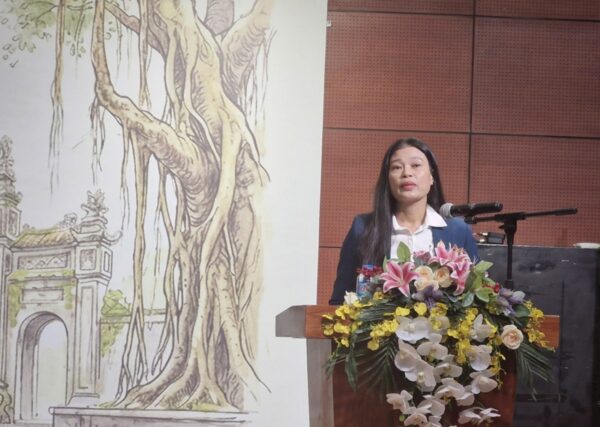
Director of the Hanoi Department of Culture and Sports Bach Lien Huong delivers the opening remarks at the conference.
In her opening address, Director Bach Lien Huong noted that since July 1, 2025, the Cultural Heritage Law No. 45/2024/QH13 has officially taken effect, introducing many new provisions. For the first time, heritage impact assessment has been codified into law, linked to the responsibilities of state management agencies and the obligations of entities related to relics and world heritage sites. At the same time, numerous regulations concerning relics have been revised and supplemented.
Delegates participating in the training session.
With more than a thousand years of cultural history, Hanoi is one of the localities with the highest density of heritage assets nationwide, including 6,489 historical and cultural relics; 1,793 inventoried intangible cultural heritage elements (among them six tangible and intangible heritages recognized by UNESCO; 22 national special relics and relic complexes; 1,165 national-level relics; 1,600 city-level relics; and 59 heritages listed in the national inventory of intangible cultural heritage); 351 national treasures; 23 non-public museums; 131 artisans awarded the honorary state titles of “People’s Artisan” and “Meritorious Artisan” by the President (including 18 People’s Artisans and 113 Meritorious Artisans) in the field of intangible cultural heritage; and 1,350 traditional craft villages.
These values are not only the “memory of the land and its people,” but also invaluable assets for the future and a powerful endogenous resource for building a creative, civilized, and modern capital.
Several provisions related to decentralization of management, decision-making authority, and procedures for relic restoration have also been adjusted and supplemented. This provides a more comprehensive legal basis to enhance the effectiveness of heritage management at the local level, particularly for Hanoi, which manages a large and complex heritage system and therefore needs to fully grasp and update the new contents of the Law.
The Director of the Department expressed her hope that, with their experience and dedication, experts from the Department of Cultural Heritage would convey valuable knowledge closely linked to practical experiences across provinces and cities nationwide, as well as Hanoi’s own historical and cultural relics. She encouraged participants to attend fully and seriously, and to proactively exchange and discuss challenges, so that after the conference they would not only master theoretical knowledge but also be able to apply it immediately in practice.
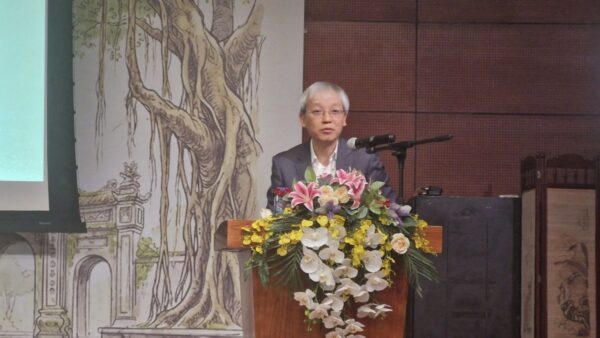
The conference rapporteur is Tran Dinh Thanh, Deputy Director General of the Department of Cultural Heritage.
At the conference, Tran Dinh Thanh delivered training on state management and professional expertise in the protection and promotion of cultural heritage values. He also addressed key issues arising in heritage protection and promotion activities, clarifying the current situation and proposing appropriate solutions to enhance the effectiveness and efficiency of state management.
The revised Cultural Heritage Law of 2024, passed by the National Assembly and officially effective from July 1, 2025, introduces many new points, with additional provisions aimed at concretizing areas that were previously insufficiently regulated. It is regarded as a solid legal framework that will help improve the effectiveness of heritage conservation and value promotion, meeting the demands of a new era.
Phan Anh