

On November 6, at Temple of Literature, the French Institute in Hanoi, in collaboration with the Temple of Literature Center for Cultural and Scientific Activities, opened the exhibition “The Huong Examination in the Late 19th Century,” part of the Photo Hanoi ’25 program.
The exhibition offers the public a rare opportunity to view a compelling collection of photographs, providing a vivid perspective on Vietnam’s scholarly education system in the late 19th century at Temple of Literature, the country’s first national academy and a cradle of Vietnam’s Confucian learning tradition.
The exhibition also brings a sense of novelty by presenting, for the first time, an exhibition displayed outside the walls of the Temple of Literature complex, allowing visitors closer and more direct access to these valuable historical images.
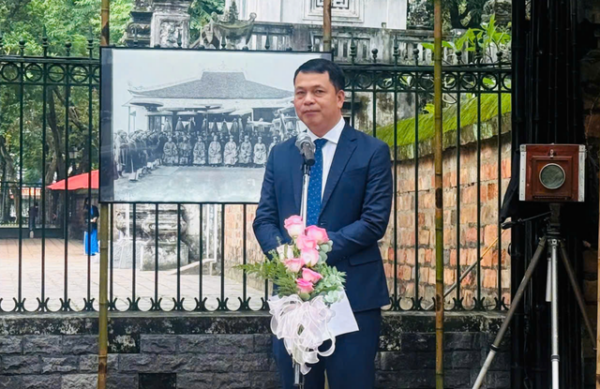
The Director of the Temple of Literature Center for Cultural and Scientific Activities speaks at the opening ceremony.
Speaking at the opening ceremony, Le Xuan Kieu, Director of the Center, expressed his hope that the exhibition would serve as a source of inspiration, nurturing respect for learning and reinforcing the core values of Vietnamese Confucian education, devotion to learning, respect for teachers, and the appreciation of talent, while resonating with UNESCO’s four pillars of education: learning to know, learning to do, learning to be, and learning to live together.

Eric Soulier, Cultural Counselor of the French Embassy and Director of the French Institute in Vietnam, visits the exhibition.
Eric Soulier noted that the exhibition’s placement along the Temple of Literature grounds stands as a powerful symbol of the dialogue between the site and the Photo Hanoi ’25 exhibitions. The works are displayed in a bamboo-structured space inspired by the architecture of historical examination halls, set against the walls of Van Mieu, both a symbol of Confucianism and a major historical and cultural landmark of ancient Thang Long.
“Beyond highlighting this rare photographic collection, the exhibition raises questions about the role of photography in how we perceive history, shedding light on visual practices and educational traditions of the feudal era,” Eric Soulier observed.
Firmin-Andre Salles (1860-1929) was a French photographer who worked in Vietnam, Laos, and Cambodia from 1896 to 1898. Using dry-plate photography techniques, he captured images of exceptional clarity and detail, offering vivid insights into daily life, landscapes, and cultural events in Vietnam at the end of the 19th century.

A visitor at the exhibition.
The exhibition “The Huong Examination in the Late 19th Century” presents photographs by Andre Salles documenting the 1897 Huong Examination in Nam Dinh, displayed within a distinctive bamboo installation inspired by the original architecture of historical examination compounds.
The Huong Examination was a central component of the Confucian examination system. The Dinh Dau Examination of 1897 took place at a time when Confucian education was gradually declining and being replaced by the Romanized Vietnamese script. The photographs on display are rare surviving records, vividly conveying both the solemnity and the lively atmosphere of the examination grounds.
Beyond presenting a valuable photographic archive, the exhibition invites dialogue on the role of photography in shaping historical understanding and aims to provide the public with meaningful insights into photographic techniques as well as the education and examination system of Vietnam’s feudal period.
To further enrich the exhibition, the organizers worked closely with local cultural experts to deepen perspectives on the Huong Examination and the figures captured in the photographs.
The exhibition runs through November 30, 2025.
Minh Anh