
On the afternoon of December 16, the Hanoi Department of Culture and Sports held a press conference to provide information on the Hanoi Food and Culture Festival 2025. The festival is an annual cultural event assigned by the Hanoi People’s Committee to the Department of Culture and Sports, in coordination with relevant units, aiming to honor the value of the Capital’s culinary heritage while promoting cuisine as a driving resource for the development of cultural industries.
Hanoi Food and Culture Festival 2025: Connecting Cuisines Through Every Dish – Opening of the Hanoi Craft Village and Traditional Trade Street Food & Tourism Festival 2025 – Highlights of Pho Day 2025 (9th edition).
Identifying the Capital’s Cuisine as a Field with Great Potential
Speaking at the press conference, Ms. Le Thi Anh Mai, Deputy Director of the Hanoi Department of Culture and Sports, stated that Hanoi currently has seven culinary heritages inscribed on the National List of Intangible Cultural Heritage. After being recognized, many of these heritages have not only been better safeguarded but have also become iconic cultural-tourism products, contributing to improved livelihoods for local communities and helping spread the image of Hanoi.
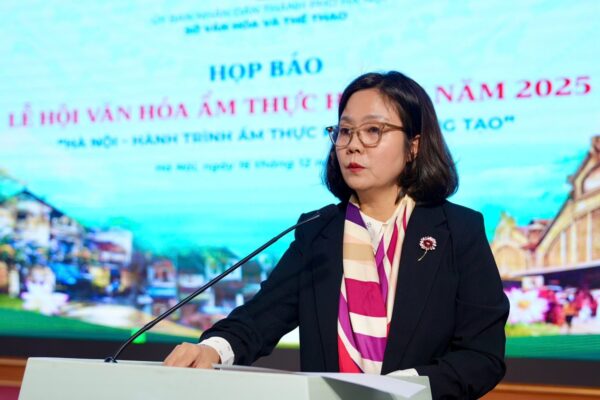
Ms. Le Thi Anh Mai, Deputy Director of the Hanoi Department of Culture and Sports, speaks at the press conference.
The craft of making Me Tri green rice flakes (Tu Liem Ward) and Quang An lotus tea (Tay Ho Ward) has gone beyond the boundaries of traditional craft villages to become refined gifts, appearing at diplomatic events and international meetings as distinctive cultural presents representing Hanoi. Meanwhile, the Phu Thuong sticky rice craft (Phu Thuong Ward) currently sustains more than 300 production households, forming a resilient craft community. Its products are familiar daily breakfast foods for Hanoians, while also being respectfully presented on traditional ceremonial trays.
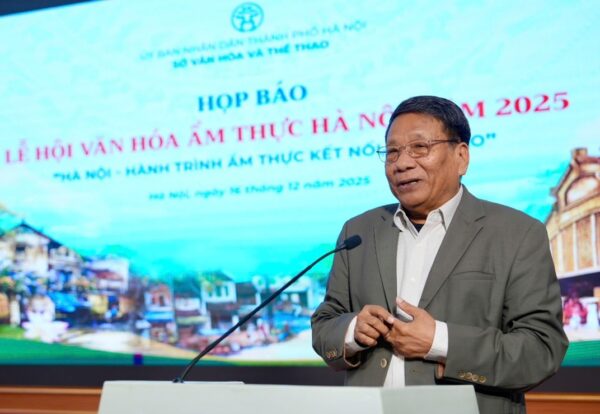
Assoc. Prof. Dr. Dang Van Bai, Vice Chairman of the National Council for Cultural Heritage, shares insights at the press conference.
The craft of making Thanh Tri steamed rice rolls (Vinh Hung Ward) once faced the risk of fading away as fewer young people pursued the trade. Today, it has recovered to around 60 production households operating under flexible business models. Similarly, the knowledge of preparing Bat Trang ceremonial feasts (Bat Trang Commune), after being inscribed, has attracted greater community attention, highlighting the traditions of 19 lineages, strong communal bonds, and distinctive dishes found only in Bat Trang.
Notably, through cooperation between the Hanoi Department of Culture and Sports, Kinh te & Do thi Newspaper, and corporate partners, many activities promoting and enhancing the value of Hanoi Pho heritage have been implemented, such as pho heritage sketching contests, short video production, and the creation of a Hanoi Pho map. These products will continue to be introduced during this year’s festival.
One of the most remarkable highlights of the Hanoi Food and Culture Festival 2025 is that, at the opening ceremony, the Ministry of Culture, Sports and Tourism will officially announce the decision to inscribe “The Knowledge of Preparing and Enjoying Cha Ca La Vong (Hanoi City)” on the National List of Intangible Cultural Heritage. The public will have the opportunity to meet representatives of the Doan family and listen to the story of six generations preserving the craft, creating a dish deeply rooted in the memory and consciousness of Hanoians.
At the press conference, Assoc. Prof. Dr. Dang Van Bai, Vice Chairman of the National Council for Cultural Heritage, emphasized that cuisine is not merely a basic human necessity but has become a form of cultural heritage that helps shape local identity and national branding in the context of tourism and cultural industry development. With Cha Ca La Vong, the heritage value lies not only in its cooking techniques or way of enjoyment, but also in its historical narrative, communal memory, and family traditions associated with the dish’s formation.
Dr. Dang Van Bai noted that Cha Ca La Vong is a typical example of how a dish can become an urban symbol, when the name of the dish is inseparably linked to the name of a street, leaving a lasting imprint on Hanoi’s physical space and collective memory. Inscription is therefore not only an act of honoring tradition, but also a foundation for safeguarding, transmitting, and sustainably exploiting heritage as a cultural and tourism resource.
Spreading the Stories of Culinary Heritage
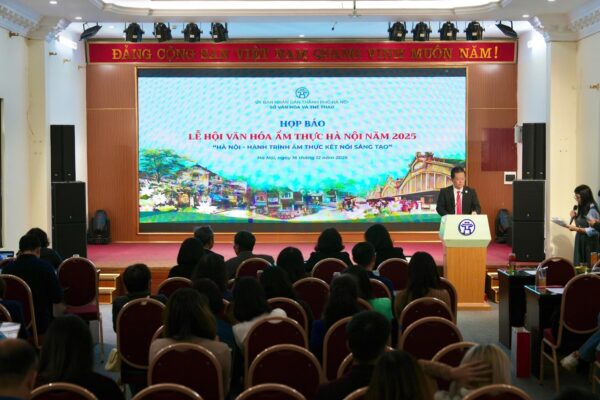
Overview of the press conference.
According to the Organizing Committee, the festival is not only a space for showcasing and enjoying cuisine, but also a platform for artisans to tell heritage stories and connect with younger generations. Many rich sideline activities will be organized, including the thematic seminar “Exchange on Enhancing Human Resource Quality – Developing Culinary Culture”, with the participation of artisans, culinary associations, and the community.
Educational institutions will also play an active role through demonstration workshops and quick competitions for pupils and students in culinary preparation under the guidance of artisans. Students from the University of Industrial Fine Arts will participate in sketching culinary products, supporting signage design, and heritage promotion.
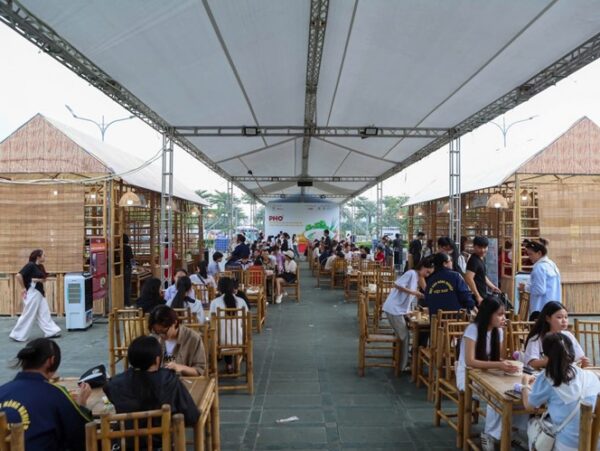
Diners enjoy Hanoi pho within the framework of the activity series “Pho – A Story of Intangible Cultural Heritage in the Flow of Creative Industries.”
Alongside culinary activities are diverse traditional and contemporary art performances such as circus acts, hat van, hat xam, and street arts; photo exhibitions promoting Vietnamese culture, tourism, and cuisine; as well as book exhibitions and mobile libraries featuring hundreds of titles for different audiences.
Within the festival framework, the public can directly participate in and experience live demonstrations of culinary heritage such as wrapping banh chung, preparing Bat Trang feasts, scenting West Lake lotus tea, making green rice flakes, cooking Phu Thuong sticky rice, cold snail noodle soup, making candied fruits and preserves, and cooking chao se. The festival space will include around 60 booths introducing Hanoi cuisine and specialties from other localities, contributing to honoring heritage values and affirming the brand “Hanoi Cuisine” associated with elegance and refinement.
With the message “Listen to the stories of culinary heritage,” the Hanoi Food and Culture Festival 2025 is expected to become an attractive weekend cultural destination, where cuisine is not only to be tasted, but also experienced as a vivid cultural journey. By connecting heritage, creativity, and community, the festival contributes to preserving traditional values while expanding the space for developing the Capital’s cultural industries in a new phase.
Acecook Vietnam is the official partner accompanying the protection and promotion of pho heritage values and the development of Hanoi’s cultural industries.
Phuong Bui
According to: https://laodongthudo.vn/le-hoi-van-hoa-am-thuc-ha-noi-2025-mo-rong-khong-gian-phat-trien-cong-nghiep-van-hoa-thu-do-203028.html?gidzl=Q3__NiH3dmTc8lbTobgQ26ac-bNT3Pe88IF_KezRcmfm8VfHqrwP2N0X-LQCMfeC9o7y13cQJrTjmqEU0m