

The program “Heritage Tourism Routes in Hanoi” will introduce four distinctive heritage journeys, offering residents and visitors a comprehensive experience of the capital. The official launch is scheduled for December 3 at Quan Thanh Temple.
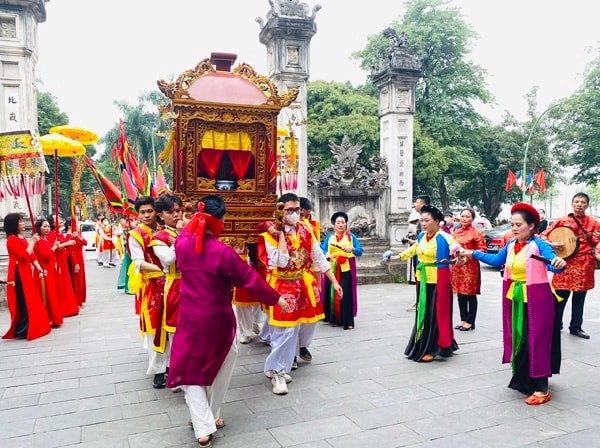
Quan Thanh Temple. Illustrative photo
The program aims to promote Hanoi’s tangible, intangible, and digital heritage through four pilot routes, supported by interactive maps, the H-Heritage application, and QR code systems at key heritage sites across central Hanoi.
The first route, “The Four Sacred Guardians of Thang Long,” guides participants through four revered temples: Bach Ma, Voi Phuc, Quan Thanh, and Kim Lien, representing the east, west, south, and north of the ancient Thang Long citadel. The journey highlights Hanoi’s sacred cultural identity and its distinctive spiritual structure, where community life and belief systems are closely intertwined.
The second route connects eight Mother Goddess temples, including the shrine of Mother Goddess Lieu Hanh and other Holy Mothers, representing the Tam Phu belief system – an intangible cultural heritage recognized by UNESCO. This route introduces rituals, music, dance, and the veneration of motherhood, with stops such as Dong Ha, Vu Thach, Ba Kieu, Xuan Yen, Dau Temple, Vong Tien, Phu Tay Ho, and the Long Bien incense tree.
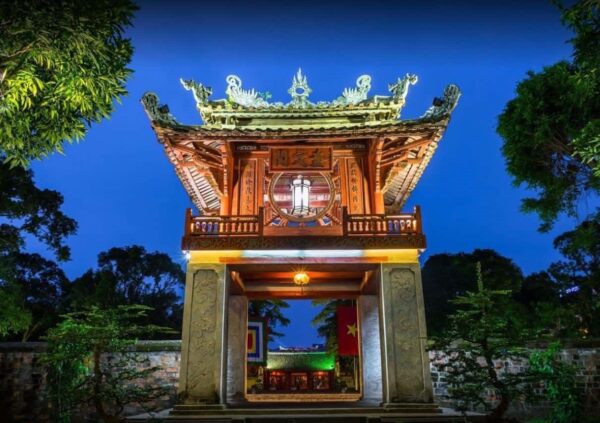
The third route, “Guild Communal Houses,” takes visitors through communal houses in Hanoi’s Old Quarter that honor the founders of traditional crafts. Each site reflects the craftsmanship and enduring creativity of ancient Thang Long, including Kim Ngan (goldsmithing), Dong Lac (traditional bodice making), Pha Truc Lam (leatherwork), Ha Vi (lacquer), Phuc Hau (mirror coating), Tu Thi (embroidery), Lo Ren (blacksmithing), and Ngu Xa (bronze casting).
The fourth route explores pagodas associated with Monk An Thien (Phuc Dien), a prominent figure in Vietnamese Buddhism. From the now-lost Bao Thien Pagoda to Lien Tri, Ham Long, and Lien Phai, the journey traces the spiritual and historical flow of Thang Long, where memory, technology, and belief converge to tell a story of loss, continuity, renewal, and heritage preservation.
These heritage routes target both domestic and international visitors and can also be integrated into extracurricular programs for Hanoi students, enabling younger generations to engage with heritage through hands-on experience and visual learning.
The initiative is part of the FEF-R Patrimoine Project, funded by the French Ministry for Europe and Foreign Affairs (via the French Embassy and the French Institute in Vietnam – IFV), and implemented in cooperation with the University of Social Sciences and Humanities – Vietnam National University, Hanoi (USSH-VNU), the French School of Asian Studies (EFEO), and partner organizations.
The “Heritage Tourism Routes in Hanoi” program was developed to identify, research, connect, and present these heritage assets to the public using modern approaches that combine academic research, student training, and digital technology.
Minh Anh