

On the morning of November 22, in Hanoi, the Department of Culture and Sports of Hanoi held a conference to review the five-year implementation of the Library Law.
Attending the conference were representatives: Dao Xuan Dung, Deputy Head of the Hanoi Party Committee’s Propaganda Department; Tran Thi Van Anh, Deputy Director of the Hanoi Department of Culture and Sports; Tran Tuan Anh, Director of Hanoi Library, and representatives from the Department of Culture Management, Legal Affairs Organization, etc. (Hanoi Department of Culture and Sports), along with representatives from the Library Department, Hanoi Department of Education and Training; representatives of Education and Training Departments, Culture and Information Departments, Cultural Information and Sports Centers, and library staff of districts, towns across the capital.
Enhancing Quality and Timely Meeting Readers’ Needs
On November 21, 2019, the National Assembly passed Library Law No. 46/2019/QH14, marking an important milestone for the library sector, opening a new era in the development of library activities and the nation’s reading culture. The Library Law demonstrates the Party and State’s attention to library work. It has specific provisions on state policies, including investment, support, and promotion of socialization. Detailed regulations on the establishment and operation of libraries have gradually enhanced their capacity to fulfill their functions and tasks, actively contributing to developing a reading culture and creating a lifelong learning environment for people, building a learning society, raising intellectual standards, and developing well-rounded Vietnamese citizens.

Deputy Director of the Hanoi Department of Culture and Sports, Tran Thi Van Anh, speaking at the conference.
In her opening remarks, Deputy Director Tran Thi Van Anh stated that following the Library Law’s issuance, the Hanoi Department of Culture and Sports advised the Hanoi People’s Committee to issue a plan to implement the Library Law and related guidance documents.
Over five years, the Library Law has positively changed the responsibilities of all levels, sectors, and the whole society in timely, coordinated, unified, and effective implementation to develop various types of libraries, meeting the learning, research, and entertainment needs of all social classes. Hanoi Library has gradually upgraded to adequately and promptly provide books, newspapers, magazines, and other materials according to readers’ needs.
“Frankly acknowledging the existing limitations to continue proposing solutions to enhance the effectiveness of the Library Law’s implementation, Tran Thi Van Anh noted that there remains much room for levels, sectors, and localities to implement the Library Law to develop the library system and network, thereby enhancing the reading culture for the capital’s residents”.

Chief of Culture Management Department (Hanoi Department of Culture and Sports) Le Thi Hong Hanh reporting on the five-year implementation of the Library Law.
In the report on the five-year implementation of the Library Law, Le Thi Hong Hanh stated that the department had advised on the issuance of Resolution No. 07/2023/NQ-HDND on July 4, 2023, by the Hanoi People’s Council regarding the fees and charges under the city council’s decision-making authority, whereby library usage fees at public libraries in Hanoi were waived to encourage and develop the reading culture of the capital’s residents.
The waiver of library usage fees at public libraries in Hanoi has positively impacted library users, with a significant increase in library card registrations, thereby encouraging readers to enjoy reading printed books and visit libraries more often. This is a socially meaningful and humane aspect of the Library Law and the effectiveness of its implementation by the Hanoi People’s Committee in enacting state and city policies on developing the reading culture.
“With the goal of developing Hanoi Library into a central modern library and district, town libraries as satellite libraries through state funding and socialized resources, thereby promoting the development of the public library system in the city, igniting the need for reading and developing the reading culture among the capital’s residents; contributing to improving the cultural and spiritual life of the people, towards building elegant and civilized Hanoians”.
Positive Changes in Library Implementation at All Levels
During the conference, Hanoi Library Director Tran Tuan Anh shared that, with the efforts of staff, libraries at all levels have achieved certain accomplishments in storing and preserving valuable documents; building a reading movement, maintaining, and developing the reading habit among the capital’s population. This contributes to improving intellectual standards, spreading and applying science and technology to labor and daily life, moving towards a more civilized and better society and country.
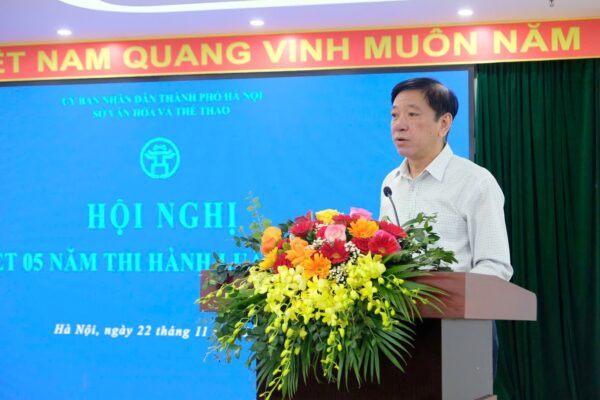
Tran Tuan Anh, Director of Hanoi Library, speaking at the conference.
The implementation of the Library Law and its guiding documents has facilitated the effective execution of the city’s policies, programs, and initiatives on library cooperation to develop the reading culture among the capital’s population as directed by the Hanoi People’s Committee.
“The issuance of the Library Law demonstrates the Party and State’s attention to library work, with specific provisions on state policies for the development of the library sector, including investment, support, and socialization. Detailed regulations on the establishment and operation of libraries have gradually enhanced their capacity to fulfill their functions and tasks, actively contributing to the development of the reading culture and creating a lifelong learning environment for the people, building a learning society, raising intellectual standards, and fostering comprehensive Vietnamese citizens.”
Statistically, currently, there are 29 district libraries, 53 commune libraries, 1,096 grassroots libraries, and reading rooms, and 15 private libraries serving the community in Hanoi. Annually, district libraries participate in reading culture development activities organized by the city, such as activities to celebrate Vietnam Book and Reading Culture Day, attracting many readers and students from districts and towns. Notably, in 2024, 28 out of 30 districts and towns organized events that attracted nearly 500,000 readers.

Do Phan Khoi, Deputy Director of Phuc Tho District’s Cultural Information and Sports Center, speaking at the conference.
Do Phan Khoi, Deputy Director of the Phuc Tho District’s Cultural Information and Sports Center, noted that the district has paid great attention to developing libraries in schools, village and neighborhood bookcases, and training library staff. The district has particularly focused on building “smart cultural houses” in villages and neighborhoods, including libraries and reading rooms. The district plans to implement pilot projects in advanced new rural communes and exemplary new rural communes, building “reading villages” in communes across the district.
Despite the achievements, challenges remain in implementing the Library Law and the conditions ensuring its enforcement. For example, Hanoi Library currently lacks specialized vehicles for mobile library services and book circulation. The lack of modern equipment for digital and electronic library development and limited funding for annual document digitization hampers the construction of digital databases.
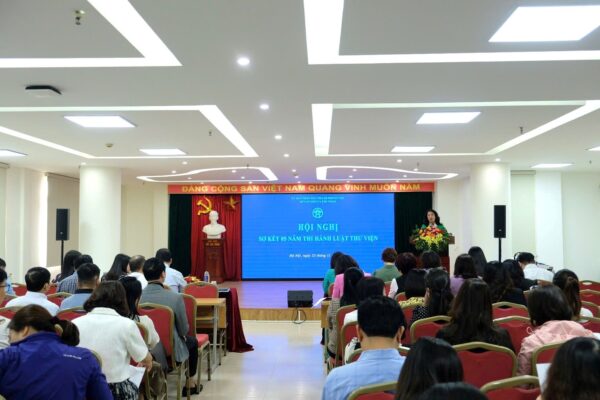
Conference scene
At the district level, most libraries face difficulties regarding facilities and IT equipment for professional activities. Some district libraries receive low, unstable funding, affecting their professional activities. The application of IT in district library operations is slow and ineffective. Many staff members have additional responsibilities, affecting library operations.
At the commune level, there is generally little attention or investment in library activities. Human resources are unstable and lack professional expertise. Some private libraries serving the community have limited expertise, so their materials are not processed and organized scientifically according to library procedures.
In the future, the Hanoi Department of Culture and Sports intends to continue enhancing communication and promoting the 2019 Library Law and library activities in the city to attract the interest and participation of all levels, sectors, social organizations, and the capital’s population. Increasing investment in funds and human resources for developing the reading culture of the public library system, especially at the district, commune, and grassroots levels. Encouraging the development of community library models, mobile bookcases, and diverse reading spaces to better serve the needs of the people./.
Minh Ly
https://nguoihanoi.vn/ha-noi-chu-trong-day-manh-phat-trien-van-hoa-doc-tien-toi-xay-dung-nguoi-ha-noi-thanh-lich-van-minh-88245.html