
The Vietnam Sports Delegation won a total of 278 medals, including 87 gold, 81 silver, and 110 bronze, maintaining its position among the region’s leading teams. Within this, Hanoi sports continued to assert its position and play the role of the nation’s leading sports center by winning 79 medals.
Affirming the leading role
At SEA Games 33, Hanoi sports had 169 athletes participating out of the total 841 athletes of the Vietnam Sports Delegation (accounting for 20.10%). With the spirit of being a pioneering unit in the country for many years, Hanoi athletes competed impressively and won important medals for the Vietnam Sports Delegation.
Specifically, Hanoi’s gold medals came from a wide range of events, spanning Olympic and Asian Games sports to traditional martial arts and team sports such as taekwondo, rowing, bocce, chess, karate, gymnastics, athletics, shooting, sepak takraw, bowling, wushu, kickboxing, fencing, wrestling, handball, muay, football, and boxing. These are all disciplines with a rich track record, a large pool of athletes, and a systematic training system in the capital.

Hanoi athlete winning the men’s team sabre gold medal at SEA Games 33.
Notably, most of Hanoi athletes’ gold medals came from Olympic sports – a group identified as a pillar in the strategy to elevate Vietnamese sports. Prominent names include Dinh Phuong Thanh (gymnastics), Ha Thi Linh (boxing), Nguyen Xuan Thanh (taekwondo), Hoang Thi Minh Hanh and Nguyen Thi Hang (athletics), Phung Viet Dung (shooting), Can Tat Du, Nguyen Huu Dinh (wrestling), Dinh Thi Hao (rowing), Dinh Thi Huong (karate)…
In addition, Hanoi athletes continued to play a “backbone” role in many national team squads. From the women’s futsal team, U22 men’s team, men’s four-player sepak takraw team to the women’s handball team, the core members are athletes trained through Hanoi’s sports system, significantly contributing to the outstanding achievements of the teams, including many convincing gold medals.
Concluding SEA Games 33, Hanoi sports won 29 gold, 23 silver, and 27 bronze medals, accounting for 33.33% of the Vietnam Sports Delegation’s total gold medals. This figure not only reflects the quality of the athlete pool but also demonstrates the depth of training and stability of Hanoi’s strong sports disciplines.
Sustainable development through breakthrough policies
The remarkable achievements at SEA Games 33 further affirmed Hanoi sports’ pillar role in the national high-performance sports system. Not only is it a “cradle” supplying quality athletes for national teams, Hanoi sports also demonstrates strategic vision and systematic approaches in developing elite sports alongside mass physical training.
According to Hanoi Department of Culture and Sports Deputy Director Pham Xuan Tai, the results at SEA Games 33 are the outcome of deep investment, especially in the 2023-2025 period with a series of breakthrough mechanisms and policies. Notably, the preferential policy system for high-performance athletes and coaches, when the Hanoi People’s Council issued Resolution No. 13/2023/NQ-HDND and continued with Resolution No. 65/2025/NQ-HDND dated November 27, 2025, stipulating certain contents and spending levels in high-performance sports in Hanoi (effective January 1, 2026), provides an important legal framework for investment and care for elite sports forces.
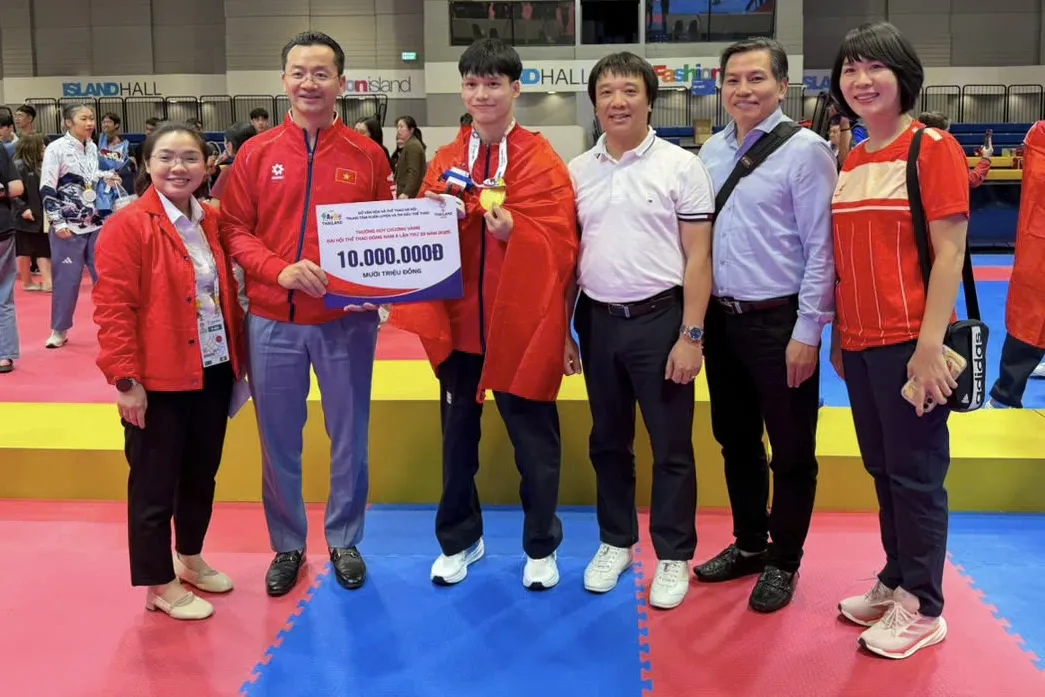
Hanoi Department of Culture and Sports Deputy Director Pham Xuan Tai awarding Hanoi athletes who won gold at SEA Games 33.
“The Resolutions clearly define long-term support for outstanding athletes, especially those who earn the right to participate in the Olympics or the FIFA World Cup, with support of up to VND 17 million per month throughout the 4-year cycle. Reward policies for achievements at world, Asian, and regional championships are also specified, with group 1 world gold medalists receiving monthly support of VND 13-17 million. Coaches of high-achieving athletes receive half of the athlete’s support level, and the city also supports athletes who have contributed for over five years but are no longer able to compete,” said Pham Xuan Tai.
In addition to preferential policies, Hanoi is implementing a long-term sports development strategy through 2030, with a vision toward 2045, via Plan No. 151/KH-UBND implementing the Directive of the Hanoi Party Standing Committee on strengthening Party leadership over the capital’s physical training and sports. Accordingly, the targets by 2030 are that 50% of the population regularly exercises, Hanoi maintains the top position at the National Sports Games, and contributes at least 30% of athletes for the Vietnam Sports Delegation at SEA Games. The city also focuses on investing in regional sports centers and international-standard facilities, ready to host continental and world competitions.
Furthermore, the development of sports infrastructure and grassroots facilities continues to be promoted through Resolution No. 07/2024/NQ-HDND on supporting the effectiveness of the cultural-sports system in building new rural areas. Notably, the investment initiative for the Red River Landscape Avenue Project and the Olympic Sports Urban Subzone Planning, approved by the Hanoi People’s Council in December 2025, opens expectations for a modern sports space capable of hosting major international events.
Importantly, Hanoi is actively leveraging the “boost” from the 2024 Capital Law (effective 2025) to prioritize resources for talent training, promote public-private cooperation in managing and operating sports facilities, and attract high-quality foreign experts to directly coach the capital’s teams.
With a synchronized policy foundation, special preferential mechanisms, and long-term investment orientation, Hanoi sports is gradually building a sustainable development model, maintaining its leading role, and spreading motivation for Vietnamese sports on the journey to conquer regional and international arenas.
Mr. Pham Xuan Tai, Deputy Director of Hanoi Department of Culture and Sports
Ngoc Tu
Hanoi Sports Continues to Assert Its Position at SEA Games 33
According to “Urban Economy”