
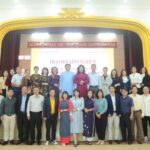
On the morning of December 4, at the headquarters of the Department of Culture and Sports of Thua Thien Hue, the Hanoi Department of Culture and Sports held an exchange with the Thua Thien Hue Department of Culture and Sports to share experiences in state management in the fields of culture and sports.
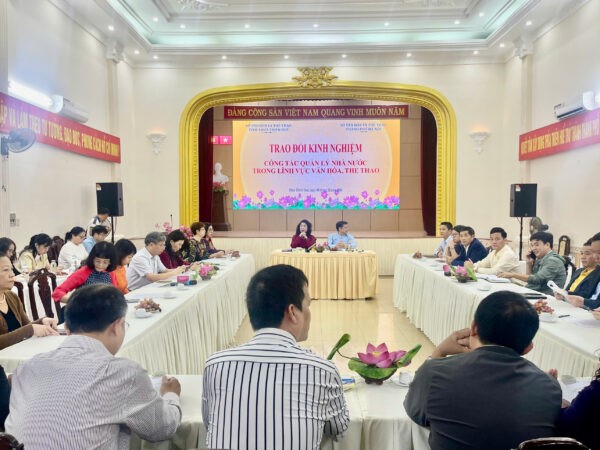
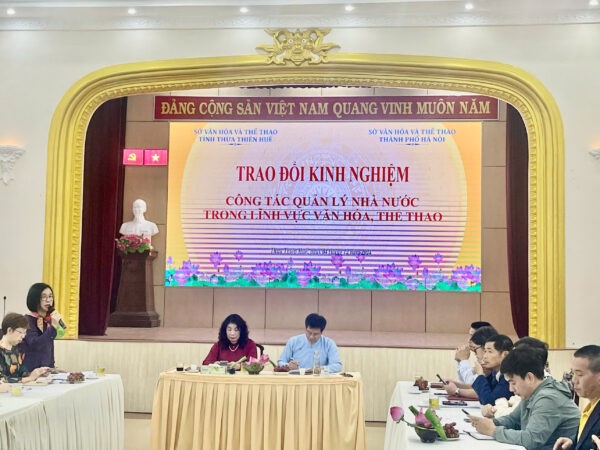
Overview of the Meeting
The delegation from the Hanoi Department of Culture and Sports was led by Ms. Tran Thi Van Anh, Deputy Director of the Department, and included leaders, officials, and staff from various specialized divisions and affiliated units.
Welcoming the delegation were Mr. Phan Thanh Hai, Director of the Thua Thien Hue Department of Culture and Sports; representatives from the province’s Department of Tourism; and representatives of several enterprises actively contributing to the development of cultural industries in the region.
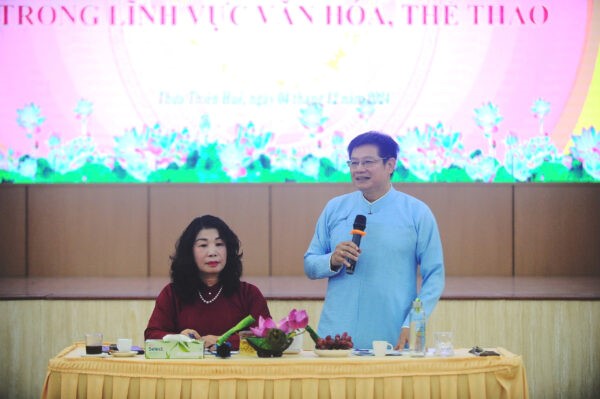
Mr. Phan Thanh Hai – Director of the Department of Culture and Sports of Thua Thien Hue province spoke at the meeting.
At the meeting, in an atmosphere of friendliness and openness, the Thua Thien Hue Department of Culture and Sports shared their experiences in management, as well as in training and developing sustainable human resources for cultural industry models. Representatives from organizations and enterprises in the fields of performing arts, heritage, creative spaces, and cultural tourism in Thua Thien Hue shared their practical experiences in promoting cultural industries. The Hanoi Department of Culture and Sports also exchanged insights on state management and sustainable human resource development for cultural industry models in localities.
Mr. Phan Thanh Hai, Director of the Thua Thien Hue Department of Culture and Sports, highlighted the department’s efforts to implement the national strategy for developing cultural industries. This includes advising the provincial People’s Committee on the issuance of directives and action plans, such as Decision No. 312/CTr-UBND, aimed at establishing Thua Thien Hue as a prominent cultural center in Vietnam and Southeast Asia by 2030, including focusing on implementing tasks to develop cultural industries within its territory. Various cultural activities have been organized to highlight the Central Arts and Cultural Space of Hue City. The province has also applied the results of the scientific research project “Building a Database on Hue Culinary Culture” to meet the requirements of tourism development and cultural industries. Furthermore, it has developed the project to establish the Hue Fine Arts Space under the Hue Museum of Fine Arts, as approved by Decision No. 2209/QD-UBND dated October 8, 2018, issued by the provincial People’s Committee, regarding the Central Arts and Cultural Space of Hue City.
Notably, the Department of Culture and Sports advised the provincial People’s Committee to issue the project “Hue – The Capital of Ao Dai” under Decision No. 678/QD-UBND dated March 29, 2023. Since 2020, numerous cultural activities have been implemented in connection with the project, including events during the Hue Community Ao Dai Week, seminars, and discussions. Ao Dai of Hue has been introduced and promoted in Hanoi and Ho Chi Minh City. The scientific dossier “Knowledge of Sewing and Wearing Hue Ao Dai” was completed and recognized as a National Intangible Cultural Heritage by the Ministry of Culture, Sports, and Tourism. Additionally, the collective trademark “Hue – The Capital of Ao Dai” was successfully designed and registered.
Regarding policies to develop culture and sports, the Department has advised the provincial People’s Committee to issue mechanisms and policies to mobilize resources for the development of heritage, culture, arts, and high-performance sports. Noteworthy examples include resolutions and projects supporting the restoration, preservation, and maintenance of relics outside the Complex of Hue Monuments through 2030; resolutions and projects supporting the development of private museums in Thua Thien Hue Province through 2030; and resolutions by the People’s Council of Thua Thien Hue Province on funding and nutritional support for coaches and athletes. Additionally, policies on rewards and incentives for athletes and coaches achieving outstanding results in national and international competitions have been established. The province has also developed and implemented the high-performance sports development plan for 2021–2025, with a vision toward 2030.
In terms of human resource development in the fields of culture and sports, the Department has focused on training and fostering cultural and sports human resources over the years. It regularly disseminates resolutions, strategies, projects, and programs from the Government, the Prime Minister, the Ministry of Culture, Sports, and Tourism, the Provincial Party Committee, and the provincial People’s Committee to build intellectual teams and develop high-quality human resources. These efforts ensure that all relevant organizations and units fully grasp and effectively implement the policies.
For high-performance sports development, the province has annually prioritized budget allocation for sports activities, including funding for training athletes and coaches. These allocations cover training courses, competitions, and specialized programs. The Department of Culture and Sports frequently collaborates with sports universities, such as the Bac Ninh Sports University and the Sports Training Center II, to invite experts for training athletes and coaches. In recent years, high-performance sports in the province have seen remarkable progress, gradually affirming its position in national, regional, and international arenas. Both achievements and the number of high-performance sports disciplines have significantly increased, particularly in national, international, and regional competitions. In 2024, athletes from Thua Thien Hue Province competed in national and international sports tournaments, winning a total of 582 medals: 157 gold, 152 silver, and 273 bronze. This exceeded the target set in Decision No. 01/QD-UBND dated January 1, 2024, by 182 medals, including 35 international medals (14 gold, 11 silver, and 10 bronze).

Ms. Tran Thi Van Anh, Deputy Director of the Hanoi Department of Culture and Sports spoke at the meeting
Comrade Tran Thi Van Anh, Deputy Director of the Hanoi Department of Culture and Sports and Head of the Working Delegation, stated that Hanoi boasts 5,922 historical and cultural relics. Among these, there is one World Heritage Site, 21 complex relic sites (comprising 93 individual relics) recognized as Special National Relics, 1,163 relics/complexes (including 1,174 individual relics) recognized as National Relics, and 1,512 relics/complexes recognized as Municipal Relics. Over 3,000 relics are yet to be classified but are listed in the inventory. Hanoi is also home to 1,793 intangible cultural heritages, including 41 recognized as National Intangible Cultural Heritages, and four recognized by UNESCO. The city has 22 private museums specializing in fields such as painting, antiquities, war remnants, and memorabilia of famous figures. Moreover, Hanoi holds a strategic position as a major center of science, technology, economy, and international trade, maintaining cooperative relationships with over 100 capitals worldwide and trade ties with more than 200 countries and territories, etc.
In 2022, the Hanoi Party Committee issued Resolution No. 09-NQ/TU on “Developing Cultural Industries in the Capital from 2021 to 2025, with an orientation toward 2030 and a vision for 2045.” Hanoi has focused on developing industries with existing potential and advantages, including cultural tourism, handicrafts, performing arts, design, cuisine, software, and entertainment games. Additionally, attention has been given to developing sectors such as advertising, architecture, cinema, television and radio broadcasting, publishing, and fashion.
To implement Resolution 09, Hanoi has reformed its thinking, enhanced awareness of cultural industries, developed and refined mechanisms and policies, and invested in human resource development. Regarding human resources, Hanoi has carried out several initiatives, including drafting a plan for overseas training and capacity building for civil servants and public employees using state budgets for 2023–2025, with a vision toward 2030. The city has organized training programs for cultural industry development in China and arranged for artists to participate in performance and art promotion trips to countries like South Korea, Russia, and France. It has also sent staff to advanced training programs, such as a capacity-building initiative for librarians under the “Reimagining Public Libraries” project in South Korea. Additionally, efforts have been made to enhance promotional and design skills for businesses in the handicraft sector by organizing 40 training sessions for 3,400 leaders and managers from rural industrial enterprises, along with 600 participants focused on product design improvement. Furthermore, the city has initiated 23 scientific tasks under the Intellectual Property Development Program, while prioritizing consultation and guidance on establishing intellectual property rights, enabling organizations and individuals to register trademarks, patents, utility solutions, and industrial designs.
Hanoi has successfully digitized 3D models of artifacts and significant components of the Van Mieu–Quoc Tu Giam (Temple of Literature) and the Hanoi Museum. It has created a series of cultural and artistic activities in the Old Quarter and former French Quarter, establishing five pedestrian street zones featuring numerous activities that attract visitors. The city has also developed innovative tourism products, including night tours that highlight traditional values, such as the “Sacred Night” tour at the Hoa Lo Prison Relic, the “Decoding the Imperial Citadel” experience, and the “36 Streets of Hanoi” tour. Other unique experiences include the “Mystical Ngoc Son” tour and various creative tourist sites. The number of visitors to relics and museums under the city’s management has grown annually, with revenue from these visits increasing tenfold – from 9 billion VND in 2008 to 90 billion VND in 2023. Hanoi has also promoted cultural, rural, and community tourism models, linking hands-on experiences with traditional craft villages in Ba Vi, Thach That, Quoc Oai, Chuong My, My Duc, and Me Linh. The city has explored tourism models aligned with local strengths, such as golf tourism and community-based health tourism in Ba Vi and Soc Son. It has also conducted feasibility studies for river tourism routes connecting attractions along the Red River and established craft village tourism models aligned with urban planning. These models provide comprehensive services, including accommodation, relaxation, and diverse experiential activities, integrated into Hanoi’s key tourism areas. A program has been launched to promote Hanoi’s intangible cultural heritages, focusing on nearly 200 iconic dishes and culinary specialties, such as pho, com (young rice flakes), bun Mach Trang, and bun cha que tre. Culinary streets and areas showcasing Hanoi’s traditional foods have been developed, and dossiers for iconic dishes like Com Me Tri and Xoi Phu Thuong are being prepared for inclusion in the National Intangible Cultural Heritage List.
Notably, Hanoi has made significant strides in joining UNESCO’s Creative Cities Network, initiating three international-level projects: (1) Successfully organizing the Creative Design Festival in 2022, 2023, and 2024, which has left a strong impression on both locals and international audiences; (2) Hosting the UNESCO Creative Cities Network Forum for Southeast Asia in November 2023, with over 20 international delegates attending; and (3) Establishing a network of young creative designers through design competitions, connecting creative spaces, universities, organizations, and individuals to foster young designers and link them with enterprises. These initiatives aim to develop creative products that contribute to the city’s creative industries.
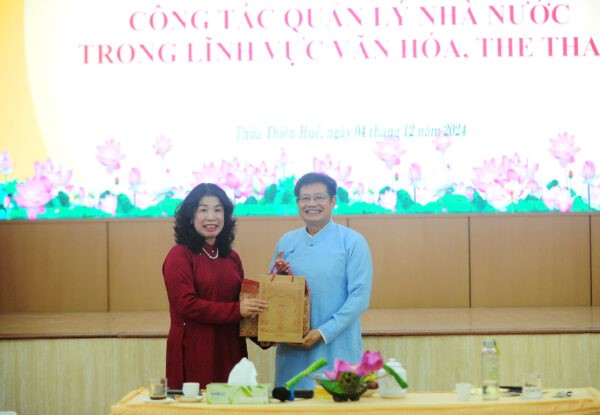
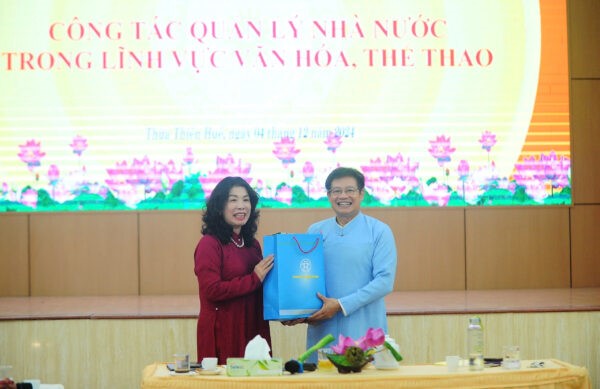
Leaders of the Hanoi Department of Culture and Sports and the Thua Thien Hue Department of Culture and Sports presented souvenirs
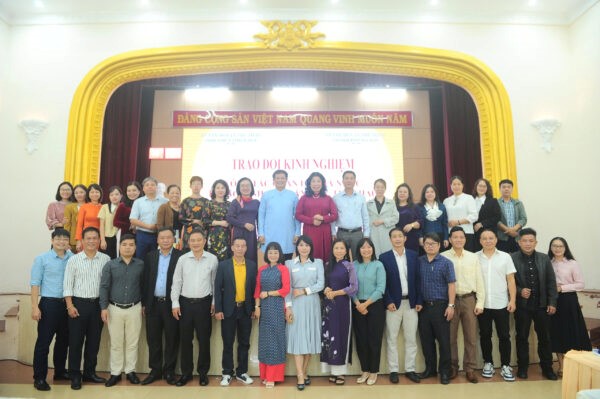
The delegation of the Hanoi Department of Culture and Sports and the Thua Thien Hue Province took a souvenir photo.
As part of the working program, the Hanoi delegation conducted field studies to learn about Thua Thien Hue’s cultural industry development models. They visited notable sites such as the Le Ba Dang Art Gallery, the Huong River Ancient Ceramics Museum, and the Imperial City of Hue.
Duc Minh