
On the morning of November 29, at the Hanoi Museum, the Hanoi Department of Culture and Sports organized the international seminar “Transforming Cultural Heritage into Assets for Cultural Industry Development”, with the participation of numerous cultural experts and scholars from Vietnam and China. The seminar aimed to identify practical solutions to transform cultural heritage resources into assets, thereby contributing to the economic growth of the Capital.
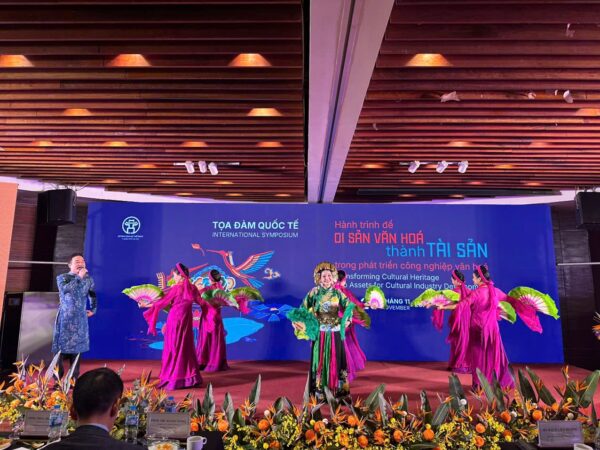
Art performance at the seminar. Photo: Hoang Lan
In her opening remarks, Ms. Bach Lien Huong, Director of the Hanoi Department of Culture and Sports, stated that while history has forged a proud Thang Long rooted in tradition, today’s digital transformation and innovation are opening a new journey for Hanoi – a journey to shape identity in an era of globalization and technologization.
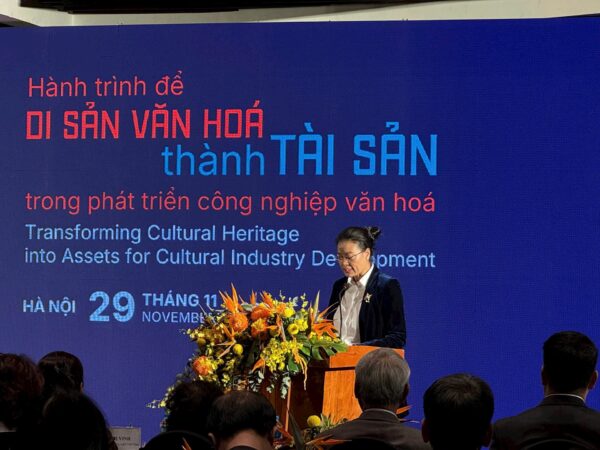
Ms. Bach Lien Huong, Director of the Hanoi Department of Culture and Sports, delivering the opening speech
With more than a thousand years of cultural heritage, Hanoi is among the localities with the highest density of heritage nationwide, comprising 6,489 historical-cultural relics, nearly 1,793 inventoried intangible cultural heritage elements, 351 national treasures, 22 non-public museums, 131 artisans honored by the State with the titles “People’s Artisan” and “Meritorious Artisan” in the field of intangible cultural heritage, and 1,350 traditional craft villages. These values are not merely “the memory of land and people,” but invaluable assets for the future – strong endogenous resources for building a creative, civilized, and modern Capital.
Thang Long – Hanoi culture is the wellspring of Vietnamese identity, a place where quintessence converges and national pride is disseminated. Heritage preservation is not about keeping the past in silence, but about ushering the past into the future. Hanoi is entering a new phase of development – one of creativity, integration, and cultural confidence. Digital transformation and innovation do not erode identity; rather, they are the means for heritage to live on and spread more powerfully, enabling traditional culture to meet modern technology and generate new vitality for Thang Long – Hanoi.
In the context of globalization and international integration, cultural industries (or creative industries) have become a global development trend and are regarded as a spearhead economic sector – one of the most important strategies for comprehensive and sustainable development and for positioning a nation’s cultural brand internationally.
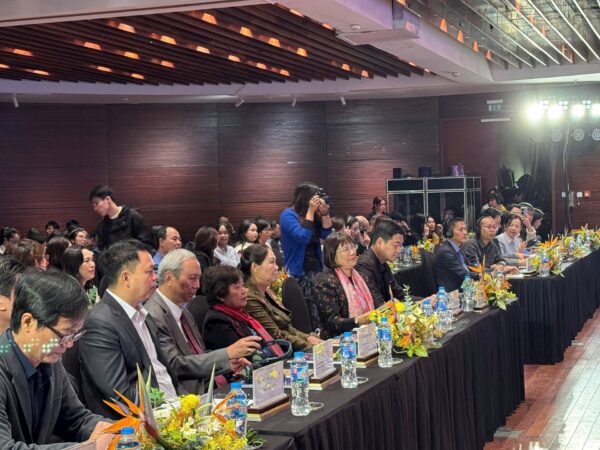
At the seminar, Vietnamese and Chinese cultural experts shared assessments and lessons from developing cultural industries and converting cultural resources into valuable assets. According to Professor Dr. Huong Dung, China and Vietnam share similar “heritage complex” structures with significant value for conservation and development. This concept emphasizes not only the protection of monuments but also the evaluation of surrounding areas. When researching and developing heritage, managers must consider the broader spatial context and how local communities’ lives interact with heritage, thereby guiding spatial reorganization, cultural tourism development, and the creation of clear economic drivers.
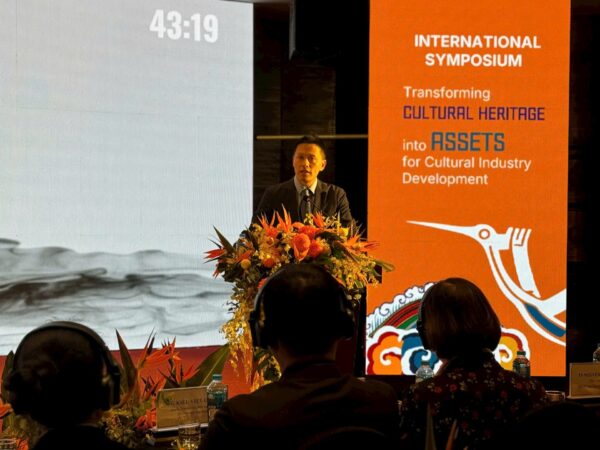
International expert sharing experience in cultural industries. Photo: Hoang Lan
Associate Professor Dr. Khu Hanh Phu shared experiences on heritage succession and cultural industry development in rural art practices. In many rural areas of China, traditional crafts have been modernized, with young people encouraged to return to rural areas to start businesses. Numerous localities have applied technology in product design, upgrading 2D products to 3D, creating effects that attract visitors.
Speaker MSc. Ly Kha Minh presented the paper “How to Harness Cultural Heritage to Promote Cultural Industry Development – A Case Study of the Ru Porcelain Brand Nhu Son Minh.” He is a representative inheritor of a National Intangible Cultural Heritage Project – Ru kiln firing techniques – and currently a Chinese Ceramic Art Artisan, as well as the founder of the Nhu Son Minh brand, a typical model combining traditional excellence with contemporary development thinking.
Sharing perspectives specific to Hanoi, Dr. Tran Thi Thuy (Institute for Asia-Pacific Studies, Vietnam Academy of Social Sciences) emphasized that the development of Hanoi’s cultural industries should be situated within the overall cultural and socio-economic development strategy of the Capital, and aligned with Vietnam’s national cultural industry strategy. Alongside potentials and opportunities, she identified key bottlenecks, including insufficient awareness of the role of cultural industries; limited skills in building models suited to local cultural characteristics; weak socialization mechanisms to attract private resources; shortages of high-quality human resources; and fragmented technological infrastructure and cultural heritage databases.
From this analysis, Dr. Tran Thi Thuy proposed that Hanoi continue to develop training programs for local levels on leveraging cultural heritage as assets; research and establish indicators to measure contributions across cultural industry sectors; and build an integrated digital data bank for cultural heritage.
The seminar provided a forum for researchers, international experts, educators, managers, and organizations active in cultural industries to exchange experiences and promote heritage values as drivers of cultural industry development. This, in turn, fosters cooperation toward economic, cultural, and social development and the cultivation of high-quality, sustainable human resources.
Following the academic presentations, the seminar transitioned to an open dialogue session – a space for perspectives, experiences, and shared concerns surrounding the journey of turning heritage into assets, engaging speakers and invited experts who are directly involved in research, teaching, and practical implementation.
Kim Hoang