

Quynh Lam Communal House features a main architectural layout resembling the Chinese character “Nhi” (meaning “double horizontal line”), consisting of the Dai Bai (Front Hall) and Hậu Cung (Rear Sanctuary). Within its premises, there is also a Van Chi house (a structure dedicated to literature and education) and other auxiliary buildings. From the outside, the Dai Bai is constructed in a traditional three-bay, two-wing style with double-sloping tiled roofs and solid gable-end walls. Inside, the structure is supported by four sets of trusses resting on six rows of columns. The trusses in the central bay are intricately designed with an upper beam bracket system, superimposed purlins, and decorative brackets. The Van Chi house stands out with its single-story, one-bay, two-wing design.
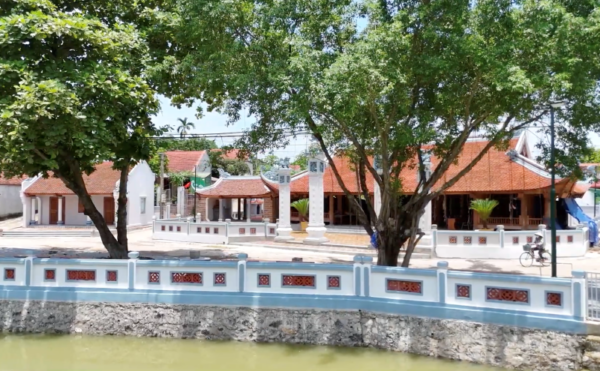
Quynh Lam Communal House After Restoration and Renovation
Quynh Lam Communal House is dedicated to the village’s tutelary deity, the mother of Nguyen Kinh, a distinguished figure in the nation’s history and a founding meritorious official of the Mac Dynasty. Through many turbulent wars, Nguyen Kinh rendered significant services to the Mac Dynasty and was conferred the titles of Grand Marshal (Thai Uy) and Duke of the Western Region (Tay Quoc Cong).
The Van Chi within the communal house complex honors Le Huu Ta, a Minister of the Nguyen Dynasty from Dong Vien Village, Dong Quang Commune. Nearby, Me Shrine, located on Me Hill, is dedicated to the local tutelary deity Nham Lang Dai Vuong, a mountain god associated with the indigenous spiritual beliefs of the Ba Vi Mountain area. According to historical records, Quynh Lam Communal House was initially constructed in the late 16th or early 17th century. It was later destroyed by fire, resulting in the loss of the original lore about the deity. The communal house was rebuilt in the 12th year of Emperor Tu Duc’s reign (1859). On April 6, 2022, the Hanoi People’s Committee issued Decision No. 1186/QD-UBND, recognizing the Quynh Lam Communal House and Me Shrine complex as a Provincial- and Municipal-Level Historical and Architectural Heritage Site.
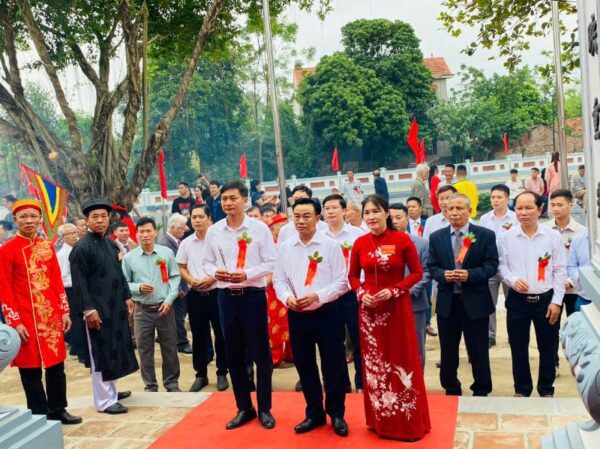
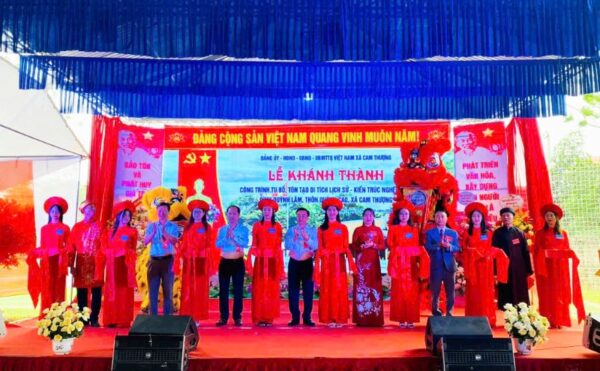
The delegates performed the incense-offering ceremony and cut the ribbon at the inauguration.
Over the course of wars and historical changes, despite undergoing multiple renovations, Quynh Lam Communal House has retained nearly intact its original architecture from the 12th year of Emperor Tu Duc’s reign (1859). Notably, with the support of the State, in 2023, the Ba Vi District People’s Committee approved and implemented a project to restore and renovate the Quynh Lam Communal House, funded by municipal support. According to the project plan, the restoration included various components such as the ceremonial gate, the main communal house (comprising the Dai Bai and Hau Cung), the Van Chi, the sedan chair storage house, the kitchen, the incantation paper-burning shrine, the communal house pond, and other auxiliary structures. The total investment for the project amounted to 30 billion VND. After nearly two years of implementation, the project was completed on schedule. All components were constructed with high quality, ensuring technical precision, artistic value, and adherence to traditional architecture. The renovation not only safeguards the historical and cultural significance of the site but also meets the spiritual and cultural needs of the local community.
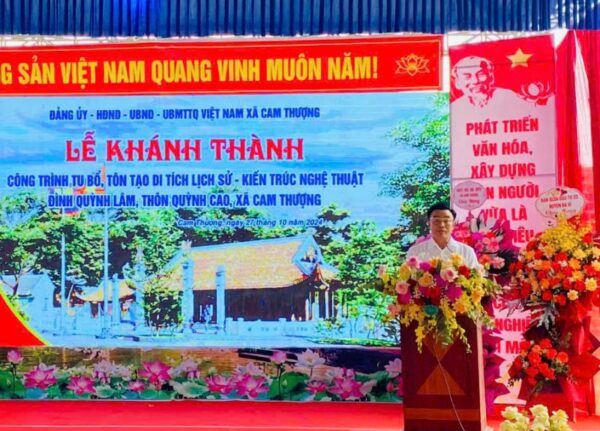
Chairman of the Ba Vi District People’s Committee, Tran Quang Khuyen, delivered a speech at the ceremony.
Speaking at the inauguration ceremony, Vice Chairman of the Ba Vi District People’s Committee, Tran Quang Khuyen, extended congratulations and acknowledged the efforts of the Party committees, authorities of Cam Thuong Commune, and particularly the people of Quynh Cao Hamlet, in preserving the national and local heritage. To ensure the site serves as both a communal space for spiritual and cultural activities and a venue for promoting revolutionary traditions and the moral principle of “drinking water, remember its source,” the Vice Chairman urged local Party committees, authorities, and residents to continue preserving and enhancing the value of the heritage site cluster in the coming time. He emphasized the importance of intensifying the dissemination and implementation of legal regulations on heritage management and protection, raising public awareness, and fostering a sense of responsibility among residents in safeguarding and promoting the historical value of the Quynh Lam Communal House – Me Shrine complex.
BV