
Creating High-Value Cultural Products and Services
Hanoi is preparing to develop a creative ecosystem as the Draft Resolution on the organization and operation of cultural industry centers is being widely circulated for public and community feedback.
The Draft Resolution proposes a comprehensive legal framework for the establishment, management, and operation of cultural industry centers, where traditional cultural heritage is connected with modern technology to produce high-value cultural products and services.
|
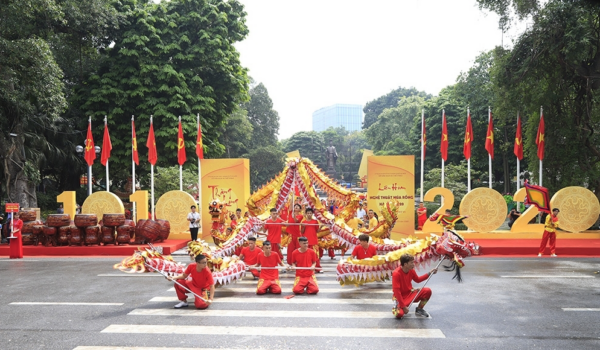
Dragon Dance Art Festival in Hanoi |
According to the Draft, a cultural industry center is defined as “an area with a clearly defined geographical boundary, specializing in activities in the cultural industry.” These centers can be established under organizational models such as enterprises, public non-business units, or cooperatives.
This is considered an important step to facilitate the conversion of old, inefficiently used facilities into new cultural creative spaces while attracting investment in the cultural industry – a new economic driver of the capital.
Cultural industry centers operate according to the principles of compliance with Hanoi city laws and regulations; ensuring sustainable development, combining preservation and promotion of traditional cultural values with innovation; developing under a market mechanism with State management; ensuring balanced interests between the State, enterprises, organizations, individuals, and the community.
The fields of operation for cultural industry centers include advertising, architecture, software and entertainment games, handicrafts, design, cinema, publishing, fashion, performing arts, fine arts, photography and exhibitions, television and radio, and cultural tourism.
Regarding resources, the Draft Resolution clearly states the combination of State and private resources to invest in and develop infrastructure, services, and cultural products; harmonizing the interests of the State, and the legal rights and interests of enterprises, organizations, and individuals. Investment in cultural industry development is investment in people and sustainable development. Investment efficiency is calculated in a balanced, long-term manner over the overall interests of the State, enterprises, organizations, individuals, and society as a whole.
Leverage for Cultural Industry Development
The model of cultural industry centers has proven successful in many countries such as South Korea, Japan, and China. Accordingly, in providing feedback on the Draft Resolution on the organization and operation of cultural industry centers, many citizens believe that this is necessary in the current context and will bring breakthrough opportunities for the capital’s cultural industry.
Ms. Nguyen Thi Mai (Ha Dong District), working in the field of translation, expressed: “I fully support the regulations on the organization and operation of cultural industry centers as stipulated in the Draft Resolution, Clause 7, Article 21 of the Capital Law. These regulations will ensure harmony between preservation and development, promoting the potential, strengths, and traditional cultural values of the capital.
At the same time, they will combine traditional cultural elements with modern technology to create unique products in line with international integration trends, absorbing global cultural quintessence, contributing to nurturing and developing the cultural value system of Thang Long – Hanoi, building sophisticated and civilized Hanoians, making Hanoi a ‘Creative City,’ and promoting and enhancing the position and image of the capital and Vietnam regionally and globally.”

Developing the cultural industry creates opportunities for Hanoi’s Traditional Craft Villages.
Sharing the same view, Mr. Bui Van Chu (a young designer living in Hanoi) said that Hanoi is inherently rich in cultural traditions, with thousands of heritage sites, craft villages, contemporary art spaces, and a large community of artists and creators. However, the conversion of cultural values into concrete products with high economic value remains limited.
“The cultural industry center will act as a ‘conductor’ connecting resources: Artists – enterprises – authorities – investors to create market-viable creative products. The cultural industry center will provide an environment for artists and creators to express innovative ideas, develop cultural products, and promote the application of technology in production and distribution,” Mr. Chu shared.
Hanoi has many preferential policies and support mechanisms for cultural industry development. Specifically, the City prioritizes planning and land allocation; prioritizes investment in cultural industry infrastructure; mobilizes resources to implement cultural industry development projects to hand over or lease to cultural industry centers; prioritizes consideration of converting the function of public assets into new cultural creative spaces to develop cultural industry centers.
Cultural industry centers are considered for land lease exemption or reduction under laws on socialization encouragement policies. Organizations and individuals producing and trading within cultural industry centers are supported by the City’s budgets at all levels in loan interest for production and business investment; supported in training and fostering high-quality human resources in cultural industries; supported to participate in the City’s investment, trade, and tourism promotion programs.
In addition, the City supports creative startups through funding programs and business incubators, as well as encourages public-private cooperation in cultural industry development. This is an important policy that allows creative initiatives to be realized and developed sustainably.
These breakthrough policies, when applied in practice, will create momentum for the capital’s cultural industry to achieve a breakthrough in the near future.
“I fully support the policies from the Draft Resolution. The government’s support in land planning and infrastructure is highly commendable. When organizations and individuals producing and trading in cultural industry centers are considered for land lease exemption or reduction; and supported by the City’s budgets at all levels in loan interest for production and business investment, it will help many young enterprises in the cultural field reduce financial burdens in the early startup phase,” said Ms. Nguyen Thi Ngoc Linh, Hai Ba Trung District.
N.Hoa