
On the morning of January 29, at the Hanoi Museum, the Hanoi Department of Culture and Sports hosted the international symposium “The Journey to Turn Cultural Heritage into Assets” within the context of developing cultural industries. The event brought together cultural experts and scholars from Vietnam and China, aiming to identify practical solutions for transforming cultural-heritage resources into valuable assets that contribute to the capital’s economic growth.
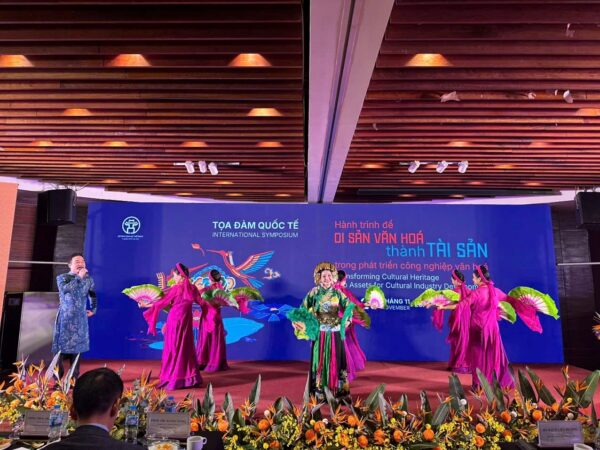
Art performance at the symposium. Photo: Hoang Lan
In her opening remarks, Bach Lien Huong, Director of the Hanoi Department of Culture and Sports, emphasized that if history gave Thang Long its proud legacy, then today’s digital transformation and creative innovation are opening a new path for Hanoi, a journey toward shaping its identity in an era defined by globalization and technology.
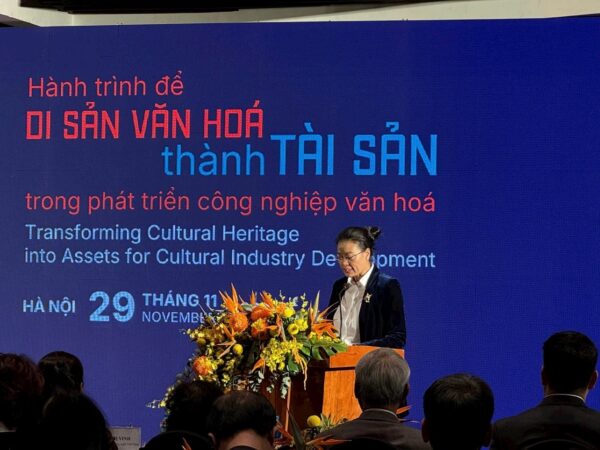
Director of Hanoi Department of Culture and Sport, Bach Lien Huong (representing the host organization) delivers the opening speech.
With more than a thousand years of cultural heritage, Hanoi possesses one of the highest densities of heritage sites in the country: 6,489 historical and cultural relics; nearly 1,793 intangible cultural heritage elements documented; 351 national treasures; 22 non-public museums; 131 artisans honored with the State titles “People’s Artisan” and “Meritorious Artisan” in intangible cultural heritage; and 1,350 traditional craft villages.
These values are not merely the “memory of the land and its people”, they are priceless assets for the future, a powerful internal resource for building a creative, civilized, and modern capital.
The cultural identity of Thang Long–Hanoi is a vital source of national character, a place where cultural essence converges and pride radiates outward. The purpose of heritage preservation is not to confine the past in silence, but to carry it into the future. Hanoi today is entering a new phase of development, an era of creativity, integration, and cultural confidence. Digital transformation and innovation do not erode identity; they are the means by which heritage remains alive and spreads more widely, allowing ancient culture to meet modern technology and breathe new life into Thang Long-Hanoi.
In the current context of globalization and international integration, cultural industries, also known as creative industries, have become a global development trend, regarded as a key economic sector and one of the most important strategies for achieving comprehensive and sustainable development while positioning each nation’s cultural brand on the international stage.
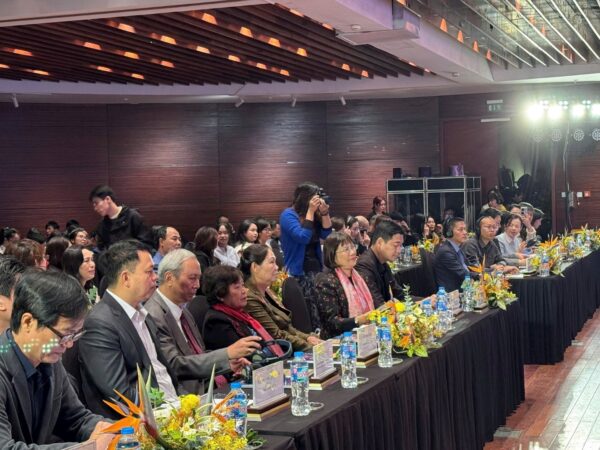
At the symposium, cultural experts from Vietnam and China shared assessments and lessons from their experience developing cultural industries and transforming cultural resources into valuable assets. According to Professor Huong Dung, China and Vietnam share similar “heritage complexes,” which hold significant potential for preservation and development. A “heritage complex” refers not only to individual sites that require protection but also to the broader surrounding environment. When researching and developing heritage, managers must consider how the surrounding living space and local communities influence the site, enabling them to reorganize spatial planning, design cultural tourism, and create clear economic drivers.
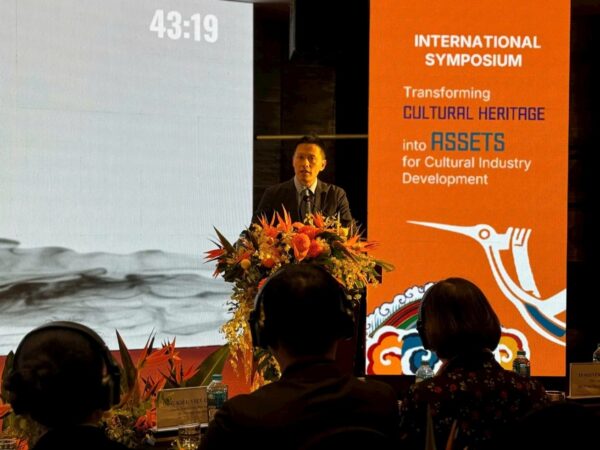
International expert sharing cultural-industry experience. Photo: Hoang Lan
Associate Professor Khu Hanh Phu discussed heritage continuity and the development of cultural industries through rural arts. In many rural areas of China, traditional handicrafts have been modernized, and young people are encouraged to return to their hometowns to start businesses. Technology has also been widely applied: many 2D craft designs have been upgraded to 3D, creating attractions that draw tourists.
Speaker Ly Kha Minh presented the paper “How to Harness Cultural Heritage to Promote Cultural-Industry Development – A Case Study of the Nhu Son Minh Ceramics Brand.” Ly Kha Minh is a representative inheritor of China’s National Intangible Cultural Heritage Project for Nhu ceramics firing techniques, a recognized Ceramic Arts Artisan, and founder of the Nhu Son Minh brand, a model that successfully blends traditional craftsmanship with contemporary development thinking.
Sharing insights for Hanoi, Dr. Tran Thi Thuy (Institute for Asian-Pacific Studies, Vietnam Academy of Social Sciences) noted that the development of Hanoi’s cultural industries must be placed within the city’s broader cultural and socio-economic strategies and aligned with Vietnam’s national cultural-industry strategy. In addition to identifying opportunities, Dr. Thuy highlighted several “bottlenecks”: limited understanding of cultural-industry roles; insufficient skills for building models suited to local identity; inadequate social-mobilization mechanisms to attract private investment; shortages of high-quality human resources; and fragmented technological infrastructure and heritage-data systems.
From this analysis, Dr. Thuy recommended that Hanoi continue developing training programs for local authorities on how to leverage cultural heritage as assets; study the creation of measurement indicators for cultural-industry sectors; and work toward building a unified digital database of cultural heritage.
The symposium served as a platform for researchers, international experts, educators, managers, and organizations working in cultural industries to exchange experiences and explore how cultural heritage values can become resources that drive cultural-industry development. It also aimed to strengthen cooperation to promote economic, cultural, and social progress while fostering sustainable, high-quality human-resource development.
Following the academic presentations, the symposium shifted to an open dialogue session, a space for perspectives, experiences, and concerns surrounding the journey of transforming heritage into assets, shared directly with the speakers and expert guests who continue to study, teach, and implement these efforts in practice.
Kim Hoang