
Building on four consecutive years of success, the Hanoi Tourism Ao Dai Festival has continued to affirm its role as a signature annual cultural gathering, attracting thousands of participants. Each year, the festival adds a new chapter to the ongoing journey of bringing heritage to life in contemporary society, nurturing national pride and a deep affection for the Vietnamese ao dai.
This year, the Hanoi Tourism Ao Dai Festival 2025 was held at the Hanoi Museum, whose entire grounds were transformed into a miniature “ao dai city.” More than 80 meticulously curated exhibition booths brought together designers, fashion brands, weaving, embroidery, and silk craft villages, along with artisans from across the country. Visitors had the opportunity to admire ao dai collections rich in Vietnamese cultural identity, ranging from traditional court attire to modern designs inspired by Hanoi’s autumn hues.
The opening night, titled “Hanoi Ao Dai – Shining the Essence of Heritage,” held on the evening of November 7, marked a major highlight of the festival, elevating the ao dai to the realm of performance art. Under shimmering lights and traditional music, models, artists, and designers collectively conveyed the spirit of “heritage connection,” turning the Hanoi Museum stage into a symphony of Vietnamese culture.

Ao dai performance at the press conference introducing the event. Photo: Pham Linh
Beyond runway presentations, the festival expanded into a series of engaging interactive experiences. Visitors could explore the photo exhibition “Hanoi – Ao Dai Heritage,” which traces the ao dai’s journey through different historical periods, or don ready-made ao dai for photo sessions in recreated settings such as Khue Van Cac, corners of Hanoi’s Old Quarter, or golden autumn landscapes within the museum grounds.
Creative workshops, including folk embroidery, decorative motif painting, and handcrafted accessory making (woven bags, wooden clogs, bracelets, bamboo dragonflies, and more), offered participants the chance to personally “live within the heritage.” These activities created a meaningful bridge between traditional culture and youthful creativity, enabling the public, especially Gen Z, to engage with heritage in an accessible, engaging, and emotionally resonant way.
The festival space also resonated with melodies from traditional Vietnamese art forms such as ca tru, cheo, quan ho, and xam, sounds that evoke the nation’s cultural roots. Complementing these performances was a folk games area designed as a “garden of memories,” where visitors could experience games like o an quan, bamboo dancing, and tug-of-war, immersing themselves in a festive atmosphere that fosters community connection.
One of the most anticipated highlights of the festival was the ao dai parade around Hoan Kiem Lake on the afternoon of November 8, recreating the ancestral procession of the Trac Xa ao dai tailoring village, the birthplace of the renowned traditional ao dai craft of the ancient capital. Thousands of participants dressed in ao dai and traditional costumes formed a vibrant spectacle in the heart of the capital, turning Hoan Kiem Lake into a colorful “sea of ao dai.”
Amid the festival atmosphere, the mass performance “Capital Women: Integration and Development,” organized by the Hanoi Women’s Union with the participation of 350 women, conveyed a powerful message about the courage, intellect, and beauty of modern Vietnamese women.
Alongside this, the children’s program “Em Yeu Ha Noi” and the final round of the design competition “Ao Dai – Connecting Heritage” continued to spread love for the ao dai throughout the community, encouraging young creatives to take part in preserving and developing the nation’s cultural heritage.
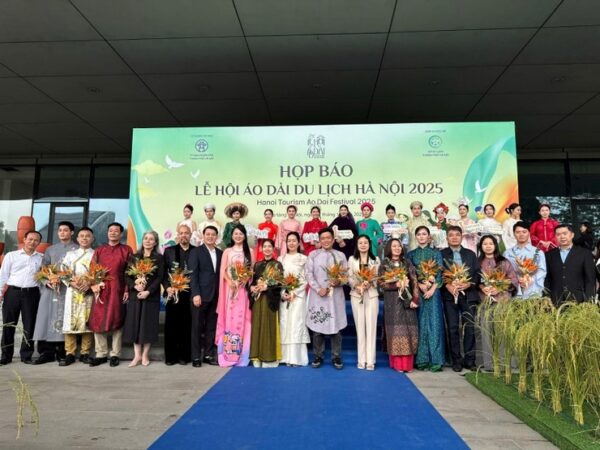
The Organizing Committee presents flowers in appreciation to designers and models. Photo: Pham Linh.
Notably, visitors could also choose the “Cham Thu Ha Noi” double-decker bus tour, an autumn journey through the Old Quarter, Hoan Kiem Lake, the Hanoi Opera House, and Long Bien Bridge, where the ao dai becomes the “language” of Hanoi’s beauty. This is one of the innovative tourism products that the capital’s tourism sector is actively developing to connect culture, fashion, and experiential travel.
The Hanoi Tourism Ao Dai Festival 2025 not only honors the ao dai as an aesthetic symbol, but also as a living cultural language, one that connects people with both past and present, linking heritage with creativity, tourism, and the economy. As flowing ao dai silhouettes dance in Hanoi’s autumn breeze, they present a portrait of a refined, modern, and proud capital, where heritage does not reside solely in memory, but lives vibrantly in the rhythm of everyday life.
Linh Anh