
A highlight of the Hanoi Food and Culture Festival 2025 is the honoring of heritage values and creative interpretations rooted in traditional cuisine.
Hanoi boasts a rich culinary treasury, an exquisite blend of Thang Long–Ke Cho sophistication, the rustic flavors of Xu Doai, and cultural exchanges with regions and countries near and far. As a result, Hanoi cuisine is diverse and vibrant, refined and distinctive, yet continuously innovative.
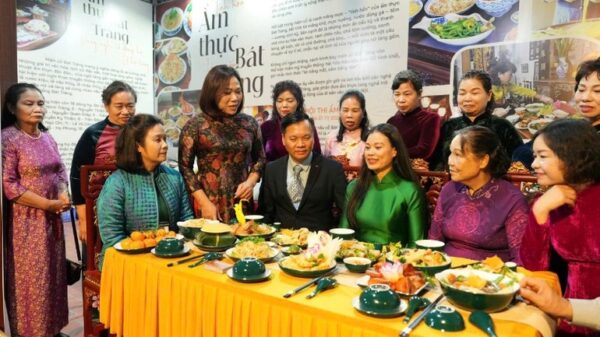
Many Hanoi culinary heritages have been inscribed on the National List of Intangible Cultural Heritage, including Hanoi pho, the craft of making Me Tri green rice flakes, the art of scenting lotus tea in Quang An, the craft of Thanh Tri steamed rice rolls, and the culinary knowledge of Bat Trang ceremonial feasts.
Delegates visit and sample Bat Trang ceremonial dishes.
At the opening ceremony, Le Thi Anh Mai, Deputy Director of the Hanoi Department of Culture and Sports, emphasized that in 2022 the Hanoi Party Committee issued Resolution No. 09-NQ/TU on developing cultural industries in the Capital. Cuisine was identified as a key sector, transforming heritage into “assets” and a sustainable driver of cultural-industry growth. The festival is a vivid testament to that policy.
Held under the theme “Hanoi – A Culinary Journey Connecting Creativity,” the festival creates a platform for artisans to tell their heritage stories and engage younger generations through seminars, culinary heritage performances, experiential competitions, photo and book exhibitions, artistic performances, and 60 culinary spaces featuring Hanoi specialties and regional cuisines.
Beyond preservation and transmission of culinary knowledge and skills, the festival also fosters creative cultural products derived from cuisine.
On this occasion, the Organizing Committee announced the decision to inscribe “Culinary Knowledge and Appreciation of Cha Ca La Vong” on the National List of Intangible Cultural Heritage. The heritage bearer is the Doan family at No. 14 Hang Son Street (now 14 Cha Ca Street, Hoan Kiem Ward), which has preserved the traditional recipe for six generations. Over time, Cha Ca La Vong has become a culinary icon of the Capital; today, 22 restaurants help spread its legacy, including Cha Ca Thang Long, Cha Ca Hang Son, Vua Cha Ca, Cha Ca Anh Vu, and Lao Ngu Cha Ca, among others.
As part of honoring culinary heritage, pho was given a prominent, dedicated space, aimed not only at deepening public understanding of Hanoi pho’s value, but also at promoting Vietnamese pho globally. As Hanoi’s partner in safeguarding and promoting pho heritage, Shimamura Masafumi, Marketing Director of Acecook Vietnam JSC, noted that a key highlight this year is the “A Thousand Words of Pride” check-in space, where residents and visitors share messages and pride in Vietnamese pho.
According to https://nhandan.vn/gioi-thieu-nhieu-dac-san-ha-noi-tai-le-hoi-am-thuc-post931658.html?gidzl=wJGZFB5FT1xdAIK_lrPn7E8jA3wY0NyOgYWjEV1NVXhxAYWwh59y6VigAptpLdySh2ekRpbkI60Mjazr6W