
Since their introduction in 2017, the two Codes of Conduct, covering officials, civil servants, public employees, and workers in Hanoi’s city agencies, as well as conduct in public spaces across the city, have been increasingly implemented in depth. Their rollout has been closely linked to the movement “All People Unite to Build Cultural Life” in residential communities, receiving active participation from agencies, organizations, and citizens from all walks of life.
To further enhance the effectiveness of these Codes, the Dai Thanh Commune People’s Committee recently organized a communication conference on “Implementing the Public-Space Code of Conduct in Connection with the All-People Cultural Life Movement and Building Elegant, Civilized Hanoians,” along with “Implementing the Code of Conduct for Officials, Civil Servants, Public Employees, and Workers in Commune-Level Agencies, and the Public-Space Code of Conduct for School Administrators, Teachers, and Staff.”
The conference attracted more than 150 participants, including officials and employees from the Party Committee, People’s Council, People’s Committee, and Vietnam Fatherland Front Committee of the commune; leaders of local hamlets; community representatives; and heads of the Women’s Union, Farmers’ Association, Veterans’ Association, and Youth Union.
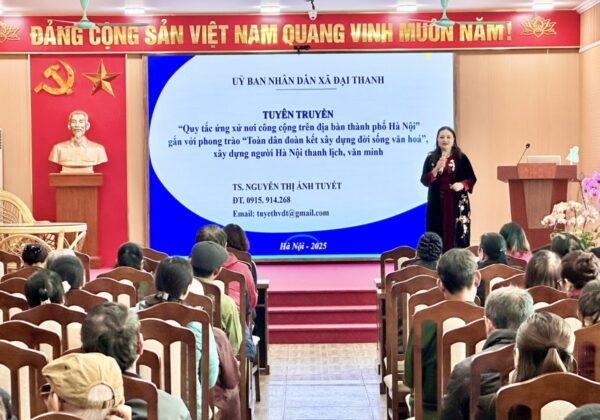
The conference drew more than 150 participants.
In previous years, the “All People Unite to Build Cultural Life” movement focused on areas such as guidance on festival organization and management; environmental cultural standards at traditional festivals; key issues in heritage-site management; and procedures for awarding titles including “Cultural Family,” “Cultural Hamlet/Residential group,” and “Outstanding Commune/Ward/Township,” aligned with the criteria of elegant and civilized Hanoians.
Through the movement, appropriate cultural models and values have been developed and replicated, closely connected to daily life. These efforts have contributed significantly to improving spiritual well-being, building a healthy cultural environment, strengthening national solidarity, and fostering patriotism, national pride, confidence, and aspirations for the development of the capital and the country in a new era.
In 2025, the commune recorded 25,176 out of 26,219 households recognized as cultural families (96%). All 21 hamlets proposed recognition as cultural hamlets (currently under public disclosure). The movement promoting a civilized lifestyle in weddings, funerals, and festivals has received strong public support, particularly in civilized funeral practices, with 120 out of 132 cases choosing cremation (90.9%).
Through the communication program, residents gained a clearer understanding of the Codes of Conduct, helping the movement become more substantive, routine, and closely integrated into daily life. The role-model responsibility of officials, Party members, and institutional leaders continues to be emphasized.
Bao Thoa