
On the morning of December 24, at the special national historical site of Hai Ba Trung Temple-Pagoda-Communal House, the Hanoi Department of Culture and Sports coordinated with the People’s Committee of Hai Ba Trung District to organize a seminar on “Enhancing the role of the community in protecting and promoting the intangible cultural heritage values of Dong Nhan Temple Festival, in Dong Nhan Ward and Bach Dang Ward, Hai Ba Trung District, Hanoi”. Attendees at the seminar included the following representatives: Mr. Do Dinh Hong, member of the City Party Committee cum Director of the Hanoi Department of Culture and Sports; Mr. Nguyen Van Nam, member of the City Party Committee cum Secretary of Hai Ba Trung District Party Committee; Ms. Nguyen Thi Thu Hien, member of the Standing Committee of the District Party Committee cum Vice Chairman of the People’s Committee of Hai Ba Trung District… Notably, the seminar was attended by many scientists and researchers: Assoc. Prof. Dr. Do Van Tru, President of the Vietnam Cultural Heritage Association; Assoc. Prof. Dr. Dang Van Bai, Vice Chairman of the National Cultural Heritage Council; Prof. Dr. Le Hong Ly, President of the Vietnam Folklore Association; Prof. Tran Lam Bien; Assoc. Prof. Dr. Tran Duc Cuong, President of the Vietnam History Science Association; Assoc. Prof. Dr. Phạm Lan Oanh, Institute of Cultural and Art Studies, Vietnam; Dr. Le Thi Thu Huong, Director of the Hanoi Institute, Hanoi Metropolitan University; Dr. Nguyen Thi Don, Vice President of Thang Long – Hanoi Cultural Heritage Association. Also attending the seminar were representatives from the Culture and Information Departments of the districts: Ha Dong, Hoan Kiem, Ba Dinh, Dong Da, Long Bien, Cau Giay, Thanh Xuan, Tay Ho, Nam Tu Liem, Bac Tu Liem; and representatives from communities where the temples honoring Hai Ba Trung interact with Dong Nhan village community.
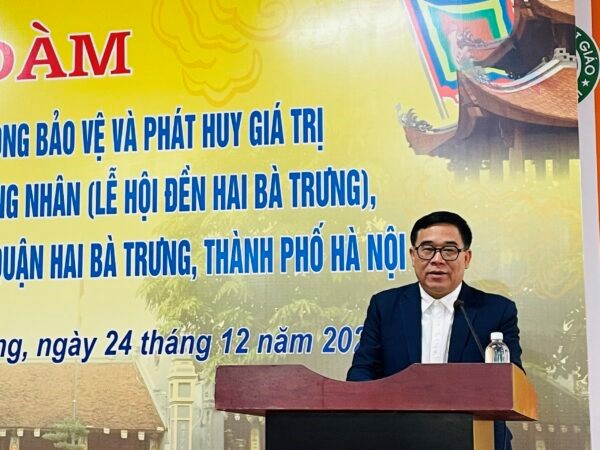
Mr. Do Dinh Hong, a member of the City Party Committee cum Director of the Hanoi Department of Culture and Sports, delivered the opening speech at the seminar.
In his opening speech at the seminar, Mr. Do Dinh Hong, a member of the City Party Committee cum Director of the Hanoi Department of Culture and Sports, stated that the capital, with a history of over a thousand years, is a place that gathers a rich treasure of cultural heritage, including 1,793 intangible cultural heritages that have been cataloged and classified into 6 categories. Traditional festivals are one of these 6 categories of intangible cultural heritage, accounting for 67% of the intangible cultural heritage identified and cataloged in the area. Traditional festivals are an inseparable part of the community’s life and have been deeply embedded in its culture for a long time. In addition to meeting cultural and religious needs, festivals also play an important role in educating traditional culture and history, and fostering the spirit of remembering one’s roots.
According to the Convention for the Safeguarding of the Intangible Cultural Heritage 2003 and the Cultural Heritage Law 2024, communities play a key role in creating, preserving, maintaining, and revitalizing intangible cultural heritage, thereby enriching cultural diversity and human creativity. Traditional festivals are spiritual activities of the community, with the local residents as the main participants. The strength of the community is embodied through ceremonial practices. Therefore, in protecting and promoting cultural heritage, particularly intangible cultural heritage, priority should always be given to the decision-making rights of the community as the bearer of the heritage for its long-term, continuous existence and practice, in alignment with the meaning and function of the heritage, and in compliance with Vietnam’s cultural heritage laws and international documents to which Vietnam is a party. The opinions expressed at the seminar will serve as an important foundation for the Hanoi Department of Culture and Sports, the Hai Ba Trung District People’s Committee, and the community to build and propose policies on the protection and promotion of traditional festivals in urban areas, and the intangible cultural heritage of the Dong Nhan Temple festival in particular.
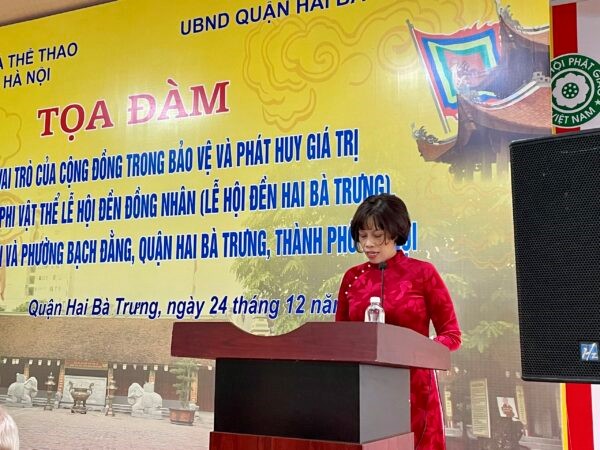
Ms. Nguyen Thi Thu Hien, a member of the Standing Committee of the District Party Committee cum Vice Chairman of Hai Ba Trung District People’s Committee, delivered a welcoming speech at the seminar.
In her welcoming speech at the seminar, Ms. Nguyen Thi Thu Hien, a member of the Standing Committee of the District Party Committee cum Vice Chairman of Hai Ba Trung District People’s Committee, shared: The district currently has 51 cultural heritage sites on the inventory list, with 35 of them being classified as heritage sites. Associated with these sites are intangible cultural practices and festivals. The district has completed the digitization of heritage site management through the electronic information portal “360° Historical and Cultural Heritage Sites of Hai Ba Trung District” and is proposing the recognition of the Hai Ba Trung Temple, Pagoda, and Communal House as a city-level tourist destination.
Dong Nhan Temple Festival is held annually by the local communities of Dong Nhan and Bach Dang wards (Hai Ba Trung District) from the 4th to the 6th of February (according to lunar calendar). The festival honors the two female heroes, Trung Trac and Trung Nhi, through traditional rituals such as water procession and offerings. Particularly, the festival has preserved the custom of “ket cha” (a form of mutual alliance) and “giao hieu” (a bonding custom), which strengthens the solidarity between localities where temples dedicated to Hai Ba Trung were located. Today, the district, in collaboration with the Hanoi Department of Culture and Sports, organized this meaningful seminar to support the dossier for recognizing Dong Nhan Temple Festival as an intangible cultural heritage. This will help raise the responsibility of individuals in the preservation and promotion of both tangible and intangible cultural heritage associated with historical sites and festivals, improve the effectiveness of state management, and contribute to the Party’s and state’s policy on preserving and promoting the cultural identity of the nation. We sincerely hope to receive valuable contributions and discussions from the seminar participants, especially from scholars, historians, and cultural researchers, to further clarify the protection and enhancement of the intangible cultural heritage values of Dong Nhan Temple Festival (Hai Ba Trung Festival) of Dong Nhan and Bach Dang wards, especially in terms of the scientific community’s input. The seminar, “Enhancing the Role of the Community in the Protection and Promotion of the Intangible Cultural Heritage of Dong Nhan Temple Festival,” attracts a large number of scholars, managers, and local communities to exchange ideas about the cultural and historical value of the heritage, as well as to guide the enhancement of the community’s capacity in practicing and protecting heritage in the context of urbanization.
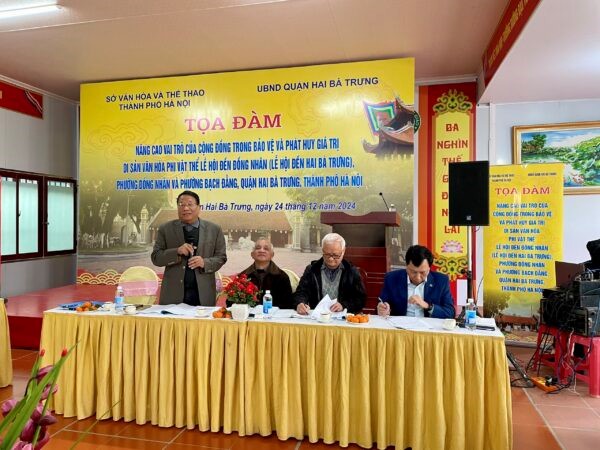
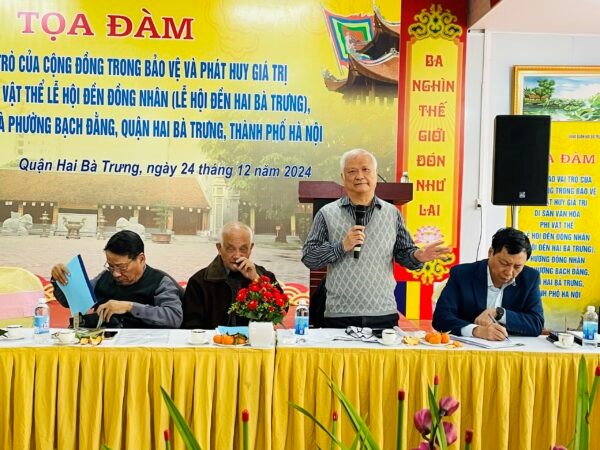
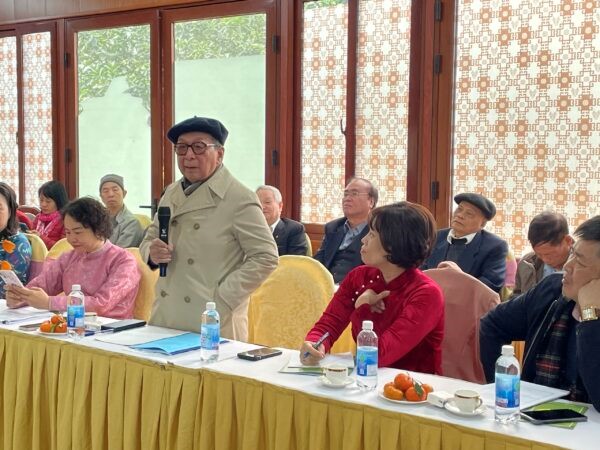
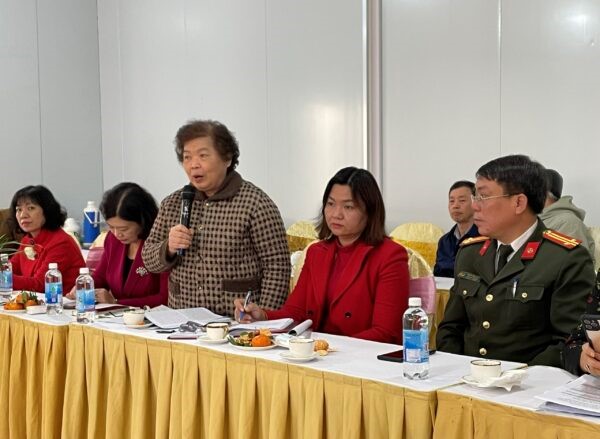
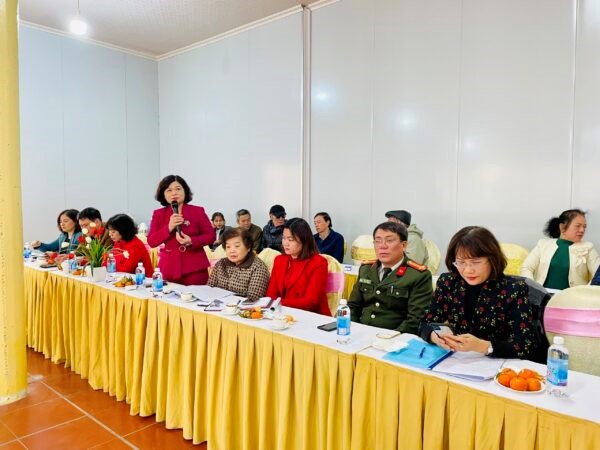
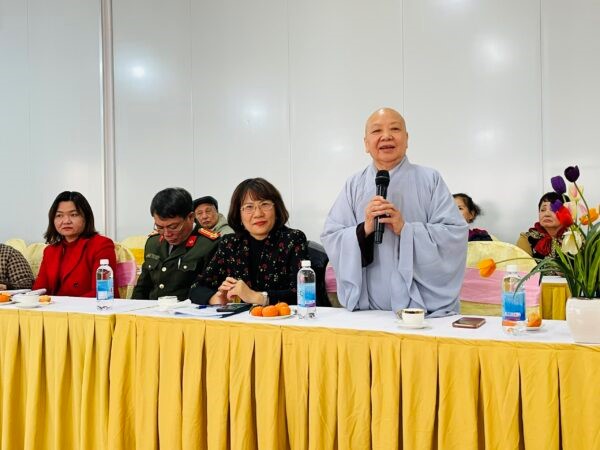
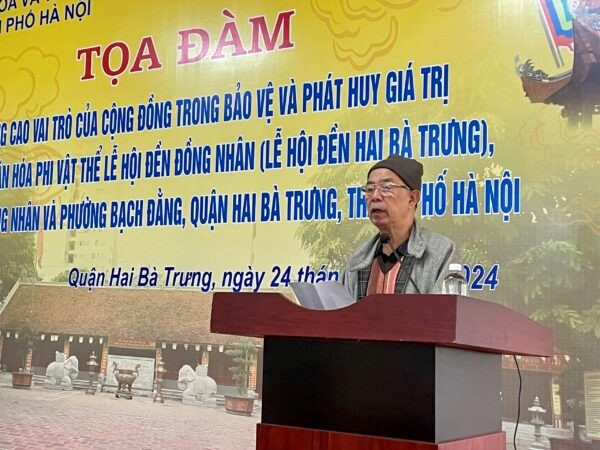
8 ideas given at the seminar.
Eight ideas were given at the seminar, focusing on topics such as: recognizing the cultural, historical, and scientific value of Dong Nhan Temple Festival; guiding the development of the cultural industry from traditional festivals, using Dong Nhan Temple Festival as a case study; enhancing the capacity for preserving and promoting the heritage values for the community involved in the heritage; and proposing solutions for the preservation and promotion of Dong Nhan Temple Festival heritage.
At the seminar, scholars, experts, and representatives from the heritage-practicing community also emphasized the important role of the community in preserving and promoting the intangible cultural heritage of Dong Nhan Temple Festival. Furthermore, the preservation and enhancement of heritage values should not only involve long-established local communities but also the active participation of young people. It is necessary to continue strengthening and innovating the work of promoting and publicizing the heritage.
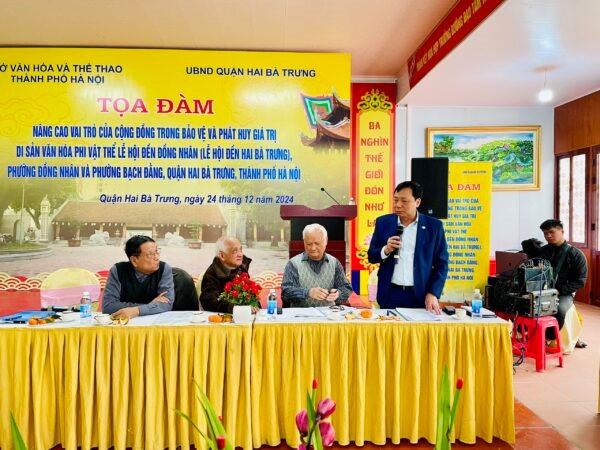
Mr. Nguyen Van Nam, Member of the City Party Committee cum Secretary of Hai Ba Trung District Party Committee, thanked the scholars and experts for their valuable contributions.
Mr. Nguyen Van Nam, Member of the City Party Committee cum Secretary of Hai Ba Trung District Party Committee, noted that the ideas reflected the dedication of the scholars and experts. Hai Ba Trung District People’s Committee deeply appreciates these suggestions and will use them as valuable resources to continue working with the Hanoi Department of Culture and Sports to complete the dossier for nominating Dong Nhan Temple Festival for inclusion in the National Intangible Cultural Heritage List.
Thanh Binh