
The Dong Ho folk woodblock printing craft has recently been inscribed by UNESCO on the List of Intangible Cultural Heritage in Need of Urgent Safeguarding, reaffirming its distinctive and enduring traditional cultural value.
Originating approximately 500 years ago in Dong Khe Quarter, Thuan Thanh Ward, Bac Ninh Province, the Dong Ho folk painting craft has been shaped by generations of artisan communities who created works with a unique identity in terms of subject matter, woodblock printing techniques, color palette, and graphic composition. Common themes include ritual and devotional paintings, congratulatory images, historical scenes, depictions of daily life, and landscapes. These works are closely associated with traditional practices such as displaying paintings during Lunar New Year and Mid-Autumn Festival celebrations, as well as ancestor and deity worship.
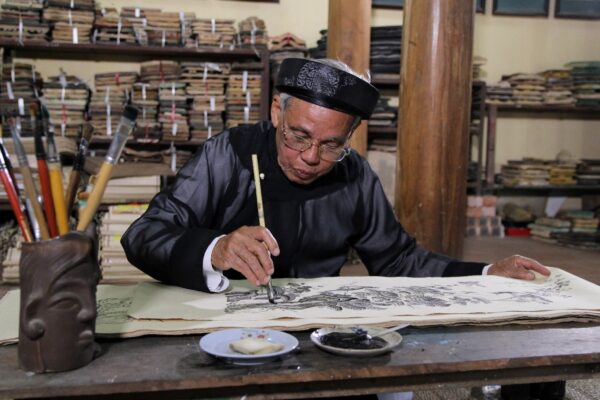
Artisan Nguyen Dang Che creating a Dong Ho folk painting. Photo: DSVH
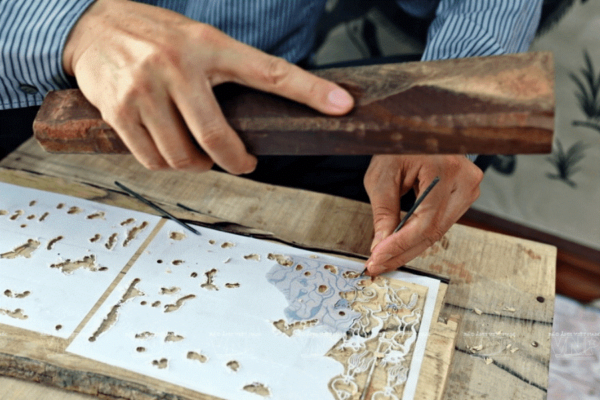
All stages of production, from designing the motifs and carving the printing blocks to preparing pigments and printing, are carried out entirely by hand. Original designs are drawn with brush and ink on traditional paper and then carved onto jackfruit wood blocks. Colors are made exclusively from natural materials: blue from indigo leaves, red from laterite stones, yellow from sophora flowers and gardenia fruits, white from weathered scallop shell powder, and black from ash derived from bamboo leaves and glutinous rice straw. The printing process uses an overlaid method with five basic colors on do paper coated with a layer of dieb powder. Colors are applied in sequence, red first, followed by blue, yellow, and white, while the final black outline block is printed last to complete the image.
According to the Intergovernmental Committee for the 2003 Convention for the Safeguarding of the Intangible Cultural Heritage, Vietnam’s nomination dossier for the Dong Ho folk woodblock printing craft meets the criteria for inscription on the List of Intangible Cultural Heritage in Need of Urgent Safeguarding.
Specifically, Dong Ho folk paintings are deeply intertwined with major traditional festivals such as Lunar New Year and the Mid-Autumn Festival, as well as with rituals of ancestor and deity worship. Today, however, only a small number of families continue to practice the craft, transmitting knowledge and skills primarily within families and to apprentices through direct instruction and hands-on mentorship. The carved woodblocks are regarded as treasured family heirlooms, passed down through multiple generations.
At the same time, the number of highly skilled artisans has declined sharply, with only a few households still maintaining the craft. This decline is attributed to limited interest among younger generations, the difficulty of sustaining a livelihood through the craft, and a reduced demand for traditional woodblock prints in contemporary ritual contexts. The remaining artisans with sufficient expertise and commitment are too few to ensure effective transmission, making urgent safeguarding measures necessary.
The proposed safeguarding plan outlines seven key objectives, including opening transmission classes, conducting heritage inventories, developing new designs, diversifying markets, improving access to raw materials, and providing protective equipment for artisans. These measures are considered feasible, aligned with safeguarding goals, sustainable in nature, and firmly community-centered. The dossier demonstrates active community participation, particularly from artisan families, throughout the nomination process, including inventory activities and public events.
Accordingly, the Intergovernmental Committee for the 2003 Convention decided to inscribe the Dong Ho folk woodblock printing craft on the List of Intangible Cultural Heritage in Need of Urgent Safeguarding and encouraged Vietnam to consider integrating this heritage into both formal and non-formal education systems, in order to foster awareness and appreciation among younger generations regarding the importance of heritage protection.
UNESCO’s inscription of the Dong Ho folk woodblock printing craft carries profound significance for both the practicing community and the wider Vietnamese public. The recognition helps raise societal awareness of the heritage’s value, stimulates interest among younger generations, and encourages support for safeguarding efforts at both institutional and community levels. Moreover, it provides an important opportunity to promote Vietnamese cultural identity internationally, nurturing national pride while contributing to the preservation of the country’s cultural diversity.
To date, Vietnam has 37 heritages inscribed on UNESCO’s lists, including nine World Cultural and Natural Heritage sites, 17 Intangible Cultural Heritage elements, and 11 items of Documentary Heritage. Among these, Bac Ninh Province is home to several UNESCO-recognized heritages, including five Representative Intangible Cultural Heritage elements of Humanity, Bac Ninh Quan Ho Folk Songs, the Dong Ho folk woodblock printing craft, Ca Tru singing, the Mother Goddess Worship belief, and Huu Chap Tug-of-War, as well as one trans-provincial World Cultural Heritage site, the Yen Tu – Vinh Nghiem – Con Son -Kiep Bac complex.
Minh Hoang