

This legal document aims to implement Clause 7, Article 21 of the Law on the Capital, promising to open new space for the cultural industry sector, a highly potential economic field that has proven successful in many developed countries.
The draft Resolution proposes a comprehensive legal framework for the establishment, management, and operation of cultural industry centers, where traditional cultural heritage and modern technology are connected to create high-value cultural products and services.
According to the draft, a cultural industry center is defined as “an area with a defined geographical boundary, specializing in activities in the field of cultural industry.” These centers can be established under three organizational models: enterprises, public service units, or cooperatives.
Transforming the Gia Lam train factory into a cultural industry zone
This is considered an important step to facilitate the conversion of old, underutilized facilities into new creative cultural spaces, while attracting investment into the cultural industry, a new economic driver for the Capital.
A notable point in the draft is the proposal of two main approaches to develop cultural industry centers. The first approach is that the State invests in infrastructure construction using the budget, then establishes a public service unit or grants a concession to an enterprise or cooperative for management and operation. The second approach allows organizations and individuals to lease public assets (such as relocated industrial or commercial facilities) for renovation and transformation into cultural industry centers.
Lieutenant and musician Ta Duy Tuan (currently working at the Military Music and Dance Theater) expressed his excitement: “If this Resolution is passed, it will be a great opportunity for the creative artist community. We have long awaited a concentrated space where artists, designers, and creators can work together, share ideas, and develop unique cultural products.”
To encourage investment in this field, the draft proposes many attractive incentive policies such as prioritizing land-use planning and allocation, exemption and reduction of land rent, exemption of facility rent for the first three years, and a 50% reduction for the following three years, interest rate support for loans, human resource training, and participation in the City’s trade promotion programs.
The lease term for facilities is determined by agreement between the competent authority and the investor, but shall not exceed 10 years and may be renewed for no more than 10 years each time. This is considered a reasonable duration for investors to recover capital and ensure sustainable development.
Cultural industry centers are permitted to operate in various fields such as advertising, architecture, software and entertainment games, handicrafts, design, cinema, publishing, fashion, performing arts, fine arts, photography and exhibitions, television and radio, and cultural tourism.
The model of cultural industry centers has been proven successful in many countries, such as South Korea, Japan, and China. In Vietnam, there have been pilot models such as Zone 9, Nha San Collective (Hanoi)… but a complete legal framework for sustainable development has not yet been established.
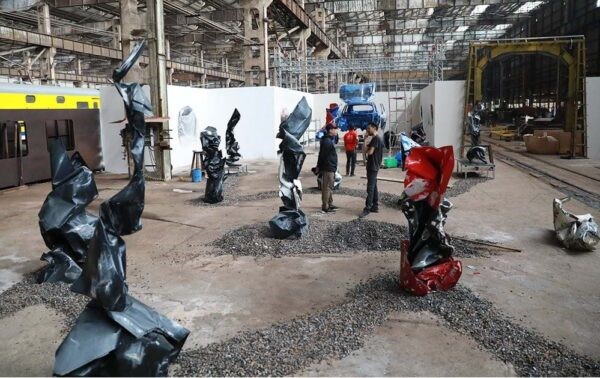
Zone 9 Cooperative
Associate Professor, Dr. Bui Hoai Son, Standing Member of the National Assembly’s Committee for Culture and Education, assessed: “The Law on the Capital (2024) will certainly play an important role in addressing the challenges facing the cultural industry in Hanoi, especially in encouraging investors and enterprises to participate in this field. The amendment of the Law has introduced several new policies with the potential to create breakthroughs.
The new policies in the Law on the Capital (2024) will create a more favorable environment for enterprises and investors, promoting the development of the cultural industry in Hanoi. If implemented effectively, these mechanisms will help ease current difficulties while creating momentum for the sustainable growth of the cultural sector in the future”.
Currently, the Department of Culture and Sports is coordinating with the Office of the City People’s Committee to collect public feedback on the draft Resolution through the City’s electronic portal. All opinions will be compiled to finalize the draft before submission to the City People’s Council for approval.
It is expected that once approved, this Resolution will create a new wave in the development of the cultural industry in the Capital, contributing to the goal of building Hanoi into a “Creative City,” while making culture a key economic sector that generates high economic value and promotes the image of the Capital.
Phuong Bui