

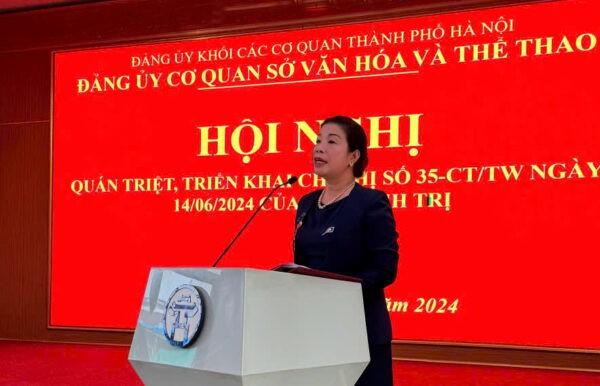
Ms. Tran Thi Van Anh, Standing Deputy Secretary of the Party Committee of the Hanoi Department of Culture and Sports, presides over the conference.
The conference was attended by members of the Executive Committee of the Party Committee of the Hanoi Department of Culture and Sports; Secretaries and Deputy Secretaries of affiliated Party cells; representatives from cell committees; executive boards of mass organizations; and officials and civil servants from state management divisions.
At the conference, Ms. Tran Thi Van Anh comprehensively conveyed key content from Politburo Directive 35. The directive outlines seven key requirements, including: Preparation and organization of Party Congresses at all levels. Leadership must ensure thorough, in-depth, and effective discussions on the viewpoints, objectives, policies, and major orientations stated in the draft documents of the 14th Party Congress and superior-level Party congresses. Leadership over personnel affairs must maintain the Party’s direct and comprehensive oversight. The process of preparing personnel and conducting elections must adhere to Party principles, state regulations, and legal frameworks. The process must ensure coherence, transparency, scientific rigor, objectivity, and accountability. Mechanisms and criteria should effectively screen and select individuals of true virtue and talent, avoiding omissions. Representation to superior-level Party congresses must be carefully managed and planned. Throughout the preparation and organization phases, emphasis must be placed on political and ideological work, particularly in the areas of information dissemination and communication.
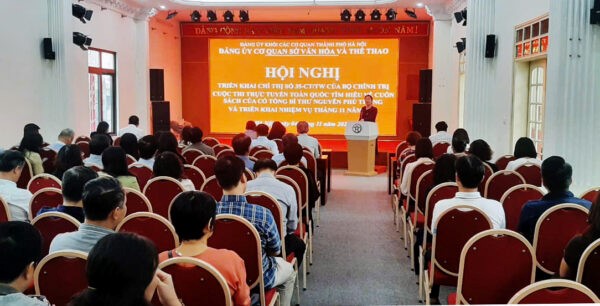
Conference overview
The Party Congresses at all levels are tasked with executing four key objectives: Reviewing the implementation of the Party Congress Resolution (2020-2025 Term) and establish the direction, goals, tasks, and solutions for the 2025-2030 term; Provide feedback on the draft documents of the 14th Party Congress and documents of directly superior Party Congresses; Electing the Executive Committee for the 2025-2030 Term; and electing delegates to attend superior-level Party Congresses. The directive also clarifies that in locations facing genuine challenges in personnel preparation and with approval from authorized Party Committees, congresses may proceed with three primary contents, deferring the election of a new executive committee.
Drafting and Discussion of Congress Documents: The directive mandates that draft documents submitted by Party Committees must primarily include a political report of the Party Committee and a self-assessment report of the Party Committee’s performance. The drafting and consultation process must encourage democratic participation and collective wisdom by soliciting input from affiliated Party Committees and organizations. It should also create practical and suitable forums for feedback from senior Party members, former leaders, intellectuals, scientists, experts, officials, Party members, and the public. Plans should be developed to disseminate the draft political report via mass media to encourage public input. Party Committees must prepare draft resolutions for congress discussions and decisions. Adequate time must be allocated to ensure democratic participation, intellectual engagement, and a heightened sense of responsibility among delegates.
Personnel Preparation and Party Committee Elections: The selection and introduction of candidates for new executive committees must adhere to Central Resolution No. 26 (May 19, 2018), the criteria outlined in Regulation No. 89 (August 4, 2017) and Regulation No. 214 (January 2, 2020) issued by the 12th Politburo, as well as other Party and State regulations. Party Committees must adapt these general criteria to fit their specific situations and contexts while remaining compliant with regulatory frameworks.
Notable Innovations in Directive 35-CT/TW: Implement concurrent appointments for Party Committee Secretaries to also serve as Chairpersons of People’s Councils across levels. In districts and communes meeting appropriate conditions (reasonable scale and qualified personnel with strong integrity, competence, and reputation), Party Committee Secretaries may concurrently serve as Chairpersons of People’s Committees with provincial-level Party Committee approval.
Aim to introduce at least one-third new members to each Party Committee per term. Maintain a three-age group structure in Party Committees at all levels and strive to achieve this structure within standing and executive boards.
Continued reassignment, introduction to new positions, or candidacy recommendations at different locations, agencies, or units will apply to Party Committee Secretaries at district level and above who have served more than two consecutive terms (over eight years) in one locality or agency.
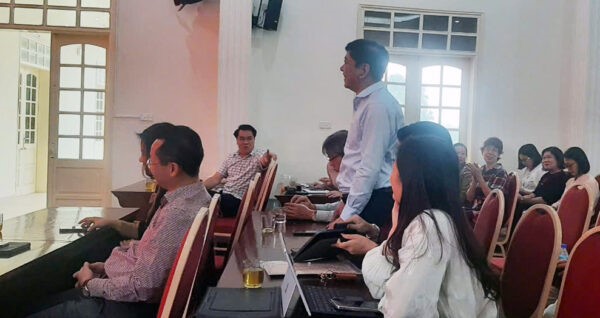
Mr. Tran Tuan Anh, Party Cell Secretary and Director of the Hanoi Library, delivering remarks and sharing insights at the Conference
Directive No. 35-CT/TW (June 14, 2024) Introduces Key Updates:
General Standards for Party Committee Members: The directive emphasizes enhanced standards, notably requiring officials nominated for Party Committee membership, or leadership positions within Party Committees, government bodies, the Fatherland Front, or socio-political organizations (for higher roles), to have held their current or equivalent positions for at least two years (24 months). In exceptional cases, candidates with a minimum of one year (12 months) in their roles may be considered, subject to approval by authorized Party Committees.
Age Criteria for First-Time Participation and Re-election: Officials entering Party Committees, government positions, the Fatherland Front, or socio-political organizations for the first time must have a remaining service period that spans at least one full term. Those nominated for re-election must have at least half a term (30 months) remaining in service. Re-elected officials may retain leadership roles in government bodies, the Fatherland Front, and socio-political organizations if they have a minimum of 18 months remaining in service. Age eligibility is determined as of the start of Party Congresses or election periods for each organizational level.
Party Committee Structure:
– The directive reinforces the policy of appointing provincial-level Party Secretaries from outside their local areas while ensuring a balanced use of locally sourced personnel under established planning guidelines. Full implementation is required at the district level, with encouragement for adoption at commune levels and for other roles.
– Members of the provincial Party Committee Standing Board are generally limited to holding no more than two leadership positions among key provincial roles, including Secretary, Deputy Secretary, Chairperson of the People’s Council, Chairperson of the People’s Committee, or Head of the National Assembly Delegation. Special cases will be subject to higher-level review and approval.
– Efforts should be made to achieve at least 15% female representation in Party Committees, with women included in the Standing Board. The goal for youth representation is set at a minimum of 10%, defined as officials under 42 years of age for provincial and district levels, and under 40 years for commune levels (calculated over the entire term).
Number of Standing Committee Members at District and Commune Levels:
– For District Level: The number of Standing Committee members ranges from 11 to 13 members for mainland districts, while island districts are limited to a maximum of 9 members. The structural framework for district-level Standing Committees is aligned with that of provincial and centrally governed municipal Party Committees.
– For Commune Level: The number of Standing Committee members is capped at 5. The structural orientation for commune-level Standing Committees includes positions such as Party Secretary, Deputy Party Secretary, Chairperson of the People’s Committee, Chairperson of the People’s Council, Chief of Police, Military Commander, and Chairperson of the Fatherland Front. The provincial-level Standing Committee is responsible for formalizing and directing district-level Standing Committees to determine the specific structure to ensure consistency and alignment with operational requirements.
For Party Committees at district and commune levels undergoing mergers or consolidations per Party regulations and resolutions from the National Assembly or its Standing Committee, the number of Party Committee members, Standing Committee members, deputy secretaries, and members of the Party Inspection Committee at the time of unification may exceed the figures specified in the Directive. However, this number must not surpass the combined total of the pre-merger Party Committees, excluding officials nearing retirement, transferring roles, or transitioning out of service. Within five years of the new Party Committee’s establishment, compliance with the Directive’s specified numbers is required.
Party Committee Personnel Procedures: The procedures encompass the introduction of candidates for re-election to the Party Committee, Standing Committee, Deputy Secretary, and Secretary roles, as well as the introduction of first-time candidates for these positions. Notably, the re-election nomination process now consists of two steps (a reduction from the previous five-step process outlined in earlier directives).
On September 18, 2024, the Party Committee of the Department of Culture and Sports issued a plan to organize the congresses of affiliated branches and party committees for the 2025-2027 term, in preparation for the Congress of Delegates of the Department of Culture and Sports Party Committee for the 2025-2030 term. Accordingly, the content preparation, drafting of congress documents, personnel selection, electoral processes, organizational structure, and the election of delegates for the higher-level congresses – including the Branch Congress for the 2025-2027 term, the Sub-Party Congress of the Training and Competition Center for the 2025-2030 term, and the Party Committee Congress of the Department of Culture and Sports for the 2025-2030 term – will be conducted in strict accordance with regulations. The timeline for the congresses is as follows: branch congresses will be conducted in no more than one day, starting in January 2025 and concluding before March 30, 2025. The Sub-Party Congress of the Training and Competition Center will be completed in no more than one day, with a deadline of April 30, 2025. The Party Committee Congress of the Department of Culture and Sports will span no more than two days and must be completed by June 30, 2025.
At the conference, the Deputy Secretary of the Party Committee emphasized key contents from the book Building and Developing an Advanced Vietnamese Culture Rich in National Identity, authored by the late General Secretary Nguyen Phu Trong. The book was coordinated by the Central Propaganda Department in collaboration with the Ministry of Culture, Sports, and Tourism, National Political Publishing House – Truth, Communist Review, Vietnam News Agency, and related organizations. Spanning 928 pages, the book features 92 selected articles, speeches, briefings, interviews, and letters by the late General Secretary Nguyen Phu Trong concerning the development of Vietnamese culture. These writings reflect the late General Secretary’s profound commitment to building and preserving Vietnamese cultural identity, blending traditional and modern elements, and fostering integration. His work underscores the mobilization of cultural and human resources as intrinsic drivers for a prosperous and thriving nation.
The book is not merely the intellectual and heartfelt creation of the late General Secretary Nguyen Phu Trong. More significantly, it represents a systematic scholarly endeavor integrating his guiding thoughts, viewpoints, speeches, and writings on the nature and distinctive characteristics of Vietnamese culture. It underscores culture’s role and mission as an intrinsic force for national development, emphasizing its connection with the economy, politics, and society. The book also explores the preservation of traditional and revolutionary cultural values, cultural development in the modern era, and the centrality of humans as creative subjects. It highlights the pivotal role of artists and cultural professionals in cultural advancement while linking cultural growth to building national, cultural, familial, and societal value systems as well as ethical standards for Vietnamese citizens.
Studying and embracing the content of Nguyen Phu Trong’s book Building and Developing an Advanced Vietnamese Culture Rich in National Identity contributes to raising awareness of culture’s vital role in the country’s sustainable development. It also reinforces a sense of responsibility among cultural professionals in implementing the Party’s policies and the State’s legal framework, following the late General Secretary’s perspectives on fostering an advanced Vietnamese culture imbued with national identity, thereby contributing to national construction and defense amid evolving circumstances.
On behalf of the Party Committee, Deputy Secretary Tran Thi Van Anh launched a call for all officials, Party members, public servants, and employees in the Department of Culture and Sports to actively participate in the nationwide online competition exploring the book Building and Developing an Advanced Vietnamese Culture Rich in National Identity by the late General Secretary Nguyen Phu Trong. The competition aims to disseminate and promote key ideas and fundamental content from the book, fostering understanding among officials, Party members, public servants, and citizens. It also seeks to convey the late General Secretary’s guiding perspectives on cultural development.
The competition runs from October 14 to November 17, 2024, and consists of five weekly rounds: Week 1: October 14–20, 2024; Week 2: October 21–27, 2024; Week 3: October 28–November 3, 2024; Week 4: November 4–10, 2024; and Week 5: November 11–17, 2024. Participants can access the competition via the website https://thitructuyen.sachquocgia.vn on the Ministry of Culture, Sports, and Tourism’s official information portal or through linked platforms on other websites, newspapers, and magazines.
At the conference, the Deputy Secretary of the Party Committee shared key updates on the implementation of Directive No. 24-CT/TU, issued on August 7, 2023, by the Hanoi Party Standing Committee. The directive emphasizes discipline, accountability, and improving service quality for citizens. After nearly a year of execution, significant progress has been observed in the awareness and responsibility of officials across localities and departments. Numerous valuable experiences and lessons have been distilled to uphold discipline, enhance accountability, and improve public service quality.
Mai Hoang