
At the seminar, Nguyen Thanh Tuyen, Deputy Head of the Department of Cultural Lifestyle and Family (Hanoi Department of Culture and Sports), reported that based on the practical results of implementing the assessment and recognition of cultural titles under Decree No. 122/2018/ND-CP from 2018, the movement to build cultural families has been actively supported by the people. Many families have become shining examples, leading in patriotic emulation movements, contributing to the economic, cultural, and social development of their localities. Since 2018, the rate of families earning the “Cultural Family” title has ranged from 85% to 88%.
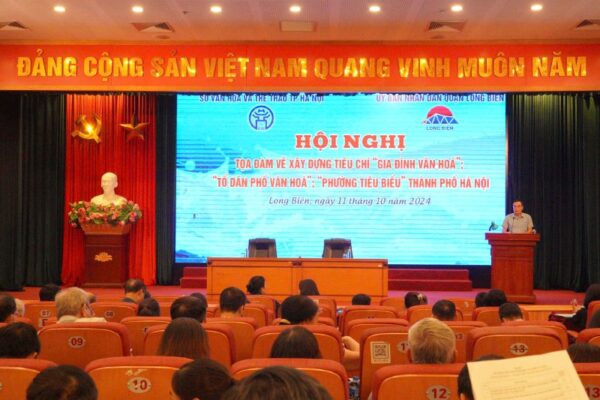
Nguyen Thanh Tuyen, Deputy Head of the Department of Cultural Lifestyle and Family (Hanoi Department of Culture and Sports), delivered the opening report at the seminar.
At the same time, the movement to build the title of “Cultural Village, Cultural Residential Area” has brought new vitality and a fresh appearance to many localities, transforming the social and cultural landscape. This is most clearly reflected in newly constructed buildings, expanded roads, well-equipped cultural houses, and improved lighting systems. Cultural and sports movements have also developed strongly, contributing to the enhancement of both the material and spiritual lives of the people.
However, alongside the achieved results, the evaluation and recognition of cultural titles still reveal some shortcomings and difficulties, such as: in some places and at certain times, the recognition of cultural titles remains somewhat formal. There are still instances where families, villages, or residential areas receive the cultural title only in name, with an emphasis on meeting quotas or achieving high rates, while in reality, many criteria are not met.
One of the reasons for these shortcomings is that the criteria for evaluating and recognizing titles such as “Cultural Family,” “Cultural Village, Cultural Residential Area” are issued and applied uniformly across the country, with many aspects not suited to the specific characteristics of each locality. This leads to evaluations and assessments that do not reflect the actual situation. Therefore, the issuance of Decree No. 86/2023/ND-CP, which provides a framework of standards and procedures for recognizing titles like “Cultural Family,” “Cultural Village, Residential Area,” and “Typical Ward, Commune, Town,” replacing Decree No. 122/2018/ND-CP, aims not only to promptly implement the Party’s guidelines and the State’s policies and laws but also to ensure consistency and alignment within the legal system, while addressing the current practical difficulties and challenges.

Delegates from communes, wards, towns, villages, and residential areas attended the conference.
Based on the framework of standards in Decree 86/2023/ND-CP, the Hanoi People’s Committee has assigned the Department of Culture and Sports to take the lead, coordinating with relevant agencies and units to propose a decision from the city’s People’s Committee on the issuance of standards for awarding the titles “Cultural Family,” “Cultural Village, Residential Area,” and “Exemplary Commune, Ward, Town” to be applied within the Hanoi area. With the goal of refining detailed and specific criteria for the evaluation and recognition of these titles, ensuring alignment with reality and the characteristics of each locality, the Department of Culture and Sports sought feedback from each commune, ward, town, village, and residential area in the city.

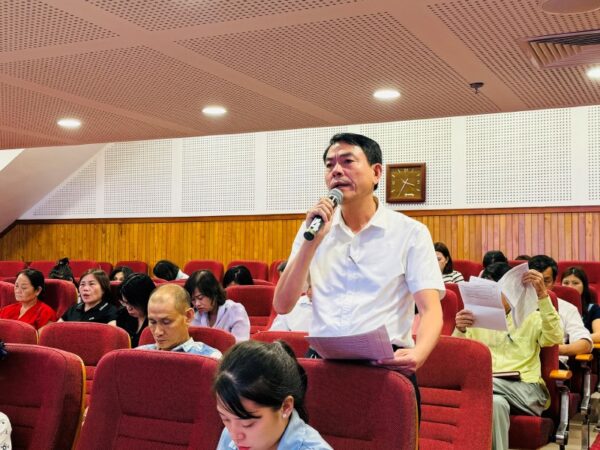
Delegates gave comments at the Conference
At the conference, many delegates agreed with most of the contents in the draft standards for awarding cultural titles, developed by the Department of Culture and Sports. However, there were also some suggestions regarding the point structure to ensure it is appropriate, such as issues with waste classification at source, where segregation is not implemented during collection, causing difficulties for residents. For the “Cultural Village, Residential Area” title, the criteria for community centers and cultural houses in urban districts are challenging due to limited land space. Regarding the “Exemplary Commune, Ward, Town” title, there was a proposal to avoid the “burial” criteria and instead focus on a requirement for 85% or more cremation rates. The Department of Culture and Sports addressed and acknowledged these suggestions for further research and adjustments to be made in the draft standards for awarding cultural titles.
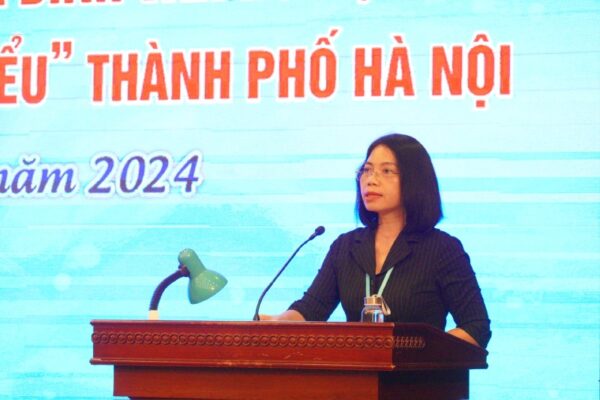
Head of the Department of Culture and Information of Long Bien district, Le Thi Huong, spoke at the Conference.
At the conference, Le Thi Huong, Head of the Culture and Information Department of Long Bien District, contributed the opinion that the criteria should be closely aligned with practical life, quantifiable, and feasible in the assessment and scoring process (measurable or with clear assessment bases). She emphasized that the criteria should not overlap with each other or be confused with the “disqualifying points” of the title. Furthermore, she suggested that the regulations for adding or subtracting points should be specific, appropriate, and consistent throughout the entire city.
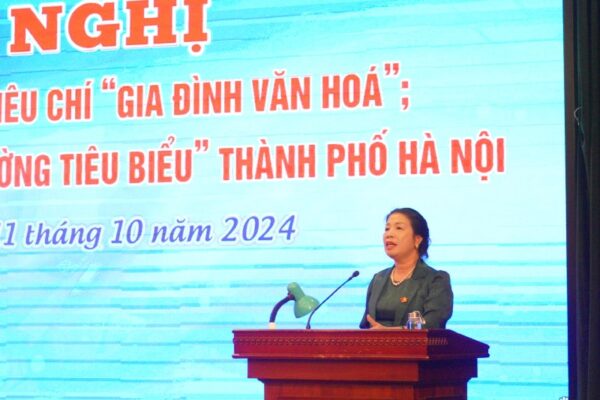
Deputy Director of Hanoi Department of Culture and Sports Tran Thi Van Anh concluded the Conference.
Concluding the conference, Tran Thi Van Anh, Deputy Director of the Hanoi Department of Culture and Sports, affirmed that the contributions of the delegates were in line with practical realities. The Department of Culture and Sports would fully incorporate these suggestions, further study and update the draft, and promptly present it to the City People’s Committee for approval and implementation.