
On the morning of July 16, the Management Board of the Hoa Lo Prison Relic Site held the opening ceremony of the themed exhibition “Sharp Pen, Loyal Heart” on the occasion of the 78th anniversary of War Invalids and Martyrs’ Day (July 27, 1947 – July 27, 2025), and in celebration of the 80th anniversary of the August Revolution (August 19, 1945 – August 19, 2025) and the National Day of the Socialist Republic of Vietnam (September 2, 1945 – September 2, 2025).
Attending the opening ceremony were representatives of the families of historical witnesses, including those of General Vo Nguyen Giap; Comrade Le Thanh Nghi; Comrade Pham Huong; Comrade Nguyen Minh Van, among others.
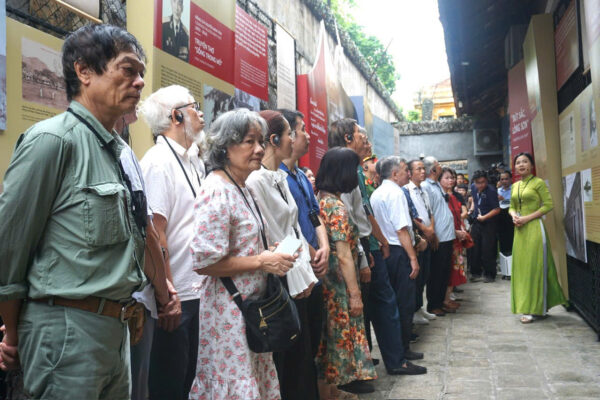
Introduction to the Themed Exhibition “Sharp Pen, Loyal Heart”
The exhibition is a meaningful activity paying tribute to patriotic and revolutionary fighters who used their pens as a silent yet powerful weapon of struggle, writing the aspiration for freedom amid the darkness of prison. That spirit and will have contributed to spreading and inspiring later generations with courage and determination to overcome all challenges and hardships in life.
The exhibition consists of three sections, closely structured to both evoke emotions and convey profound historical and humanistic values:
The section “Within the Prison Walls” takes visitors back through history to places once known as “hells on earth,” such as Hoa Lo Prison, Con Dao, Kham Lon Saigon, Chin Ham Prison Camp, Buon Ma Thuoc Exile Prison, and others. Here, French colonialists intensified repression and sought to crush the will of political prisoners through harsh detention regimes and brutal forms of torture. However, they “could imprison the body, but could not bind the patriotic spirit and indomitable will” of the prisoners. In chains and shackles, with clear minds and sharp pens, the prisoners continued to compose, to write letters, and to steadfastly maintain their ironclad faith in the victory of the revolution.
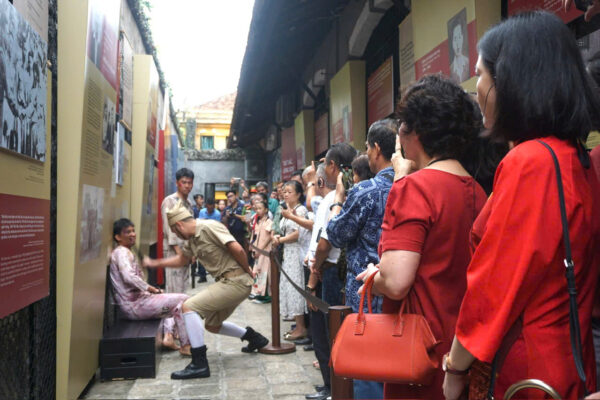
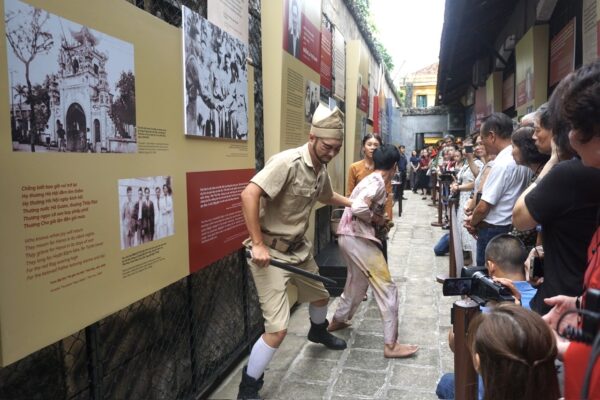
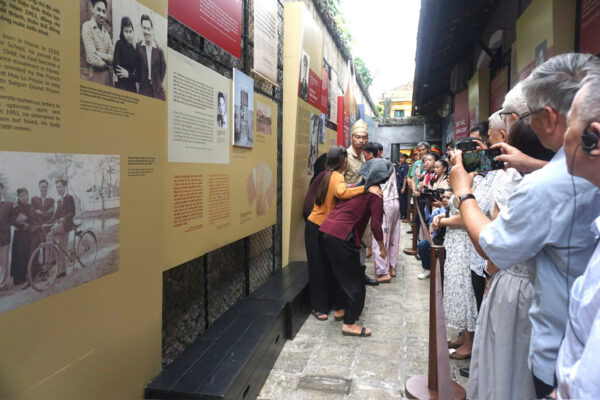
Dramatic reenactment of the tearful farewell of Comrade Pham Huong before being exiled to Con Dao
The section “Sharp Pen, Loyal Heart” introduces ten patriotic and revolutionary fighters who used their pens to reflect the realities of life, the harshness of the prison regime, and their love for the homeland and the nation, thereby helping to call upon compatriots to remain steadfast and resolute in rising up to struggle.
Patriot Nguyen An Ninh (1900-1943) was a major cultural figure, journalist, great thinker, and exemplary intellectual. The newspaper Chuong re, of which he was editor-in-chief, helped awaken the Vietnamese people to rise up and fight for national independence and freedom. He was arrested by the French colonialists and imprisoned at Kham Lon Saigon and Con Dao Prison. When he sacrificed his life, lines of poetry expressing patriotism and the aspiration for freedom were found by fellow inmates in his coat pocket.
Comrade Nguyen Duc Canh (1908-1932) was Secretary of the Tonkin Regional Party Committee. In the death row cell of Hoa Lo Prison, he made use of his remaining time to write the book Workers’ Movement. Before his sacrifice, his longing for family and homeland was transformed into poetry dedicated to his mother through the poem Farewell.
Comrade Hoang Van Thu (1909-1944) participated in founding and developing the revolutionary mass movement in Lang Son. He composed many sli songs (following the distinctive folk melodies of the Nung ethnic group) expressing patriotism and encouraging ethnic minorities in mountainous areas to join the revolution. He was captured by the enemy and imprisoned in the death row cell at Hoa Lo Prison. Before his sacrifice, he composed the poem Message to a Friend, sending it to comrades who remained behind. The verses express faith in lofty ideals and the inevitable victory of the revolution.
Comrade Nguyen Thi Minh Khai (1910-1941) was one of the first members of the Communist Party of Vietnam. During her imprisonment in colonial prisons (Catinat Police Station, Phu Mt Prison Camp, Kham Lon Saigon), she used her own blood to write lines of poetry expressing the steadfast and unyielding will of a revolutionary fighter.
Comrade Nguyen Thi Quang Thai (1915-1944) was the first wife of General Vo Nguyen Giap and the younger sister of Comrade Nguyen Thi Minh Khai. While participating in the female student movement at Dong Khanh School, she was arrested by the French colonialists and imprisoned at Thua Phu Prison (Hue). She was arrested a second time and imprisoned at Hoa Lo Prison. In Hoa Lo Prison, with the heart of a mother separated from her child, she wrote letters filled with love to her daughter Vo Hong Anh.
Journalist and poet Tran Mai Ninh (1917-1948), in the course of his revolutionary activities, used his pen as a weapon of struggle, confronting the enemy on the Party’s literary and journalistic front during the Democratic Front period (1936-1939). He collaborated with and served as editor for newspapers such as Ban dan, Thoi the, Tin tuc, The gioi, and Nguoi moi. He was arrested by the French colonialists and imprisoned at Hoa Lo Prison, Thanh Hoa Prison, and Buon Ma Thuot Exile Prison.
Poet Dinh Nho Diem (1918-1947) was one of the representative writers of the New Poetry movement. His works contributed to enriching the treasury of Vietnamese poetry. He founded the newspaper Dong Tay with the aspiration of gathering talented writers and poets to contribute to building a Vietnamese national literature. In 1944, he was arrested and imprisoned at Hoa Lo Prison. In prison, he was appointed to the Arts Committee, composing poetry and writing articles to help improve the spiritual life of inmates.
Poet and journalist Thoi Huu (1919-1950) used his pen to serve the revolution. His works span many genres, including poetry, reportage, and feature writing. In 1944, he was captured by the enemy and imprisoned at Hoa Lo Prison. He later worked at the editorial offices of newspapers such as Hon nuoc, Su that, Thu do, and Ve quoc quan. During his time working on the battlefield, he wrote many works reflecting the arduous lives and combat of our army and people.
Comrade Pham Huong (1923-1951) was a student of Buoi School who joined revolutionary activities and later became a leader of the Hanoi student resistance movement. While imprisoned at Kham Lon Saigon and exiled to Con Dao Prison, he wrote many letters to his family, expressing optimism and revolutionary enthusiasm.
Comrade Nguyen Minh Van (1923-2014) was an intelligence officer of Vietnam’s National Defense. Under the conditions of being “buried alive” at Chin Ham Prison Camp, without paper or pen, intelligence officer Nguyen Minh Van still composed 3,000 lines of poetry reflecting the harsh life of prisoners.
They were ordinary yet extraordinary people who proved that the pen can be “mightier than the sword,” and that resolve can be stronger than chains – living testimony to the indomitable patriotic spirit and the power of the written word in the struggle for independence.
The section “Bonding Through Love” conveys a message to today’s generation: in wartime, a letter or a poem was not only a means of communication but also a flame igniting faith, a bridge connecting the rear and the front, and a moving witness to comradeship, family bonds, and patriotism.
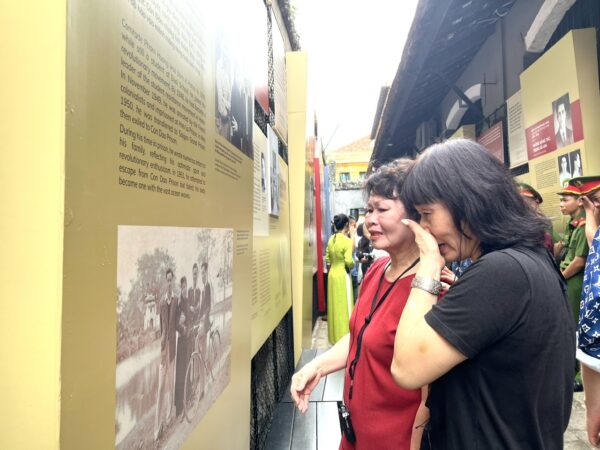
Representatives of families of historical witnesses moved while viewing the exhibition
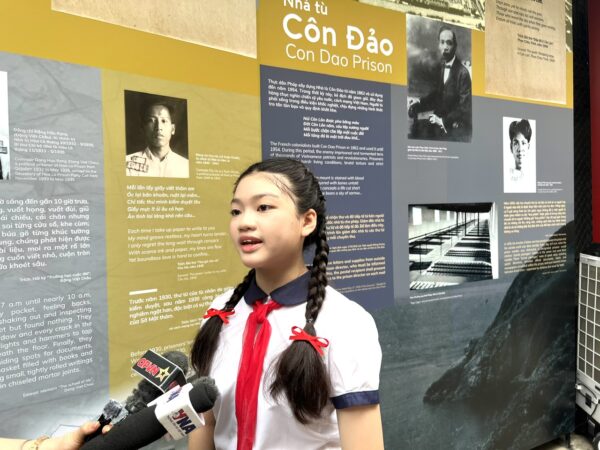
Nguyen Bao Phuong (great-granddaughter of Comrade Nguyen Minh Van) sharing her impressions of the exhibition
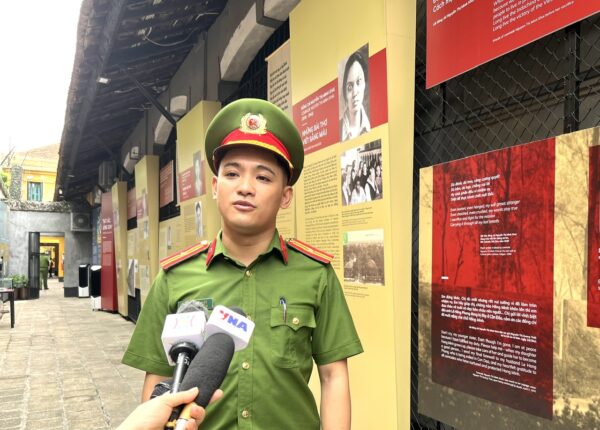
Senior Lieutenant Do Van Viet, Secretary of the Youth Union of Regiment 30, Mobile Police Command, sharing his reflections
At the exhibition, delegates and the capital’s public watched a dramatic performance reenacting the deeply emotional reunion of Comrade Pham Huong with old friends in prison, the choking moment of meeting family during a brief visitation, and concluding with the heartbreaking farewell on the day he was exiled to Con Dao. The performance brought many layers of emotion.
Attending the exhibition, Nguyen Bao Phuong (great-granddaughter of Comrade Nguyen Minh Van), a sixth-grade student at Ngo Si Lien Secondary School, shared: “When viewing the contents of the themed exhibition ‘Sharp Pen, Loyal Heart’, I deeply admire the will and resilience of Vietnamese patriotic and revolutionary fighters. To carry on that tradition, I will uphold the spirit of patriotism and strive to study well in order to contribute to building our country.”
Senior Lieutenant Do Van Viet, Secretary of the Youth Union of Regiment 30, Mobile Police Command, stated: “I have visited the Hoa Lo Prison Relic Site many times. Especially today, visiting the themed exhibition ‘Sharp Pen, Loyal Heart’, we young people are deeply moved by the arduous sacrifices of previous generations. From this, we gain greater motivation to overcome difficulties and fulfill our assigned duties well.”
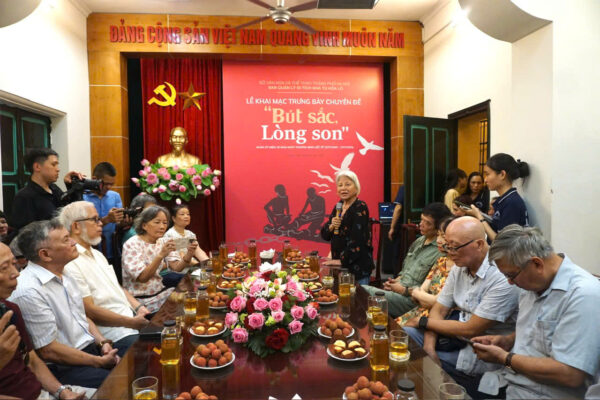
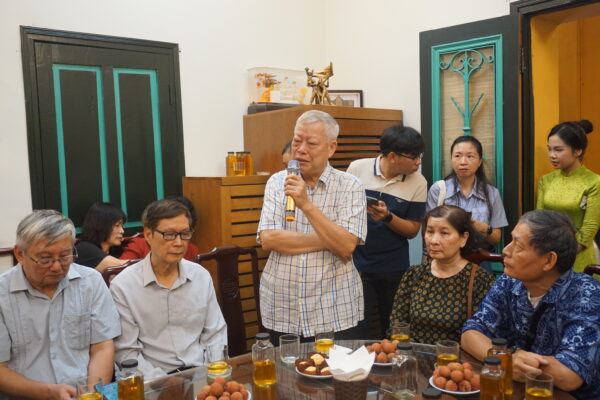
Representatives of families of historical witnesses meeting and exchanging
The exhibition “Sharp Pen, Loyal Heart” is not only a symbolic traditional education activity but also a profound, modern, and effective form of communication. Through vivid historical materials and emotional depth, the exhibition evokes national pride and inspires today’s generation to live with ideals and responsibility – those who are continuing the journey of safeguarding and promoting the precious independence of the nation.
The exhibition runs until August 31, 2025 at the Hoa Lo Prison Historical Relic Site, No. 1 Hoa Lo Street, Cua Nam Ward, Hanoi.
Ngoc Tram