
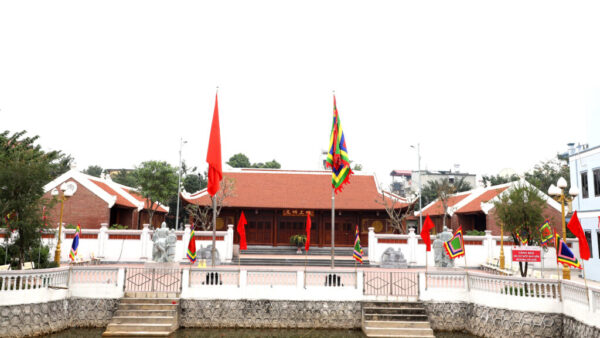
The Thuong Phuc Temple of Literature is a place dedicated to worshiping and honoring the sages and scholars of the former Thuong Phuc District (now Thuong Tin District). Situated in Van Binh Commune, it has become an attractive cultural and historical destination for visitors from near and far.
In the past, the Temple of Literature was located in An Duyen Commune (now An Duyen Hamlet, To Hieu Commune). Based on the remaining steles at the Thuong Phuc Temple of Literature, along with the rubbings numbered 8196 to 8199 preserved by the École Française d’Extrême-Orient (EFEO), the Institute of Han-Nom Studies, and the Vietnam Academy of Social Sciences, it has been determined that the Thuong Phuc Temple of Literature was originally built in An Duyen Commune, Tin An Canton, by Doctor Duong Cong Do – a native of Nhi Khe, who earned his Doctorate (Third Rank) in the Quy Hoi Year, served as an Envoy to Thanh Hoa, and held the position of Deputy Supervisor of Guan Prefecture in the 16th year of the Chinh Hoa era (1695).
Over the years, through various historical upheavals, the temple deteriorated. Recognizing its cultural and historical significance, in 1755, Nguyen Quan, the Prefect of Phuc Xuyen District, restored it. Later, Dinh Quan, an instructor of Ly Nhan Prefecture, constructed the Front Hall. Subsequently, the Prefect of Hoai An District also contributed to further renovations, enhancing the temple’s grandeur. However, the temple’s grounds at that time were small and situated on low-lying land. Seasonal floods in late autumn often disrupted ritual ceremonies. In the Year of the Goat, during the Tu Duc reign, floodwaters swept away the temple walls.

The Stele at the Thuong Phuc Temple of Literature
Photo: Nguoi Ha Noi Online Magazine
In 1812, the steles and worship objects of the Temple of Literature were relocated to Van Hoi Hamlet, Van Giap Commune, Thuong Phuc District (now Van Hoi Hamlet, Van Binh Commune). Governor Cao Huu Sung, together with local scholars and officials, initiated the reconstruction. Construction began in the winter of the Year of the Rat, and the restoration was completed within a year. Sixty years later, the temple underwent another renovation, followed by yet another twenty years after that. Over time, through many ups and downs, the Thuong Phuc Temple of Literature gradually came to be regarded merely as the Village Temple of Literature of Van Hoi Hamlet. As a result, it received little attention, and its premises were gradually reduced and degraded, no longer reflecting its true stature as a place that honors education and the district’s long-standing tradition of learning.
Through hundreds of years of history, nurtured by the legacy of heroes and scholars, the Thuong Phuc Temple of Literature has been built and restored as a lasting testament to the district’s rich cultural and historical heritage. Recognizing its profound significance, the Standing Committee of the 23rd Term Thuong Tin District Party Committee issued a resolution to mobilize social resources for the “Investment, Restoration, and Promotion of the Cultural and Historical Values of the Thuong Phuc Temple of Literature.” The project officially commenced on the 9th day of the first lunar month, Year of the Pig (2019). The newly constructed temple covers an area of over 3,500 square meters and follows the traditional “Cong” (工)-shaped architectural layout. The complex includes the front ceremonial hall, incense-burning hall, main sanctuary, left and right chambers, stele house, ornamental columns, and various auxiliary structures
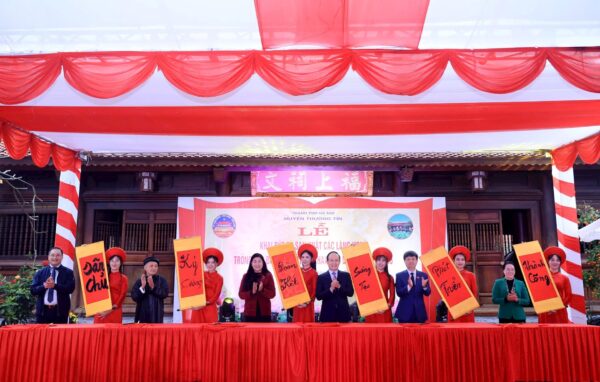
Hanoi city leaders participate in the first writing ceremony of the Lunar New Year of the Snake at the Thuong Phuc Temple of Literature
Photo: Le Hai
In 2022, the Thuong Phuc Temple of Literature was completed and officially opened. Since then, it has become a prominent destination on the cultural and historical tourism route for the people of Thuong Tin District in particular, and for visitors from Hanoi and across the country in general.
At the Thuong Phuc Temple of Literature, steles are still preserved that bear the names of scholars from the former Thuong Tin District, including the national hero Nguyen Trai, Grand Scholar Nguyen Phi Khanh, Second-Rank Doctor Ly Tu Tan, and other eminent scholars such as Duong Truc Nguyen, Tran Trong Lieu, Ngo Hoan, Nguyen Y, Duong Cong Do, Ung Ngan Luong, Vu Duc Chinh, Nguyen Trac, Doan Hoanh Tuan, Duong Hang, Doan Mau Khoi, as well as the Confucian scholar and patriot Luong Van Can. These individuals were not only the intellectuals and talents of Thuong Tin and Hanoi but also of the entire nation. They left an indelible mark in history and made significant contributions to the development of culture and education during Vietnam’s feudal dynasties.
The Thuong Phuc Temple of Literature project is also a key initiative and a highlight for Thuong Tin District in implementing Resolution No. 09-NQ/TU issued by the Hanoi Party Committee on February 22, 2022, regarding the “Development of Cultural Industries in Hanoi for the 2021–2025 Period, with Orientation Toward 2030 and Vision to 2045.”
Every year at the beginning of the Lunar New Year (on the 9th day of the first lunar month), Thuong Tin District holds the First Writing Ceremony Festival at the Thuong Phuc Temple of Literature. This annual festival, which also honors traditional craft villages, aims to awaken pride in the region’s long-standing tradition of learning and scholarship, while preserving and promoting the value of local historical and cultural heritage. The festival is also an occasion to pay tribute to predecessors who contributed to the transmission of traditional crafts, as well as to recognize, reward, and encourage organizations and individuals who have made significant contributions to preserving and developing these trades. It highlights the role of traditional craft villages in the socio-economic development of the local community. In particular, hosting the festival at the Thuong Phuc Temple of Literature serves as a message to the people of Thuong Tin, especially the younger generation, to follow the example of past scholars, inherit and develop the cultural and intellectual legacy left by their forebears, and contribute to building a prosperous, beautiful, and civilized Thuong Tin that stands proudly alongside the nation.
During the exam season, the temple welcomes thousands of students and visitors who come to request calligraphy, explore, and enjoy cultural tourism.
Minh Anh