
Thanh Tri District currently has 154 historical and cultural relics, of which 88 are classified (65 at the national level, 23 at the city level). The district also has 45 traditional festivals, among which the Tong Nam Phu Festival stands out, a sacred ritual to honor the Two Bodhisattvas, Princesses Ly Tu Thuc and Ly Tu Huy of the Ly Dynasty, who renounced palace life to practice Buddhism, promote the Dharma, and bring peace and prosperity to the people.
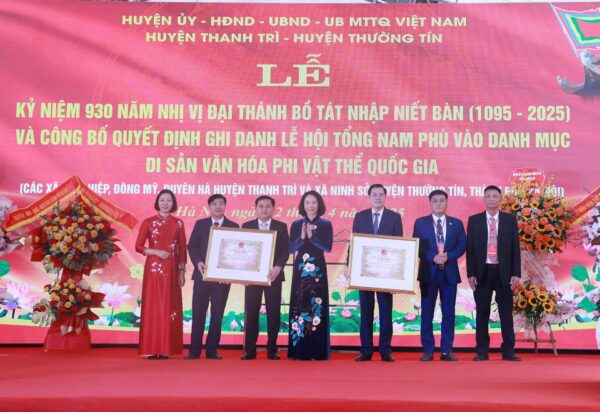
Vice Chairman of Hanoi People’s Committee Vu Thu Ha presenting the Decision recognizing the Tong Nam Phu Festival as a national intangible cultural heritage to leaders of Thanh Tri and Thuong Tin districts
Legend has it that during the reign of Ly Thanh Tong, the twin daughters, Princess Ly Tu Thuc and Princess Ly Tu Huy, reached marriageable age but refused to marry and left the palace to practice at Tu Khoat Pagoda (Hung Phuc Pagoda, Ngu Hiep Commune).
Out of deep concern for their daughters, the King ordered the pagoda burned to make them return. Yet their determination remained firm, and the princesses moved to Hung Long Pagoda in Dong My Commune to continue their spiritual practice. Lacking other means, the King provided them with some gold for subsistence.
Understanding the hardship of the people of Tong Nam Phu living in poverty, the Two Princesses practiced the Bodhisattva way, granting over 3,000 acres of rice fields to the people, guiding wet rice cultivation, mulberry planting and silkworm rearing, and teaching traditional crafts such as: cake-making in Tranh Khuc, noodle and tofu-making in Dong Phu, basket-weaving in Tu Khoat, comb-making in Tuong Truc…
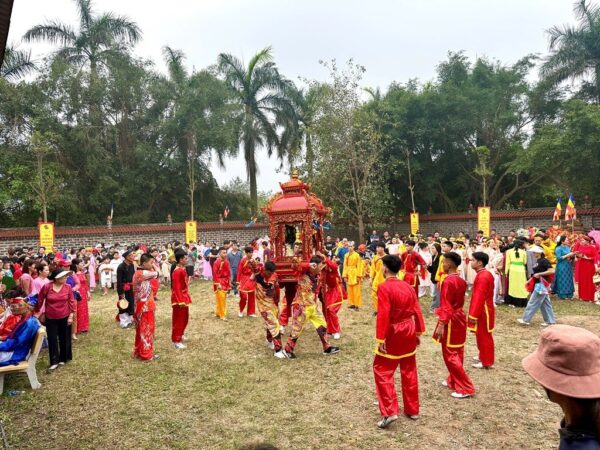
Tong Nam Phu Festival
In the fourth year of the Hoi Phong era, 1095 (At Hoi year), when their spiritual practice had reached perfection, the princesses prepared for Nirvana by establishing an underground shrine at the border of Dong Phu (Dong My Commune, Thanh Tri District) and Ninh Xa (Ninh So Commune, Thuong Tin District). They bathed, offered incense and candles, and, together with their attendants, entered Nirvana. When the people of the ten villages no longer heard the sound of bells or saw incense smoke, the princesses had passed away and attained Buddhahood.
The nearby Ninh Xa village was the first to know and was honored as the main caretaker of the shrine, leading the procession during the festival. A tomb called Lien Hoa was built here, considered highly sacred.
To honor their great merits, local people enshrined statues of the princesses at Hung Long, Hung Phuc, Pho Quang, Thanh Lien, and Linh Quang Pagodas. During the Later Le Dynasty, the princesses were posthumously honored as Great Bodhisattvas.
Every year in the third lunar month, the entire Tong Nam Phu region comes alive with the sacred and solemn atmosphere of this traditional festival, one of the unique spiritual and cultural features of Thanh Tri – Thuong Tin. Held on the 14th, 15th, and 16th of the third lunar month, the festival is an occasion for the people to respectfully remember and honor the Two Great Bodhisattvas, monks incarnated for the people, leaving a profound spiritual imprint on Vietnamese life for over nine centuries.
The significance of the Tong Nam Phu Festival lies not only in its over 900-year history but also in its extensive influence across the community and space. Six sacred pagodas – Hung Phuc, Thanh Liem (Ngu Hiep, Thanh Tri); Hung Long (Dong My, Thanh Tri); Long Khach, Kim Cuong (Duyen Ha, Thanh Tri); and Pho Quang (Ninh Xa, Thuong Tin) – form a strong spiritual network, symbolizing harmony and enduring community solidarity.
To preserve and promote the cultural value of the Tong Nam Phu Festival, Thanh Tri and Thuong Tin districts have cooperated with the Hanoi Department of Culture and Sports and the Department of Cultural Heritage (Ministry of Culture, Sports and Tourism) to research, survey, and compile historical records, and prepare a dossier to propose the festival for recognition as a national intangible cultural heritage. On February 19, 2025, the Tong Nam Phu traditional festival was officially recognized by the Ministry of Culture, Sports and Tourism as a national intangible cultural heritage.
Recently, Thanh Tri and Thuong Tin districts held a solemn ceremony commemorating the 930th anniversary of the Two Great Bodhisattvas’ Nirvana (1095–2025) and announced the decision recognizing the festival at the national level. Attendees included Vice Chairman of Hanoi People’s Committee Vu Thu Ha, representatives from the Department of Cultural Heritage, leaders of Thanh Tri and Thuong Tin districts, and numerous local residents from Ngu Hiep, Dong My, Duyen Ha, Ninh So, and visitors from other regions.
The Tong Nam Phu Festival’s recognition as a national intangible cultural heritage testifies to the preserved and promoted cultural values across generations. It symbolizes community cohesion, where traditions are honored and cultural values are illuminated today and for the future.
At the ceremony, Le Thi Hong Thu, Chairwoman of Dong My Commune People’s Committee (Thanh Tri District), stated that in the future, the communes will continue to work together effectively to implement the national action program to preserve and promote the value of the Tong Nam Phu traditional festival and other cultural heritages, following the principle: placing people at the center and as the main actors of activities; transforming heritage into assets for local economic development; contributing to building a modern Vietnamese culture imbued with national identity, truly becoming an endogenous strength and important driving force in the new era.
Thanh Binh